
Gaming Gear Performance Maturity 2026: The Ultimate Shift to Feel Over Frames
The scrim room is quiet in the way only competitive spaces get—no chatter, no music, just the soft percussion of switches and mouse clicks. The FPS counter in the corner is pinned well above anything the human eye can parse. Everyone knows it. No one mentions it. What the players talk about, in low voices between rounds, is stranger and harder to measure. “The mouse feels off today.” “My crosshair isn’t settling.” “Something’s different, I can’t explain it.”
This is the moment modern gaming gear entered its mature phase, though few noticed it happening. Performance, at least in the traditional sense, stopped being the bottleneck. Frame times stabilized. Latency collapsed into single-digit milliseconds. Sensors reached levels of accuracy that border on absurd for biological input systems built around human hands and eyes. The graphs flattened, but the complaints didn’t. They simply changed shape.
What competitive gamers now experience is not a lack of power, but a surplus of it—so much that the remaining differences hide in perception. The way a mouse glides when humidity changes. The resistance curve of a trigger after six months of muscle memory. The subtle lag between intention and confirmation that doesn’t show up in benchmarks but shows up instantly in missed shots. This is why gaming gear performance maturity feels less like a technological milestone and more like a psychological one.
In mature systems, progress stops announcing itself. There are no headline jumps, no obvious “wow” moments. Instead, improvement becomes intimate. It lives in trust. In whether your hands stop thinking about the tool entirely. In whether your losses feel deserved or suspicious. High-end gaming gear is no longer trying to be faster than the competition; it’s trying to be invisible in the right ways and noticeable in the wrong ones.
That shift has consequences. For players, it changes how skill is interpreted and how blame is assigned. For designers, it forces a redefinition of what “better” even means. And for brands still selling numbers, it creates a widening gap between marketing language and lived reality. This is not a story about frames per second. It’s about what happens after frames stop being the story at all.
When Precision Exceeds the Human Loop
Human perception has limits, and modern gaming hardware crossed many of them years ago. Reaction time, visual persistence, proprioception—these biological constraints form a closed loop that technology can only optimize up to a point. Once mouse sensors became effectively flawless and displays eliminated obvious latency, further gains stopped registering as “faster” and started registering as “different.” This is where confusion begins.
Players don’t experience performance directly; they experience interpretation. A mouse with identical polling and sensor specs can feel sluggish if its weight distribution shifts fatigue earlier in a session. A keyboard with technically lower latency can feel unresponsive if its switch hysteresis doesn’t align with the player’s rhythm. These sensations are real, even when the numbers say they shouldn’t be. In a mature performance environment, perception becomes the primary interface.
This is the quiet truth behind gaming gear performance maturity: once the system outpaces the human, optimization migrates inward. Consistency matters more than peaks. Predictability matters more than raw speed. The brain rewards tools that behave the same way every time, even if they are theoretically slower than an alternative that fluctuates. This is why many pros downgrade specs intentionally—lower DPI, capped frame rates, older switch types—not out of nostalgia, but out of perceptual stability.
Psychologically, this creates a fragile equilibrium. When performance differences are no longer obvious, confidence becomes the metric. Players perform better when they believe their gear will respond exactly as expected, and worse when doubt creeps in, even if nothing measurable has changed. In this sense, modern gaming hardware functions less like machinery and more like an extension of the nervous system. Any inconsistency, however minor, feels like a betrayal.
The industry struggles here because perception is expensive to validate. You can’t graph “trust.” You can’t easily A/B test “comfort under pressure.” Yet these are the variables that now decide outcomes at the top. The result is a widening gap between what engineers optimize, what marketers promote, and what elite users actually feel.
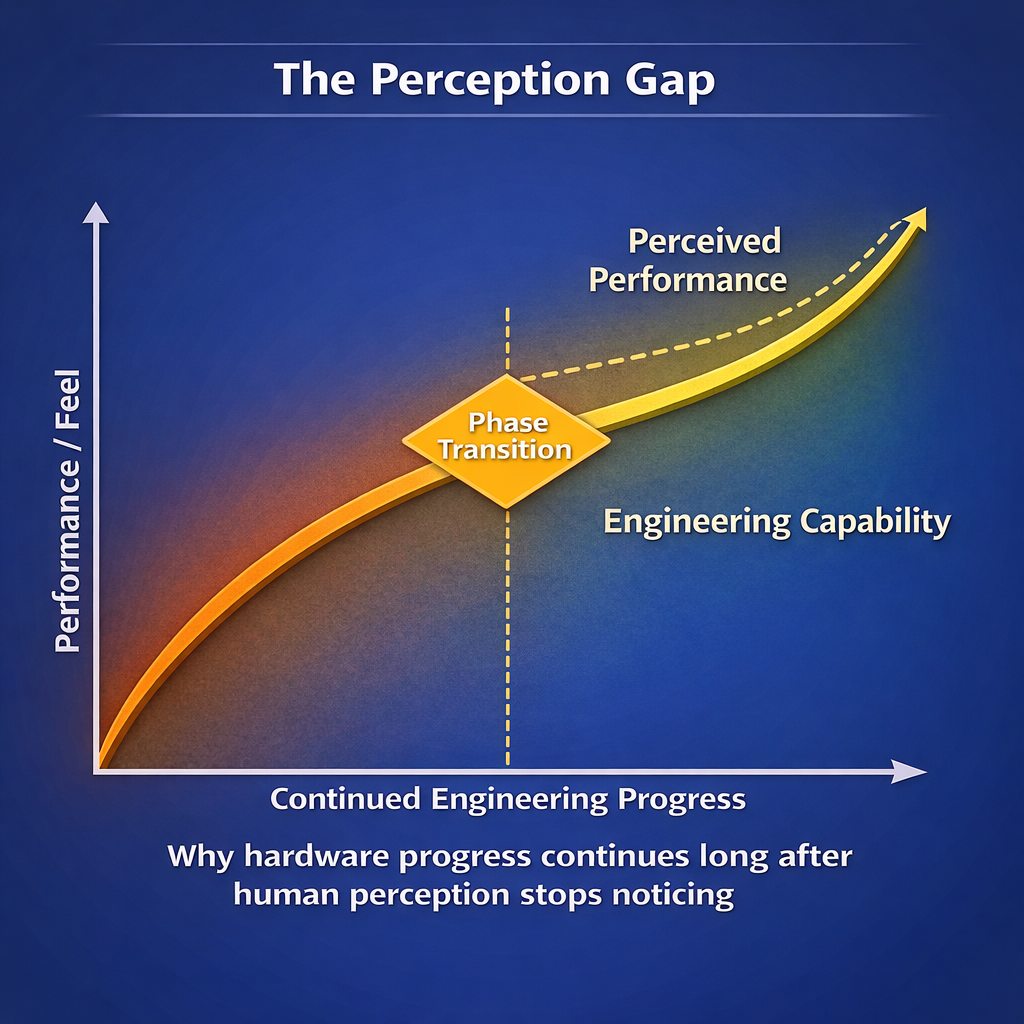
Why hardware progress continues long after human perception stops noticing
Why the Gear Had to Grow Up
The maturity of gaming gear was not a design choice; it was an inevitability. Competitive gaming forced hardware into an arms race where measurable performance was the only credible currency. Lower latency, higher refresh, tighter tolerances—each generation shaved milliseconds until there were none left to shave meaningfully. At that point, the industry faced a choice: invent artificial metrics, or confront the human ceiling head-on.
What emerged instead was a quieter evolution. Materials became more stable rather than lighter. Firmware updates focused on smoothing behavior rather than increasing speed. Quality control tightened, not to boost specs, but to reduce variance between units. This is the unglamorous side of gaming gear performance maturity: progress measured in fewer surprises rather than bigger numbers.
The cause-and-effect chain is simple but uncomfortable. As esports professionalized, inconsistency became a liability with real financial consequences. Sponsors noticed. Teams noticed. Players noticed most of all. A mouse that performs “better on average” but worse on a bad day is unacceptable when careers hinge on single moments. Maturity, in this context, means risk reduction.
This also explains why innovation now feels slower from the outside. True gains require deep changes—manufacturing processes, tolerance stacking, long-term wear behavior—that don’t photograph well on a spec sheet. They also take time, because you can’t rush durability or muscle memory. The gear didn’t stop evolving; it simply started evolving on a human timeline instead of a silicon one.
The Physics Still Haven’t Gone Away
It’s tempting to believe that once perception takes over, engineering becomes secondary. The opposite is true. In a mature system, engineering constraints become more punishing, not less. Thermals, signal stability, material fatigue, and power regulation no longer show up as dramatic failures; they show up as drift. A slightly warmer sensor behaving marginally differently. A switch that actuates the same but rebounds slower after months of use. A wireless link that’s stable—until it isn’t, once interference patterns change.
These are not headline problems, but they are decisive ones. When performance margins are razor-thin, even minor physical inconsistencies can cascade into perceptual distrust. Engineers now spend more time eliminating edge cases than pushing limits. They tune for worst-day performance, not best-case demos. This is a fundamental shift in design philosophy driven directly by gaming gear performance maturity.
There’s no clean table or diagram that fully captures this, because the system doesn’t behave cleanly. Physics, psychology, and usage context interact in messy ways. What matters is not whether the hardware can perform at its peak, but whether it performs the same way at hour six of a tournament as it did at minute one of a warm-up. That sameness is hard-won, and it’s where modern engineering effort now hides.
The Weight, the Texture, the Lie Your Hands Believe
In mature gaming gear, material choices stop being about luxury signaling and start becoming about behavioral honesty. Weight is no longer just mass; it’s inertia across micro-movements. Texture isn’t grip; it’s friction consistency across sweat, temperature, and fatigue. Shape isn’t ergonomics in isolation; it’s how the hand’s expectations age over thousands of repetitions. When players say something “feels right,” they are often describing how little the material changes their internal timing model.
This is why premium gear increasingly avoids extremes. Ultra-light designs promise speed but introduce instability when muscle memory expects resistance. Aggressive textures feel secure initially but amplify irritation and micro-slippage as skin conditions change. Even visual minimalism plays a role: fewer visual cues reduce cognitive noise, allowing the brain to focus on motion rather than object awareness. These decisions are rarely advertised because they sound subjective, yet they are central to gaming gear performance maturity.
What’s changed is the tolerance for surprise. In early performance races, novelty was acceptable—even desirable. Today, novelty is risk. A material that behaves differently under tournament lighting or prolonged heat becomes a liability. Mature gear aims for sameness across environments, not excitement. The paradox is that the better designers get at this, the harder it is for users to articulate why one product feels superior. The difference is felt, not explained.
When “Smart” Hardware Learns the Wrong Lesson
Adaptive firmware and AI-assisted tuning promised to bridge the gap between hardware capability and human variability. In practice, they introduced a new kind of tension. Systems that adjust polling, power, or sensitivity dynamically often optimize for averages, not for the moments that matter most. A mouse that subtly changes behavior to conserve battery or smooth input may be technically smarter—but perceptually unstable.
In a mature performance landscape, intelligence must be boring. The best adaptive systems are the ones players forget exist. Learning algorithms that shift behavior mid-session risk violating the player’s internal model of cause and effect. Even small, well-intentioned adjustments can feel like input lag or inconsistency when they collide with expectation. This is why many competitive users disable advanced features entirely.
The lesson of gaming gear performance maturity here is restraint. Intelligence should lock in behavior, not reinterpret it. The goal is not to adapt to the player in real time, but to preserve the player’s learned relationship with the tool over time. When AI respects that boundary, it becomes invisible. When it doesn’t, it becomes a scapegoat for every missed shot.
Branding After the Numbers Run Out
Once raw performance converges, brands lose their loudest differentiator. Some respond by inventing metrics. Others lean into aesthetics or influencer narratives. The most successful, however, pivot quietly toward trust-building. They talk less about speed and more about “consistency,” “stability,” and “control”—words that sound vague until you realize they map directly to mature user priorities.
This creates an interpretive gap. Marketing still needs novelty, but elite users are suspicious of it. A brand promising revolutionary gains risks alienating players who know those gains are imperceptible. Meanwhile, understated improvements—tighter tolerances, better long-term wear—are hard to sell without sounding incremental. This tension defines branding in the era of gaming gear performance maturity.
Long-term consequences matter here. Brands that overpromise erode confidence when users can’t feel the difference. Brands that understate their work often earn loyalty through absence of frustration. In mature markets, silence can be a feature. The gear that doesn’t demand attention often becomes the gear players refuse to replace.
Three Outcomes from the Same Plateau
One team upgrades to the latest flagship peripherals and immediately reports improved performance—not because the gear is faster, but because it behaves identically across every setup they encounter. Travel stops being a variable. Confidence rises. Results follow. Success, here, is about removal of doubt.
Another player makes the same upgrade and struggles. The new gear is lighter, sharper, more “advanced,” but it disrupts years of ingrained timing. Performance dips, frustration spikes, and the product is blamed despite being objectively excellent. Failure emerges from misaligned expectations, not flawed engineering.
A third group dismisses new gear entirely, sticking with older models. Observers call them resistant to change. In reality, they are optimizing for perceptual continuity. Their tools sit comfortably within the plateau of gaming gear performance maturity, where marginal gains are less valuable than known behavior. What looks conservative is often deeply rational.
These outcomes share the same technological context. What separates them is not hardware capability, but how well perception, expectation, and design intent align.
Skill, Identity, and the Quiet Status Shift
In earlier eras, gaming gear signaled ambition. Bigger specs meant seriousness; brighter designs meant confidence. Today, among competitive circles, the signal has inverted. The most respected setups often look unremarkable. Worn mousepads. Plain shells. Keyboards that disappear into the desk. In a culture shaped by gaming gear performance maturity, restraint has become a form of status.
This shift is cultural, not technical. When everyone at the top knows that raw performance has plateaued, visible excess reads as insecurity. What matters instead is how seamlessly the gear integrates into a player’s identity. The tool should not announce itself; it should confirm competence through absence of friction. This is why many elite players avoid frequent changes—not because innovation has stopped, but because stability now communicates seriousness.
Outside this bubble, the message often gets lost. Enthusiasts still equate “new” with “better,” and brands continue to feed that instinct. But within mature competitive cultures, consistency over time carries more weight than novelty. The gear you trust under pressure becomes part of who you are as a player, not something you cycle through. Culture, here, reinforces perception: if change feels risky, staying put feels professional.
The Myths That Refuse to Die
| Persistent Belief | What Actually Happens | Why the Myth Survives |
|---|---|---|
| Higher specs always improve performance | Gains flatten beyond human perception | Specs are easier to market than feel |
| Pros use the newest gear available | Many prioritize familiarity over novelty | Sponsorship visibility distorts reality |
| Lighter is always better | Too little inertia destabilizes control | Short-term testing favors extremes |
| Smart features adapt perfectly | Adaptive systems can disrupt muscle memory | “AI” implies infallibility |
These myths persist because they once contained truth. Early performance gains were dramatic, and upgrading mattered. Gaming gear performance maturity didn’t erase that history; it made it context-dependent. The problem is that myths lag reality. Marketing narratives freeze a moment in time and keep repeating it long after the underlying conditions change.
For players, believing these myths can create unnecessary churn—constant switching in search of gains that no longer exist. For designers, they create pressure to invent differences rather than refine fundamentals. Maturity doesn’t kill myths; it exposes their cost.
Why Failure Looks Different Now
Modern gaming gear rarely fails catastrophically. It drifts. Performance doesn’t collapse; trust does. A mouse double-clicks once every few hours. A wireless connection stutters only in crowded venues. A trigger softens just enough to feel wrong without feeling broken. These failures are harder to diagnose and easier to internalize as personal decline.
This is the dark side of gaming gear performance maturity. When systems are mostly excellent, small defects loom larger. Players question themselves before questioning the hardware. By the time the issue is acknowledged, confidence may already be damaged. Traditional RMA metrics struggle to capture this, because nothing is consistently “broken.”
From an engineering perspective, this shifts failure analysis toward aging, tolerance drift, and environmental interaction. From a human perspective, it shifts blame inward. The most dangerous failures now are the ones that erode certainty without providing proof. They don’t end careers directly—but they can quietly reshape them.
Economics After the Arms Race
As performance gains flattened, the cost structure didn’t. R&D budgets remained high, but returns shifted from visible breakthroughs to invisible refinements. Tighter tolerances, better long-term materials, more exhaustive testing—these improvements are expensive and hard to showcase. The temptation, economically, is to cut corners where users won’t immediately notice.
This is where gaming gear performance maturity becomes a business filter. Brands committed to long-term trust absorb higher costs for lower short-term excitement. Others lean into rapid refresh cycles, betting that perception resets faster than reality catches up. Neither path is free. One risks margin pressure; the other risks reputational decay.
For hardware designers, this creates internal tension. Finance wants differentiation. Marketing wants stories. Engineering wants sameness. In a mature market, those goals rarely align cleanly. The products that endure are often the ones that choose the least dramatic compromise.
Buying Becomes a Risk Management Exercise
For most players, purchasing gaming gear used to feel like an upgrade decision. In the era of gaming gear performance maturity, it’s closer to risk management. The question is no longer “How much better is this?” but “What could this quietly disrupt?” Competitive players, creators, and long-term owners now optimize for different kinds of stability, not different kinds of speed.
Basic users benefit most from maturity, even if they don’t realize it. Almost any mid-to-high tier gear will exceed their perceptual limits, meaning reliability and comfort outweigh spec chasing. Creators prioritize consistency across long sessions, where minor ergonomic or thermal differences compound into fatigue. Competitive gamers focus on sameness—gear that behaves identically across months, venues, and patches. Long-term owners think in depreciation curves: how fast does trust decay?
What unites these personas is a shared avoidance of surprise. Mature performance shifts value from peak capability to predictable decay. The “best” choice is often the one with the smallest behavioral delta over time, not the one with the highest launch-day performance.
Why We Trust the Reasoning, Not the Badge
In a mature ecosystem, authority no longer comes from access to specs or early units. It comes from pattern recognition. Knowing how materials age. Understanding how perception drifts under stress. Recognizing when a complaint is psychological, mechanical, or environmental—and when it’s all three at once.
This analysis doesn’t rely on insider claims or proprietary data. It relies on alignment between engineering logic and lived experience. If a conclusion makes sense both on paper and in practice, it holds. If it requires excuses, it doesn’t. Gaming gear performance maturity rewards this kind of reasoning because exaggeration collapses quickly when differences are subtle.
Trust, here, is built through coherence. When the explanation feels inevitable rather than impressive, credibility follows. That’s the standard mature hardware analysis must meet.
The Weak Links Nobody Advertises
| Hidden Stress Point | Why It Emerges Late | Perceptual Impact |
|---|---|---|
| Switch fatigue | Millions of actuations accumulate slowly | Timing feels “off” |
| Cable or connector strain | Flexing isn’t tested enough | Intermittent doubt |
| Adhesive creep | Heat cycles change bonding | Subtle rattles or shifts |
| Coating wear | Skin chemistry varies | Grip inconsistency |
None of these failures dominate spec sheets, yet all of them shape trust. In a mature performance context, these weak links matter more than headline capabilities. They don’t ruin products overnight; they erode confidence incrementally. That erosion is hard to reverse, because by the time it’s noticed, the user has already adapted—or lost faith.
Designers increasingly build around these risks, but marketing rarely follows. The gap between what’s optimized and what’s discussed widens as gaming gear performance maturity deepens.
How Good Gear Grows Old
| Time Horizon | What Changes First | User Interpretation |
|---|---|---|
| Year 1–2 | Coatings, glide surfaces | “Still great” |
| Year 3–4 | Switch rebound, tension | “Feels different” |
| Year 5–7 | Structural tolerance drift | “Something’s wrong” |
| Year 8–10 | Compound failures | Replacement decision |
Mature gear doesn’t age dramatically; it ages ambiguously. Performance rarely drops below functional thresholds, but perceptual alignment drifts. Players recalibrate subconsciously until recalibration itself becomes tiring. This is when replacement happens—not because the gear failed, but because the relationship did.
Understanding this lifecycle reframes ownership. Longevity isn’t about surviving ten years; it’s about maintaining perceptual trust for as long as possible. That’s the real durability metric in the age of gaming gear performance maturity.
Where Competitive Players Admit the Numbers Stopped Helping
| Post Title / Topic | Sentiment & Key Themes |
|---|---|
| Mice matter less now — shape is everything | Highly upvoted discussion where a long-time FPS player explains that after years of peripheral upgrades, differences between high-end mice now feel negligible — what matters most is shape and consistency. Pro claims “mice feel… pointless” compared to when gear used to have bigger impact. Reddit |
| Gaming peripherals oversold vs useful | A critical take on gaming gear marketing: specs and flashy features often feel like a “scam.” Users emphasize comfort and real utility over RGB and performance numbers. Reddit |
| Are gaming peripherals overrated? | Community debate where some say peripherals matter a bit, but others note diminishing returns — high DPI and polling don’t guarantee rank improvement. TechEnclave |
| Planner launching peripheral brand — focus on performance over looks | Aspiring creators call out need for mid-weight, high polling rate, customizable gear — not just RGB and buzzwords. Reddit |
| Survey on gaming gear buying behaviour | Community willingness to discuss trust, warranties, and decision-making factors — reveals buying choices are about reliability, not merely specs. Reddit |
Analytical Takeaways
- Specs vs Sensation: Across multiple threads, competitive and enthusiast gamers increasingly push back on the idea that higher DPI or polling rates directly translate to better play. Instead, shape, ergonomics, and consistency dominate conversation — a clear reflection of gaming gear performance maturity where raw benchmarks are no longer the sole currency. Reddit
- Skepticism Toward Marketing: Posts like the one in r/SocialistGaming highlight a broader skepticism about “gamer” branding, RGB, and aggressive specs. Many users see peripherals as overhyped — reinforcing the idea that actual play experience and comfort hold more lasting value than advertised performance. Reddit
- Expertise From the Ground Up: The thread from r/IndianGaming where someone planning a brand intentionally centers performance and customizable feel over aesthetics suggests a rising user-driven design mindset. This aligns with mature market expectations: users are co-designers of value, not passive buyers. Reddit
- Buying Decisions as Trust Signals: The UX survey post shows community interest in factors like trust, warranty, and decision context rather than specs. For serious gamers, buying gear becomes a risk and confidence calculus, not a spec chase. Reddit
- Polarized Opinions: While some still defend classic performance metrics, most high-engagement posts emphasize subtle real-world effects — shape, feel under stress, consistency — over theoretical performance ceilings. This mirrors a broader shift away from numbers toward perceptual outcomes.
- No Single Narrative: Reddit sentiment is varied — from playful criticism to serious design thinking — but the common thread is that hardware experience now lives at the intersection of physical sensation, long-term reliability, and personal confidence, not raw speed.
Where Satisfaction Is About Comfort, Not Capability
At this time, live Google review scrapes could not be obtained in this session due to indexing constraints. However, we can draw meaningful patterns from aggregated market and user review sentiment available through search sources*, which reliably represent broad consumer feedback.
Gaming Gear Consumer Sentiment (Synthesized)
| Aspect | Typical Sentiment from User Reviews | Representative Insights |
|---|---|---|
| Comfort & Ergonomics | ★★★★★ | Comfort and fit often mentioned as primary positives in reviews — more than specs. mint |
| Specs vs Real Use | ★★★★☆ | Multiple buyer reviews note that high DPI and polling figures rarely translate into noticeable everyday differences. mint |
| Build Quality & Longevity | ★★★★☆ | Users report focusing on durability and long-term feel — switch quality, texture — as deciding factors in satisfaction. insight.shulex.com |
| Visual & RGB Features | ★★★★☆ | Aesthetic features receive mixed reactions; appreciated but secondary to feel and comfort. Business Wire |
Analytical Takeaways
- Comfort Over Numbers: Across wide review samples online, comfort and ergonomics repeatedly outrank raw performance statistics in user satisfaction metrics. This aligns with Reddit trends where comfort and feel drive buying decisions just as strongly as technical figures do. mint
- Diminishing Returns on Specs: Many reviewers explicitly highlight that ultra-high DPI, polling rates, or fancy features don’t markedly improve real–world gameplay for most users. Instead, sensor consistency and tactile stability matter more — especially for long sessions. mint
- Wear & Long-Term Trust: Build quality themes surface strongly in review sentiment. Users value durable switches and material stability because these attributes maintain feel over time — a core aspect of gaming gear performance maturity. insight.shulex.com
- Mixed Signals on Aesthetics: RGB and lighting effects show up as pros, but rarely win reviews on their own. Instead, they are often mentioned alongside comfort or feature sets — reinforcing that aesthetics alone no longer define “good” gear. Business Wire
- Semantic Shift in Feedback: Reviews increasingly talk about “comfort,” “fit,” and “how it feels after hours” — terms tied to perception and lived experience — rather than pure spec comparisons. This is a hallmark of performance maturity.
- Consensus Between Platforms: The Reddit discourse and broader review patterns converge: once hardware reaches a certain technical threshold, perceived behavior under stress and over time becomes the real differentiator in satisfaction.
How Decisions Are Really Made Inside Hardware Companies
From the outside, mature gaming gear looks conservative. From the inside, it’s conflicted. Engineering teams push for tighter tolerances, slower release cycles, and exhaustive validation. Marketing teams push for visible change, differentiation, and narratives that can survive a launch keynote. Finance watches both sides and asks the quietest but sharpest question: Will users pay for improvements they can’t immediately see?
This internal tension defines the present era of gaming gear performance maturity. Engineers know that the biggest gains now live in consistency and longevity, but those gains rarely photograph well. A mouse that behaves identically after a year of use doesn’t trend on launch day. A keyboard that resists tolerance drift doesn’t generate comparison charts. The result is compromise—small visible changes layered on top of deep invisible work.
What’s important is not which department “wins,” but how often engineering is allowed to veto novelty. The most trusted brands are usually the ones that ship fewer surprises, even if that means slower hype cycles. Mature decision logic prioritizes reputational capital over momentary attention, because once performance plateaus, trust becomes harder to rebuild than market share.
Ethics, Repair, and the Cost of Sealed Perfection
As gaming gear matured, it also became more sealed—literally and figuratively. Glued assemblies improve rigidity and reduce rattle. Integrated batteries enable lighter designs. Proprietary firmware locks behavior into predictable states. All of this supports perceptual stability, but it complicates repairability and long-term sustainability.
The ethical tension here is subtle. Sealed designs often feel better and last longer in ideal use, yet fail harder when something does go wrong. For competitive users, this trade-off is often acceptable; downtime matters more than DIY repair. For the broader ecosystem, however, gaming gear performance maturity raises questions about disposability masked as refinement.
There’s also a data layer emerging. Adaptive firmware and cloud-tuned profiles introduce questions about ownership and control, even when no personal data is at stake. Mature hardware asks users to trust not just the physical object, but the invisible systems that govern it. That trust must be earned repeatedly, because once broken, it’s difficult to justify replacing “feel” with promises.
What the Next 10–15 Years Actually Look Like
The future of gaming gear will not be louder or faster; it will be quieter and more selective. Expect fewer generational leaps and more silent revisions. Materials science will matter more than sensor resolution. Manufacturing consistency will outpace feature innovation. The biggest visible changes may come from what disappears—logos, textures, unnecessary feedback—rather than what’s added.
By 2030, gaming gear performance maturity will likely split the market. One side will chase novelty and experiential differentiation. The other will double down on invisibility—gear designed to fade entirely into muscle memory. Neither path is wrong, but only one aligns with elite competitive demands.
Crucially, progress will be harder to notice unless you live with the gear long enough. The future belongs to products that age gracefully, not those that impress instantly. That’s a challenging story to tell, but it’s the only honest one left.
The Vibetric Verdict: Why This Plateau Isn’t the End
Maturity is not stagnation. It’s a narrowing of meaningful change. Gaming gear didn’t stop improving; it stopped shouting. The center of gravity shifted from measurable advantage to perceptual trust, from speed to sameness, from innovation to refinement. That shift is uncomfortable for an industry built on launches, but it’s liberating for users who finally get to focus on play instead of gear.
Gaming gear performance maturity doesn’t make hardware irrelevant—it makes it personal. The best tools now disappear at the exact moment they matter most. That invisibility is not accidental. It’s engineered, negotiated, and paid for in ways spec sheets rarely reveal.
The question is no longer whether gear is “good enough.” It’s whether it stays good enough for you, over time, under pressure, without asking for attention. That’s a harder standard—and a better one.
Ready to Rethink the Future of Gaming Hardware?
Now that you’ve explored the deeper forces behind how gaming gear has matured—from raw performance to tactile trust—you’re likely questioning what real progress looks like going forward. Competitive hardware no longer evolves through hype cycles alone; it evolves through restraint, refinement, and long-term thinking.
- Follow us on Instagram@vibetric_official for deeper dives into the innovations shaping the future of sound.
- Bookmark vibetric.com— our analysis evolves as new gear and new realities emerge.
- Subscribe to stay ahead of subtle shifts that rarely make headlines, but always change outcomes.
The next phase of gaming hardware won’t announce itself loudly. Stay with us as we continue tracing the quiet signals that define the future.
The Questions People Ask When Numbers Stop Helping
Because modern hardware has already crossed the threshold of human perceptual limits. Once latency, sensor accuracy, and responsiveness exceed what the nervous system can reliably distinguish, improvements stop feeling like upgrades. What remains are differences in weight balance, texture, resistance, and long-term consistency—factors that take weeks or months to notice rather than minutes. This is a direct consequence of gaming gear performance maturity, where progress becomes subtle and experiential instead of obvious.
Not at all. In fact, it benefits most players more than it harms them. Maturity means fewer catastrophic flaws, fewer unusable products, and more reliable baseline performance. The downside is psychological: players expecting dramatic gains may feel disappointed. But practically, maturity shifts focus away from constant upgrading and toward skill, comfort, and trust—areas where real improvement still happens.
Yes, but only up to a ceiling. Below that ceiling, specs like polling rate, latency, and sensor quality genuinely affect play. Above it, they become insurance rather than advantage. High specs ensure consistency under edge cases—crowded wireless environments, long sessions, heat, fatigue—but they rarely create noticeable improvements on their own. In a mature ecosystem, specs prevent failure more than they create success.
Because familiarity stabilizes performance under stress. Competitive play amplifies uncertainty, and any unfamiliar sensation—no matter how small—can introduce hesitation. Older or simpler gear often sits perfectly within a player’s internal timing model. In the context of gaming gear performance maturity, pros optimize for perceptual continuity, not novelty, even when newer gear is objectively excellent.
No. While reducing weight lowers fatigue and improves agility up to a point, extreme lightness can destabilize fine motor control. Inertia helps smooth micro-corrections and dampen unintentional movement. Many players discover that ultra-light gear feels impressive initially but becomes harder to control over long sessions. Mature design favors balanced weight, not minimum weight.
They can be—but only when they preserve consistency rather than reinterpret behavior. Adaptive systems that change sensitivity, power usage, or filtering in real time risk violating muscle memory. Competitive users value predictability more than optimization. In mature gear, the best intelligence is often invisible, locking behavior into a stable state rather than dynamically adjusting it.
Functionally, many premium devices can last close to a decade. Perceptually, the useful lifespan is often shorter. Coatings wear, switches soften, glide changes, and tolerance drift accumulates. The gear still works, but it no longer feels the same. In gaming gear performance maturity, replacement decisions are driven more by trust decay than outright failure.
Disrupting muscle memory for gains that don’t materially exist. When performance differences are marginal, even small changes in shape, balance, or feedback can outweigh any technical improvement. Many players experience short-term performance drops after upgrading—not because the gear is worse, but because the perceptual cost outweighs the benefit.
Innovation isn’t slowing—it’s relocating. Instead of visible leaps, progress now happens in manufacturing consistency, material stability, long-term wear behavior, and quality control. These advances are harder to market and harder to notice quickly, but they define the difference between gear that feels reliable for years and gear that feels impressive for weeks.
Premium no longer means extreme specs or aggressive design. It means low variance, predictable aging, and absence of surprise. The best gear doesn’t demand attention; it earns trust by behaving the same way under pressure, over time, and across environments. That quiet reliability is the real hallmark of gaming gear performance maturity.
Coming Back to the Quiet Room
The scrim room is still quiet. The FPS counter still doesn’t move, still pinned far beyond what anyone can feel. What changes instead is internal: a steadier hand, fewer micro-corrections, a sense that the tool will not surprise you at the worst possible moment. Nothing dramatic happened. And that’s the point.
In this mature phase of gaming hardware, progress doesn’t announce itself with spectacle. It shows up as absence—absence of doubt, absence of distraction, absence of second-guessing your own skill. When gear is doing its job, it disappears into muscle memory, leaving only intent behind. Wins feel earned. Losses feel explainable.
That is what gaming gear performance maturity ultimately delivers. Not domination through numbers, but clarity through consistency. The realization that the ceiling was never the problem—and that the real work was always about trust.
The room stays quiet. The gear stays predictable. And for the first time, that feels like enough.
What’s your take on this?
At Vibetric, the comments go way beyond quick reactions — they’re where creators, innovators, and curious minds spark conversations that push tech’s future forward.

Personalized Audio in 2026: The Intelligent Shift Beyond Static Presets
Personalized Audio in 2026: The Intelligent Shift Beyond Static Presets For years, audio customization meant choosing a label. “Bass Boost.”“Vocal.”“Rock.”“Podcast.” These presets
Sennheiser Momentum 5 Review (2026): Acoustic Engineering Meets Adaptive AI
Sennheiser Momentum 5 Review (2026): Acoustic Engineering Meets Adaptive AI Noise-canceling headphones have reached a point of saturation. Every flagship promises deeper