
Gaming Controller Innovation 2026 — The Powerful Evolution of Adaptive Precision
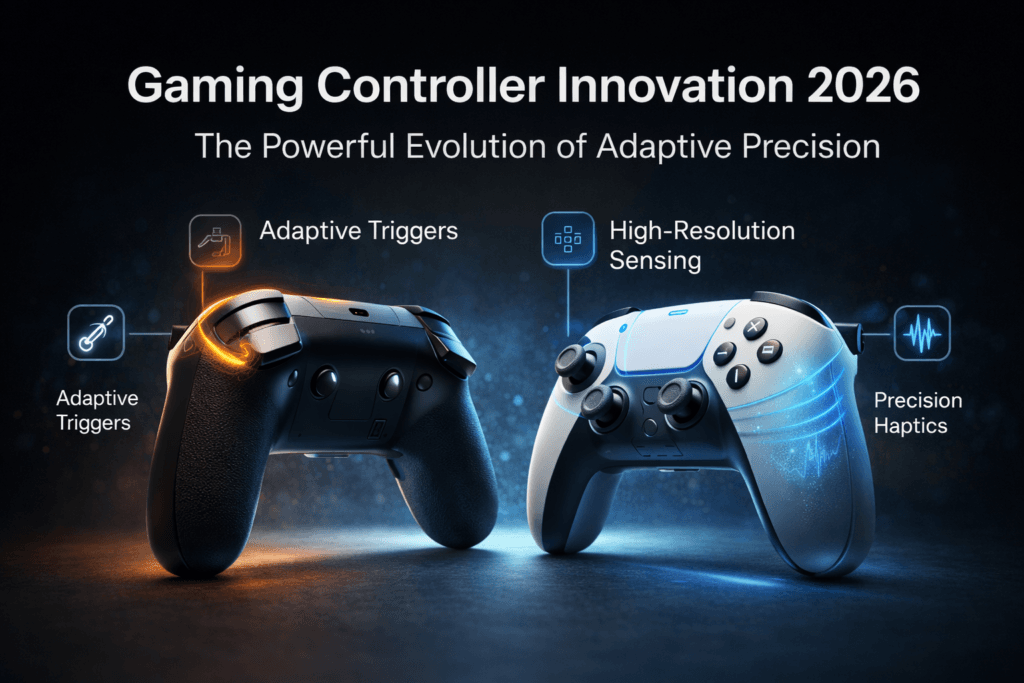
For years, controller upgrades felt incremental—minor ergonomic refinements, cosmetic redesigns, or marginal latency reductions. The core input philosophy remained stable: buttons register, sticks track, rumble motors vibrate. In 2026, that simplicity is being re-engineered. The current wave of gaming controller innovation 2026 is not centered on aesthetics or layout changes but on redefining how physical input translates into digital feedback. Adaptive triggers, next-generation haptics, and sensor-level precision are reshaping the controller from a passive input device into an active performance interface.
Precision Is No Longer Just About Stick Sensitivity
Traditional controller improvement often focused on stick accuracy—tighter dead zones, smoother rotational tracking, and improved durability. While those refinements continue, the new frontier lies in how accurately controllers interpret subtle user intent.
Modern gaming controller innovation 2026 incorporates higher-resolution input sensing, allowing more granular trigger travel detection and analog pressure variation. Instead of binary input states or broad analog ranges, controllers now capture micro-adjustments that matter in racing simulations, competitive shooters, and sports titles. This level of sensitivity allows players to modulate braking, throttle control, or trigger tension with measurable consistency.
Adaptive Triggers as Gameplay Mechanics
Adaptive trigger systems represent one of the most visible shifts in controller engineering. Rather than maintaining uniform resistance, triggers can dynamically adjust tension based on in-game scenarios—tightening during weapon recoil simulation or softening during gradual acceleration phases.
The value of adaptive resistance is not purely immersive; it can enhance mechanical feedback loops. By aligning trigger resistance with in-game physics, developers create tactile confirmation of player actions. In the broader context of gaming controller innovation 2026, this transforms triggers from simple input levers into responsive mechanical feedback tools that support both immersion and performance consistency.
The Evolution of Haptics Beyond Basic Vibration
Earlier controllers relied on rotational rumble motors producing generalized vibration. Modern systems employ more advanced haptic actuators capable of simulating directional textures, surface variations, and impact differentiation. Instead of a single vibration pattern, nuanced haptics can represent distinct environmental cues—gravel under tires, subtle environmental shifts, or mechanical tension during gameplay.
This refinement is critical in competitive and immersive contexts. Within gaming controller innovation 2026, haptic feedback is increasingly treated as an information channel rather than a novelty effect. It supplements visual and auditory cues, providing an additional sensory layer that can subtly improve situational awareness.
Comparing Legacy Controllers to 2026 Innovations
| Feature Area | Traditional Controllers | 2026 Innovative Controllers |
|---|---|---|
| Trigger resistance | Fixed | Dynamic adaptive resistance |
| Haptic feedback | Basic rumble motors | Multi-layered precision haptics |
| Input resolution | Standard analog range | High-resolution micro-detection |
| Latency optimization | Improved but static | AI-assisted signal refinement |
| Customization | Limited presets | Software-driven tuning profiles |
This shift highlights how gaming controller innovation 2026 is expanding beyond cosmetic updates toward deeper engineering upgrades that influence real gameplay outcomes.
Latency and Signal Refinement
Beyond tactile enhancements, signal processing itself is evolving. Modern controllers incorporate improved wireless communication stability and faster polling rates to reduce input delay. Some systems integrate predictive signal smoothing to eliminate micro-stutter in stick tracking, enhancing aiming precision.
These improvements often operate invisibly but contribute directly to consistency. In competitive gaming, where reaction timing matters, even minor latency reductions can produce measurable performance gains. The emphasis within gaming controller innovation 2026 is not just on faster signals but on cleaner, more stable input data transmission.
The Behavioral Shift Toward Customizable Feedback
Another defining characteristic of 2026 controllers is software-driven personalization. Players can fine-tune trigger sensitivity curves, vibration intensity, stick tension simulation, and response profiles according to specific game genres. This flexibility allows controllers to adapt to player style rather than forcing users into a single default configuration.
Customization reinforces the idea that modern controllers function as performance tools. Within the framework of gaming controller innovation 2026, adaptability becomes central—controllers adjust to both game mechanics and individual preferences, enhancing comfort and precision simultaneously.
The Contrarian Perspective: Not Every Feature Improves Performance
While adaptive triggers and advanced haptics add depth, not all players prioritize immersive resistance changes or layered feedback. In some competitive scenarios, excessive haptic effects may even be reduced or disabled to maintain minimal distraction. This highlights an important reality: innovation must remain configurable to serve different play styles.
The strength of current advancements lies not in forcing complexity but in offering optional depth. When balanced correctly, these features enhance engagement without compromising competitive clarity.
Controllers as Performance Interfaces
The trajectory of gaming controller innovation 2026 reflects a broader shift in how gaming hardware is defined. Controllers are no longer static input tools; they are evolving into adaptive interfaces that communicate information back to the player while interpreting intent with greater accuracy. Precision sensing, intelligent haptics, and dynamic resistance collectively transform gameplay from a purely visual interaction into a multi-sensory feedback loop. As developers increasingly design mechanics around these capabilities, the controller itself becomes part of the performance equation—quietly shaping how games are experienced and mastered.
Stay Updated with Vibetric
- Follow our Instagram @vibetric_official for deeper gaming hardware intelligence.
- Bookmark vibetric.com to track next-generation controller engineering.
- Stay connected for insights into how input devices are redefining gameplay performance.
What’s your take on this?
At Vibetric, the comments go way beyond quick reactions — they’re where creators, innovators, and curious minds spark conversations that push tech’s future forward.
PS5 Pro vs PS5: Powerful Upgrade or Overpriced Refresh?
PS5 Pro vs PS5: Powerful Upgrade or Overpriced Refresh? The dilemma isn’t whether the new console is better. It is whether it
NVIDIA RTX 5090 (2026): The Powerful AI GPU Redefining Modern Rendering
NVIDIA RTX 5090 (2026): The Powerful AI GPU Redefining Modern Rendering Gaming used to be about frames per second. Now it’s about