
Foldable Phones Practicality 2026 — The Real Breakthrough Finally Explained
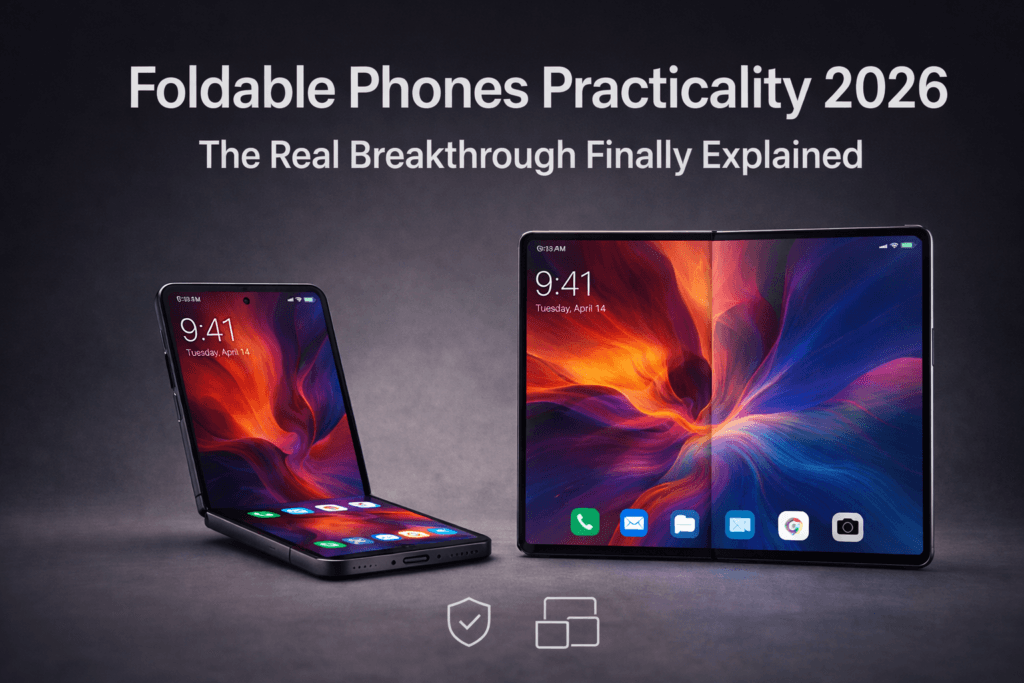
For years, foldable phones existed in a strange space: impressive to look at, difficult to justify. They were conversation starters more than daily tools. By 2026, that framing has changed. The conversation is no longer about novelty or ambition—it’s about practicality at scale.
What defines foldable phones practicality 2026 isn’t a single breakthrough hinge or display spec. It’s the accumulation of quieter decisions that determine whether these devices fit into ordinary routines without demanding compromise.
Durability Moved from Marketing to Engineering Reality
One of the most significant shifts in 2026 foldables is how durability is treated. Earlier generations relied heavily on reassurance—promises of improved hinges, tougher glass, better coatings. This year, manufacturers are behaving as if skepticism is assumed.
Hinges are simpler, not more complex. Fold radii are engineered for longevity rather than minimal crease visibility. Internal components are laid out to reduce mechanical stress over time. These aren’t flashy upgrades, but they directly address the anxiety that kept many users away.
As a result, foldable phones practicality 2026 increasingly hinges—literally—on predictability. Devices are built to survive repetition, not just first impressions.
Software Finally Caught Up to the Form
Hardware alone never made foldables impractical; software did. In 2026, that imbalance has narrowed considerably. Operating systems now treat folding states as first-class contexts, not edge cases. Apps transition more fluidly. Multitasking feels intentional rather than forced.
Crucially, developers are designing interfaces that respect attention, not just screen real estate. Folded modes prioritize speed and one-handed use. Unfolded modes emphasize continuity, not clutter. The device adapts without demanding that the user constantly manage layouts.
This maturation is central to foldable phones practicality 2026. A larger screen only matters if it behaves like a natural extension of use, not an interruption.
Weight, Thickness, and the Everyday Carry Test
A major practical barrier has always been physical: bulk. In 2026, foldables still aren’t featherweight, but they’ve crossed an important threshold—they no longer feel fragile or cumbersome in daily carry.
Material choices favor rigidity without excessive mass. Battery density improvements offset the demands of dual displays. When folded, these phones behave more like slightly thicker slabs rather than awkward compromises.
For many users, this is the difference between tolerating a foldable and forgetting about it. Foldable phones practicality 2026 improves most when the device disappears into routine, not when it announces itself.
Who Benefits—and Who Still Doesn’t
Despite progress, foldables aren’t universally optimal. Users who prioritize minimalism, pocket comfort, or single-handed use may still find traditional phones more efficient. That hasn’t changed.
Where foldables shine is role fluidity. Professionals who move between communication, reading, editing, and multitasking throughout the day gain tangible value. Content consumption feels less constrained. Split workflows reduce friction.
In other words, foldable phones practicality 2026 is uneven by design. These devices reward certain patterns of use more than others—and that selectivity is finally being acknowledged honestly.
The Industry’s Quiet Recalibration
What’s notable in 2026 is how manufacturers talk about foldables. The tone has shifted from evangelism to positioning. Brands are no longer insisting foldables are the future for everyone. They’re framing them as alternatives that now make sense, rather than inevitabilities.
This restraint signals confidence. When companies stop overselling, it usually means the product no longer needs defense. Foldables are becoming a stable category, not an experiment requiring justification.
That stability is a key indicator of foldable phones practicality 2026 reaching a meaningful plateau.
A Contrarian Take: Mass Adoption Isn’t the Goal
A common assumption is that foldables must replace slab phones to succeed. That’s a false benchmark. The more realistic outcome—and arguably the healthier one—is coexistence.
Foldables don’t need universal adoption. They need sustainable, satisfied users who choose them deliberately. By that measure, 2026 looks far more promising than any prior year. The category is settling into its role instead of chasing dominance.
The contrarian truth is that foldables become practical precisely when they stop trying to be everything.
A Snapshot of What Changed by 2026
| Dimension | Early Foldables | 2026 Reality |
|---|---|---|
| Durability | Claimed resilience | Proven repetition tolerance |
| Software | Reactive layouts | Context-aware behavior |
| Portability | Noticeable compromise | Manageable daily carry |
| Positioning | Future default | Viable alternative |
This evolution explains why the practicality conversation feels different this year.
So, Are Foldables Finally Practical?
For everyone? No—and they don’t need to be. For a growing segment of users, though, foldables in 2026 are no longer compromises wrapped in innovation. They’re deliberate tools for specific lifestyles and workflows.
Foldable phones practicality 2026 isn’t about perfection. It’s about friction dropping below the threshold where benefits outweigh adjustments. For many users, that line has finally been crossed.
Signals Worth Watching
- Follow our Instagram @vibetric_official for grounded analysis on foldable phone design and usability.
- Bookmark vibetric.com to track how foldable phones practicality evolves through real-world use in 2026.
- Stay informed as foldables move from experiment to established category.
What’s your take on this?
At Vibetric, the comments go way beyond quick reactions — they’re where creators, innovators, and curious minds spark conversations that push tech’s future forward.
CES 2026 Smartphone Trends — Important Changes You Can’t Ignore
CES 2026 Smartphone Trends — Important Changes You Can’t Ignore CES has never been the primary stage for flagship smartphones, but the
AI Cameras 2026 Features — The Powerful Shift Toward Smarter Imaging
AI Cameras 2026 Features — The Powerful Shift Toward Smarter Imaging Camera hardware stopped being the main innovation lever years ago. Sensor