
Flagship vs Midrange Smartphones: Why Flagships Still Matter
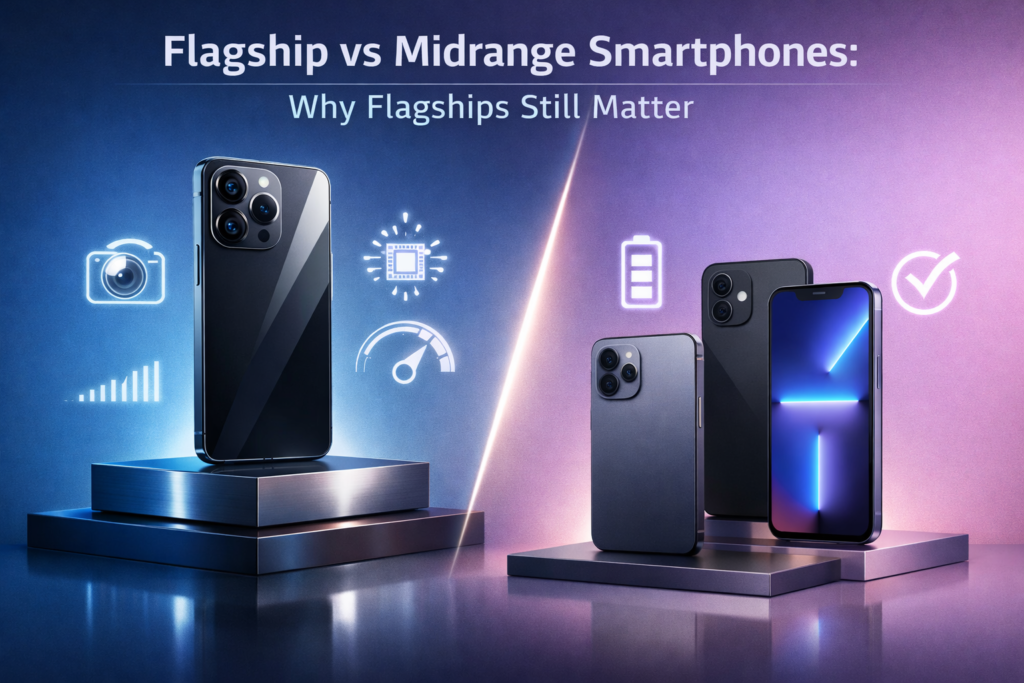
For years, flagship phones defined the smartphone narrative. They introduced new designs, new capabilities, and new expectations that eventually filtered downward. Today, that hierarchy feels less certain. Midrange devices are fast, reliable, and good enough for most daily tasks. This has raised a genuine question rather than a rhetorical one: do flagships still matter in a market where the middle has become so strong? The tension between flagship vs midrange smartphones is no longer about price alone—it’s about relevance.
This isn’t a collapse of the flagship category. It’s a redefinition of what its purpose actually is.
When “Good Enough” Became the Baseline
Modern midrange phones crossed a critical threshold. Displays are sharp and fluid. Cameras are competent in most lighting. Performance rarely bottlenecks everyday use. Battery life is predictable. For messaging, media, navigation, and work, the experience is largely frictionless.
Once this baseline was established, the perceived gap narrowed dramatically. The average user no longer feels constrained by midrange hardware, which weakens the emotional pull of premium upgrades. In the flagship vs midrange smartphones debate, midrange devices now win the argument for sufficiency.
What Flagships Still Do That Midrange Can’t
Flagships haven’t become redundant—they’ve become specialized. Their value concentrates in areas that don’t immediately register in spec comparisons. Camera systems handle edge cases more gracefully. Displays sustain peak brightness and color accuracy under stress. Performance holds steady over longer lifespans and heavier workloads.
More importantly, flagships absorb risk. They test new materials, new silicon strategies, and deeper software-hardware integration before those ideas mature. In the ecosystem of flagship vs midrange smartphones, flagships act less like products for everyone and more like reference points for the entire category.
The Industry’s Quiet Rebalancing Act
Manufacturers no longer expect flagship volume to drive growth on its own. Instead, flagships shape brand identity and technical direction, while midrange models deliver scale. This division of labor is intentional.
Midrange devices optimize for value and predictability. Flagships optimize for leadership and longevity. Both roles are necessary, but they serve different audiences. The modern flagship vs midrange smartphones dynamic reflects a portfolio strategy rather than a winner-takes-all contest.
A Snapshot of Diverging Roles
| Midrange Focus | Flagship Focus |
|---|---|
| Everyday reliability | Edge-case excellence |
| Value optimization | Long-term performance headroom |
| Mature features | Experimental or first-gen tech |
| Broad appeal | Brand and platform signaling |
This split explains why comparisons often feel unsatisfying—each category is solving a different problem.
The Contrarian View: Flagships Matter More Than Ever
It’s tempting to argue that midrange phones have “caught up.” In reality, they’ve caught up to yesterday’s expectations. Flagships define tomorrow’s. Without them, innovation would slow not because ideas vanished, but because no tier would exist to justify risk.
Flagships also anchor software support, accessory ecosystems, and developer optimization. In the long arc of flagship vs midrange smartphones, removing the top weakens the entire structure, even if the middle looks strong for a while.
How User Psychology Finally Split
What’s changed most is not technology, but intent. Users no longer buy flagships to escape poor experiences; they buy them to avoid compromise over time. Others choose midrange devices confidently, knowing they’re not sacrificing basics.
This clarity is new. The decision between flagship vs midrange smartphones now reflects priorities—longevity, prestige, experimentation versus value, adequacy, and pragmatism—rather than fear of missing out.
Closing Insight
Flagship phones still matter, but not in the way they once did. They are no longer mandatory upgrades or universal benchmarks. They are strategic instruments—shaping direction, absorbing risk, and defining ceilings. Midrange devices, meanwhile, have earned their place as the default choice for most people. The future isn’t about one replacing the other. It’s about a clearer division of purpose, where each tier finally knows why it exists.
If you’re deciding what actually matters in a phone
- Follow our Instagram @vibetric_official for signal over specs.
- Bookmark vibetric.com to keep track of how device roles are evolving
- Return for perspective on where value is shifting—not just who’s winning
What’s your take on this?
At Vibetric, the comments go way beyond quick reactions — they’re where creators, innovators, and curious minds spark conversations that push tech’s future forward.
Next-Gen Smartphones Feel Dramatically Better in 2026 — Even If They Look the Same
Next-Gen Smartphones Feel Dramatically Better in 2026 — Even If They Look the Same The industrial design hasn’t changed much. The camera
OnePlus 15 Review 2026: Intelligent Performance in the AI Era
OnePlus 15 Review 2026: Intelligent Performance in the AI Era Performance used to be theatrical. Manufacturers showcased peak clock speeds, explosive benchmark