
How Charging Speeds Affect Long-Term Battery Health
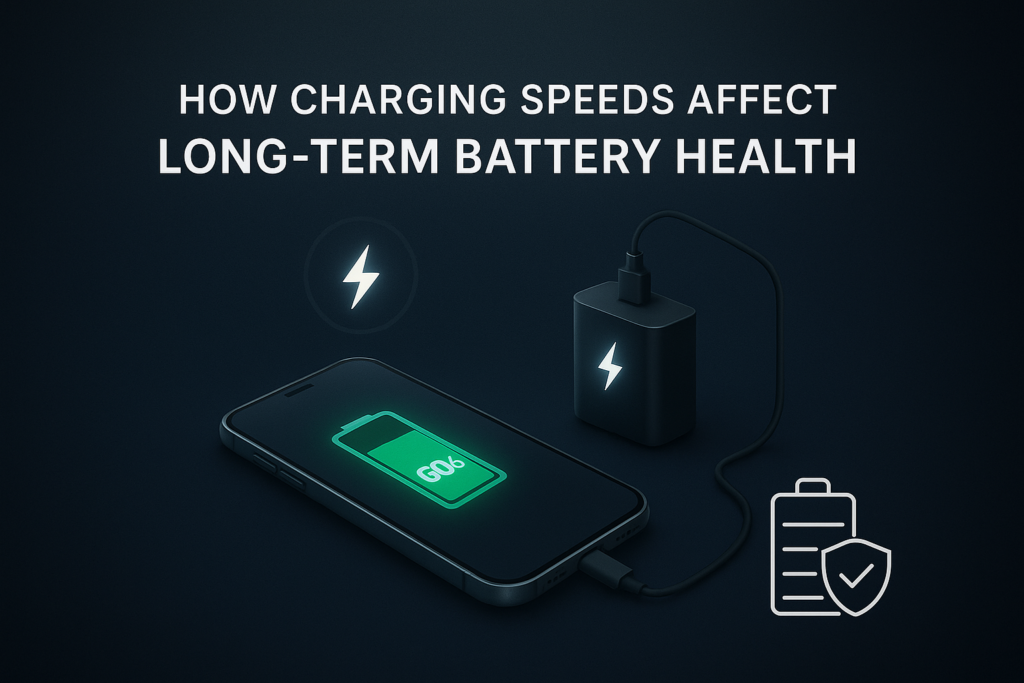
Fast charging has become a hallmark feature in 2025 smartphones, laptops, and wearables. Advertisements tout “minutes to full battery,” but most users rarely consider the long-term implications of speed-focused charging. While rapid top-ups offer convenience, they subtly affect battery chemistry, lifespan, and overall device performance. Understanding the science behind fast charging battery health is key for users who want speed without sacrificing durability.
The Science Behind Fast Charging
Fast charging battery health is influenced by the rate of electrical current delivered to lithium-ion or lithium-polymer cells. Standard charging usually ranges from 5–15W, while in 2025, fast charging spans 30W–120W for smartphones and up to 200W for some laptops.
The process generates heat, accelerating chemical reactions inside the battery. Key reactions include lithium plating, electrolyte breakdown, and gradual internal resistance increases. Over time, these factors reduce capacity, shortening battery lifespan.
Engineers mitigate these risks with:
- Thermal sensors to lower current when temperatures rise
- Dynamic voltage scaling to reduce cell stress
- Multi-cell architectures to distribute current evenly
These design choices allow high-speed charging while preserving fast charging battery health under normal conditions.
Consumer Misconceptions About Fast Charging
Many users assume that high-wattage charging immediately damages the battery. In reality, occasional fast charging is largely safe. More damaging habits involve leaving devices at 100% for extended periods or charging in hot environments.
Daily behavior has a stronger influence on fast charging battery health than raw wattage. For example, topping up to 50–70% multiple times a day stresses the battery less than a full 0–100% cycle in extreme heat. Understanding these patterns helps users balance convenience and longevity.
Engineering Innovations Protecting Your Battery
Modern devices incorporate multiple safeguards to maintain fast charging battery health:
- Temperature Management: Active and passive cooling keeps cells in the optimal range
- Intelligent Charging Algorithms: Dynamically adjust current to battery state
- Hot-Swap Cells: Split current across multiple cells to reduce localized stress
Flagship devices like the Samsung Galaxy S25 Ultra and iPhone 17 Pro showcase these innovations. Both support high-speed charging without significant degradation over 2–3 years, demonstrating how engineering protects long-term battery performance.
Real-World Impact of Fast Charging
Practical experience shows batteries using moderate fast charging retain over 80% capacity after 2–3 years. Extreme habits—continuous 120W charging in hot environments or overnight full charges—accelerate wear. Manufacturers optimize algorithms considering typical user behavior, which is why devices often slow charging after 80–90%, maintaining fast charging battery health effectively.
Myth vs Reality: Fast Charging Concerns
| Myth | Reality |
|---|---|
| Fast charging kills batteries quickly | Occasional fast charging is safe; heat and full-charge stress matter more |
| Only slow charging preserves lifespan | Modern batteries tolerate frequent fast charging |
| High-speed charging drastically reduces life | Most devices maintain 80%+ capacity after 2–3 years with responsible use |
Practical Guidelines for Users
- Use moderate fast charging for daily top-ups; reserve extreme high-wattage modes for urgent situations
- Avoid leaving devices at 100% for long periods
- Charge in cool environments to minimize thermal stress
- Always use manufacturer-certified chargers and cables
Following these steps ensures convenience while maximizing fast charging battery health.
Mini Comparison: Typical Fast Charging Specs in 2025
| Device | Max Fast Charging | Battery Type | Notes |
|---|---|---|---|
| Samsung Galaxy S25 Ultra | 120W | Li-ion | Smart thermal management slows after 80% |
| iPhone 17 Pro | 50W | Li-ion | Optimized charging with overnight mode |
| OnePlus 14 Pro | 100W | Li-Po | Multi-cell design reduces heat per cell |
| ASUS ROG Flow X17 (Laptop) | 200W | Li-ion | Rapid charging with active cooling |
This provides context for real-world usage and expectations.
Closing Insight
Fast charging battery health in 2025 is a refined balance of speed and preservation. Rapid top-ups introduce thermal and chemical stress, but engineering safeguards ensure long-term reliability. By understanding user habits, environmental conditions, and manufacturer features, devices can benefit from speed without compromising lifespan. In essence, fast charging is safe—if used thoughtfully.
Optimize Your Battery Routine
- Follow our Instagram @vibetric_official for analyses of fast charging battery health and energy management trends.
- Bookmark vibetric.com for detailed guides on battery longevity and safe charging habits.
- Stay informed on emerging smart charging features to maximize device performance without sacrificing durability.
What’s your take on this?
At Vibetric, the comments go way beyond quick reactions — they’re where creators, innovators, and curious minds spark conversations that push tech’s future forward.
The 2025 UltraBook Review — Are Thin-and-Light Laptops Finally Powerful Enough?
The 2025 UltraBook Review — Are Thin-and-Light Laptops Finally Powerful Enough? For years, ultrabooks have walked the tightrope between portability and power.

The Real Reason Mid-Range Phones Are Getting So Good
The Real Reason Mid-Range Phones Are Getting So Good For years, flagship phones dominated headlines, while mid-range phones played second fiddle. But