
Esports Influence on Gaming Gear: The Hidden Benefit or Distortion
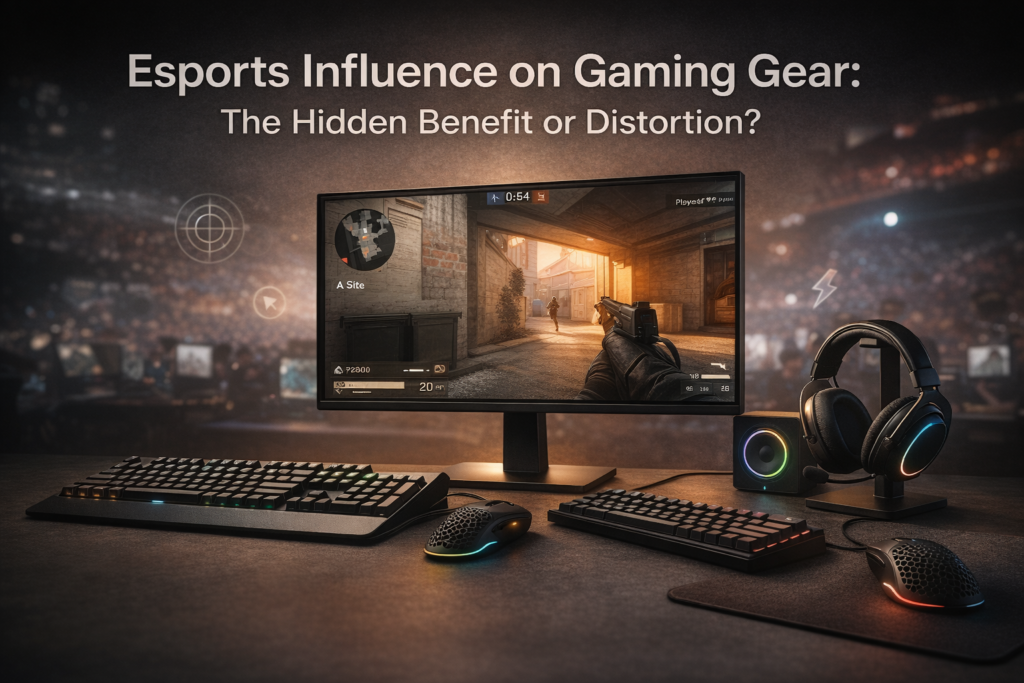
Esports has reshaped how gaming gear is designed, marketed, and evaluated—but not always in obvious ways. What began as a professional niche has become a dominant reference point for everyday products, from mice and keyboards to headsets and monitors. The question isn’t whether esports influence on gaming gear exists. It’s whether that influence genuinely benefits most players, or quietly distorts what “good” gear is supposed to be.
The answer sits somewhere between progress and misalignment.
How Competitive Play Became the Default Benchmark
Esports brought legitimacy to gaming hardware. Measurable performance, standardized settings, and visible skill ceilings created a framework manufacturers could optimize around. Low latency, consistent tracking, and reliability under pressure became non-negotiable.
This raised the baseline quality of consumer gear. Even entry-level products today outperform high-end peripherals from a decade ago. In that sense, esports influence on gaming gear has been undeniably positive—it forced manufacturers to engineer for consistency rather than spectacle.
But benchmarks designed for professionals don’t always translate cleanly to everyday play.
The Narrow Definition of “Performance”
Professional esports players operate under extreme constraints: long sessions, controlled environments, and highly specialized roles. Gear optimized for that context prioritizes speed, lightness, and minimal resistance above all else.
When those priorities trickle down unfiltered, trade-offs emerge. Ultra-light mice sacrifice structural rigidity. Minimalist keyboards favor actuation speed over comfort. Headsets tuned for positional clarity neglect musical balance.
For pros, these compromises make sense. For most consumers, they introduce friction rather than advantage.
Esports influence on gaming gear narrowed the definition of performance—sometimes too much.
When Optimization Ignores Human Variability
One overlooked issue is biological diversity. Professional setups assume adaptable hands, trained muscle memory, and tolerance for aggressive ergonomics. Casual and semi-competitive players don’t share those assumptions.
Gear shaped around a “pro average” can feel uncomfortable, fatiguing, or unintuitive for broader audiences. Grip styles vary. Desk setups differ. Session lengths fluctuate.
Industrial design once accounted for this variability. Esports-driven optimization often flattens it in pursuit of measurable gains.
A Snapshot of Impact
| Esports-Driven Focus | Consumer Outcome |
|---|---|
| Ultra-low latency | Marginal real-world benefit |
| Lightweight builds | Reduced durability |
| Minimal tuning | Less versatility |
| Pro endorsements | Perceived authority |
this snapshot shows how esports influence on gaming gear improves metrics while sometimes weakening experience.
Marketing Turned Skill Into Specification
Endorsements blurred the line between skill and equipment. Seeing elite players succeed with specific gear implies causation—even when skill outweighs hardware by orders of magnitude.
This shifted consumer expectations. Instead of asking “Does this suit me?” buyers ask “Is this used by pros?” Gear becomes aspirational rather than contextual.
Esports influence on gaming gear turned professional preference into mass-market prescription.
The Benefits Are Real—but Uneven
It’s important not to dismiss esports’ contributions entirely. Competitive gaming accelerated wireless reliability, reduced input lag across categories, and normalized high refresh-rate displays. These advancements benefit everyone.
The distortion lies not in the technology, but in the framing. Features designed for edge cases are marketed as universal upgrades. The nuance gets lost.
Progress happened—but it arrived without translation.
The Contrarian View: Esports Slowed Some Forms of Innovation
By locking onto narrow performance metrics, the industry deprioritized other forms of improvement. Comfort, repairability, acoustic balance, and long-term durability received less attention because they don’t show up on tournament broadcasts.
Ironically, as performance plateaued, these overlooked factors became more important to everyday users. Esports influence on gaming gear optimized the last milliseconds while ignoring the last miles of ownership.
Innovation didn’t stop. It just got lopsided.
Where Consumers Are Quietly Pushing Back
Recent trends suggest a correction. Heavier mice are returning. Modular keyboards are gaining traction. Design is shifting toward comfort and sustainability alongside performance.
Consumers aren’t rejecting esports influence—they’re contextualizing it. Gear no longer needs to mirror a tournament desk to feel legitimate.
This signals a healthier relationship between professional benchmarks and personal needs.
Benefit or Distortion? It Depends on Awareness
Esports influence on gaming gear is most beneficial when treated as a reference, not a rulebook. Professional requirements can inform design without dictating it wholesale.
Problems arise when consumers assume pro-optimized equals universally better. The best gear is rarely the most extreme—it’s the most appropriate.
Understanding the difference restores balance.
Reclaiming the Definition of “Good Gear”
Gaming hardware doesn’t need to escape esports’ shadow. It needs to step out from directly beneath it.
When performance, comfort, design, and longevity are weighed together, esports influence becomes one input among many—not the final authority. That’s where consumer gaming gear works best.
The future of gaming hardware won’t be decided on stage. It will be decided at desks, over long sessions, by players who value how gear fits into their lives—not just how it performs under a spotlight.
Stay Grounded with Vibetric
- Follow our Instagram @vibetric_official for deeper analysis of gaming culture and design.
- Bookmark vibetric.com to track how pro influence shapes consumer tech.
- Stay updated as gaming gear evolves beyond tournament logic.
What’s your take on this?
At Vibetric, the comments go way beyond quick reactions — they’re where creators, innovators, and curious minds spark conversations that push tech’s future forward.
Ray Tracing in 2026: The Powerful Shift From Experimental to Standard Graphics
Ray Tracing in 2026: The Powerful Shift From Experimental to Standard Graphics The technology spent years as a benchmark showcase. Now it’s
Frame Stability in 2026: The Hidden Metric Redefining Gaming Performance
Frame Stability in 2026: The Hidden Metric Redefining Gaming Performance For years, gaming conversations revolved around one number: frames per second. Higher