
Edge Computing Trends 2026 — The Powerful Shift Toward Distributed Intelligence
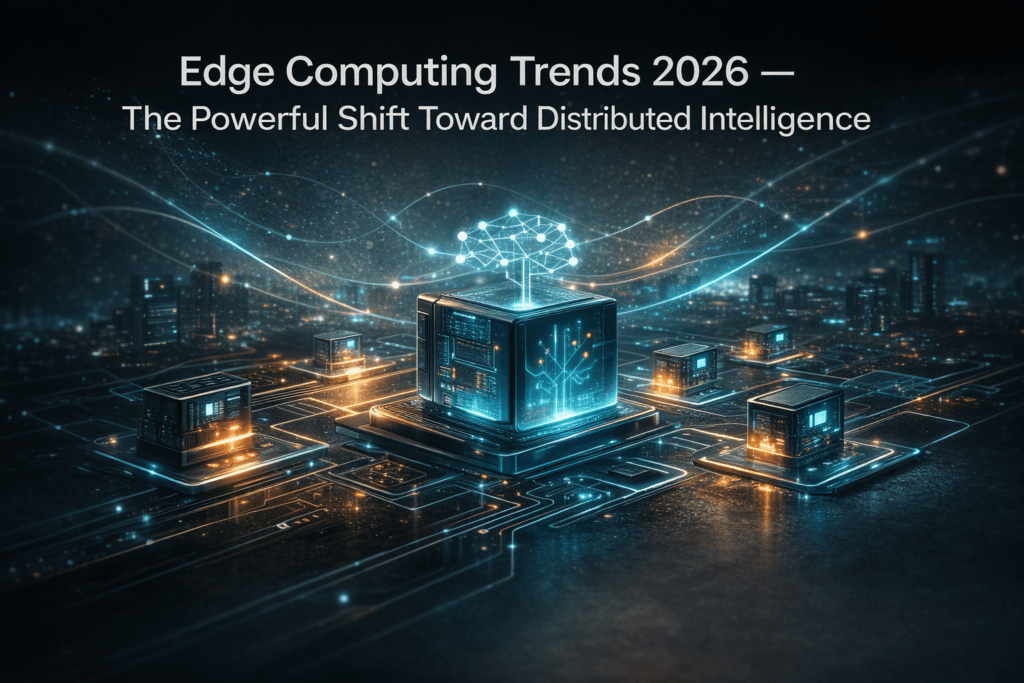
Cloud computing reshaped the last decade. Edge computing is quietly reshaping this one. In early 2026, the most meaningful performance gains across devices, networks, and AI systems are not coming from larger centralized data centers — they’re coming from computation happening closer to the source. Edge computing trends 2026 reveal a structural rebalancing of digital infrastructure.
What makes this shift “silent” is its invisibility. Users don’t see edge servers. They don’t interact with edge nodes directly. Yet latency reductions, faster AI responses, and improved reliability increasingly depend on them.
The cloud is no longer the only brain in the system.
Why Centralization Hit Its Practical Limits
For years, routing everything to hyperscale data centers made economic and architectural sense. Centralized compute allowed for massive scale and simplified orchestration. However, three constraints began surfacing:
- Latency sensitivity in AI-driven applications
- Rising bandwidth costs from constant data transmission
- Privacy concerns tied to continuous cloud uploads
As AI models became embedded in everyday devices — from cameras to industrial sensors — sending raw data to distant servers introduced delay and inefficiency. The solution wasn’t abandoning the cloud, but redistributing intelligence.
This redistribution defines edge computing trends 2026: compute workloads increasingly processed at network peripheries before interacting with central systems.
The Technical Core: Distributed Intelligence Layers
Edge computing in 2026 is not a single technology. It’s a layered architecture combining:
- Local device processing (on-device AI accelerators)
- Micro data centers near population hubs
- Network-level processing within telecom infrastructure
- Cloud orchestration for large-scale model training
Instead of a binary cloud-or-device decision, modern systems use dynamic workload allocation. Latency-critical tasks execute locally; high-scale analytics remain centralized.
This flexible distribution reduces round-trip delays dramatically. Applications like augmented reality overlays, autonomous navigation systems, and real-time analytics depend heavily on these refinements. Edge computing trends 2026 emphasize responsiveness over sheer compute scale.
Edge vs Traditional Cloud Processing
| Dimension | Traditional Cloud | Edge-Enabled Architecture |
|---|---|---|
| Data Flow | Raw data sent to central servers | Pre-processed locally first |
| Latency | Higher round-trip time | Reduced response delay |
| Bandwidth Usage | Continuous high-volume transfer | Filtered and optimized |
| Privacy Exposure | Greater centralized data storage | Localized data handling |
| AI Responsiveness | Dependent on network stability | Real-time adaptability |
The contrast highlights a philosophical shift. Instead of concentrating intelligence, systems are decentralizing it.
Consumer Impact: Faster, But Less Visible
End users rarely attribute performance improvements to edge infrastructure. They simply notice:
- Voice assistants responding more instantly
- Video analytics processing in real time
- Smart devices operating reliably even during network instability
These improvements are not cosmetic. They are architectural. Edge computing trends 2026 prioritize resilience — ensuring systems remain functional even when cloud connectivity fluctuates.
This is especially critical in sectors like healthcare monitoring, industrial automation, and smart mobility, where milliseconds matter.
The Industry Perspective: Efficiency Over Expansion
From an enterprise standpoint, edge computing addresses cost dynamics. Constant cloud data transfer is expensive. By filtering and analyzing data locally, organizations reduce transmission loads and optimize bandwidth consumption.
Telecom providers are embedding compute modules directly into 5G and early 6G network infrastructure. Hardware vendors are integrating AI accelerators into chips designed specifically for distributed workloads.
Rather than expanding central data centers indefinitely, the industry is redistributing computation capacity geographically. Edge computing trends 2026 show infrastructure becoming more spatially intelligent.
A Contrarian Reality: Edge Is Not Replacing the Cloud
Despite enthusiastic headlines, edge computing is not a cloud replacement. Large-scale model training, archival storage, and cross-regional analytics still depend on centralized resources.
The real shift is collaborative. Edge handles immediacy; cloud handles scale. Systems dynamically decide where tasks should execute. Overemphasizing one over the other creates imbalance.
The revolution is not about decentralization alone — it’s about intelligent workload orchestration.
Security and Privacy as Structural Drivers
Edge deployment also intersects with regulatory pressures. Processing sensitive data locally reduces exposure risks and aligns with stricter data protection standards emerging globally.
Instead of transmitting raw biometric or behavioral data to distant servers, systems increasingly anonymize or summarize information before cloud interaction. This design reduces attack surfaces and improves compliance positioning.
As regulations tighten, edge computing trends 2026 are increasingly shaped by governance considerations, not just performance metrics.
Infrastructure Is Becoming Invisible Intelligence
Edge computing does not produce flashy devices or dramatic hardware launches. Its transformation is systemic. By redistributing computational authority closer to users and sensors, digital systems gain responsiveness, resilience, and contextual awareness.
The most important innovation in early 2026 may not be a new device at all — but the architecture quietly enabling them to perform better. Edge computing trends 2026 signal that intelligence is no longer centralized by default. It is situational, layered, and adaptive.
As this infrastructure matures, users may never think about “edge” directly. They will simply expect systems to respond instantly — everywhere.
Track the Infrastructure Shift with Vibetric
- Follow our Instagram @vibetric_official for focused breakdowns of next-gen computing architecture.
- Bookmark vibetric.com for strategic insights into AI and network evolution.
- Stay informed as distributed intelligence reshapes digital systems.
What’s your take on this?
At Vibetric, the comments go way beyond quick reactions — they’re where creators, innovators, and curious minds spark conversations that push tech’s future forward.
Best Tech Gadgets 2026 — The Smart Devices That Truly Deliver
Best Tech Gadgets 2026 — The Smart Devices That Truly Deliver Every year begins with spectacle. Product teasers promise transformation. Launch events
Edge Computing Trends 2026 — The Powerful Shift Toward Distributed Intelligence
Edge Computing Trends 2026 — The Powerful Shift Toward Distributed Intelligence Cloud computing reshaped the last decade. Edge computing is quietly reshaping