
Creator Tools for Everyday Users 2026: Powerful Shift in Digital Making
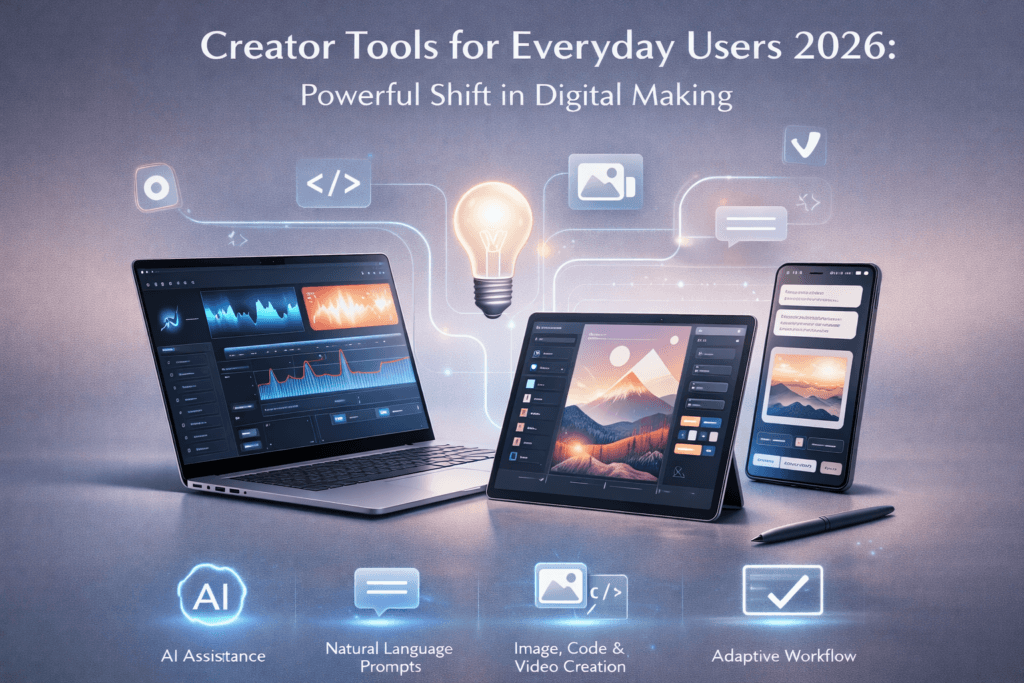
Every morning now starts with a familiar tension: a spark of an idea, followed by the friction of execution. For years, powerful tools were siloed behind skill, budget, or steep learning curves—until 2026 shifted the ground beneath that assumption. What once required formal training is now accessible to anyone with curiosity and a device. The early 2026 landscape of creator tools for everyday users 2026 isn’t just about “easier software”—it’s about redefining who gets to make, share, and influence in a digital age. This is the story of how that transition happened, and what it means for you.
When Tools Learn, Users Transform: A Sensory Moment
The first time a novice animator watched AI‑assisted keyframing predict perfectly timed motion from a rough sketch, something subtle broke: the boundary between spectator and creator. A content hobbyist whispered, “It feels like the machine sees what I see.” That moment—where technology aligned with human intuition—captures the essence of why 2026’s creator tools matter. They don’t just automate tasks; they translate intent into output.
Most Users See Features — The Real Shift Is Cognitive Augmentation
People often fixate on flashy interfaces or new buttons in apps. But the real revolution of creator tools for everyday users 2026 lies beneath the surface: systems that augment human decision‑making, reducing cognitive load while preserving agency.
Traditional tools required procedural expertise: memorize menus, learn workflows, adapt to software language. The latest generation of tools, however, interprets human context. Whether through natural language prompts, real‑time feedback loops, or predictive models, these systems act less like instruments and more like collaborators.
Here’s what’s different:
- Intent capture using natural language and semantic understanding.
- Real‑time adaptive suggestions rather than static templates.
- Contextual fairness and bias awareness, baked into generative suggestions.
- Cross‑modal synthesis (text, image, code, data) inside a unified workflow.
These aren’t incremental upgrades; they’re cognitive multipliers.
Inside the Engineering of 2026’s Accessible Power
To understand how everyday users are empowered, you have to look under the hood. The breakthroughs aren’t magic—they’re engineered.
- Unified Generative Architectures
Unlike earlier standalone models, 2026 tools deploy unified architecture frameworks that seamlessly integrate:
- Vision‑language understanding
- Temporal coherence for dynamic media
- Semantic code generation
- Ethical alignment layers
These layers work in concert, meaning users don’t need to switch contexts or learn multiple systems.
- Feedback‑Driven Interaction Loops
Adaptive systems in 2026 continuously refine outputs based on user signals:
| Feedback Type | Example | System Effect |
|---|---|---|
| Implicit | Pause / rewind | Adjust timing and emphasis |
| Explicit | “More playful tone” | Update semantic output |
| Outcome affect | Click through, shares | Long term model tuning |
This loop turns every interaction into model improvement, without burdening the user with technical settings.
- Reliability & Safety by Design
Early tools lacked robust guardrails; 2026 tools embed safeguards at every inference stage—filtering harmful outputs, reducing hallucinations, and transparently logging changes.
This is important because accessibility without reliability can erode trust.
When “Easy” Meets “Effective”: Field Examples
Across domains, creators are experiencing results previously reserved for specialists.
Scenario A — Everyday Marketer
An independent wellness coach uses a generative design assistant:
- Provides brand‑consistent visuals in minutes.
- Suggests A/B variants based on audience data.
- Auto‑optimizes formats for different platforms.
What once took a team now takes a handful of prompt cycles.
Scenario B — Community Storyteller
A volunteer documenting local history uses multimodal tools that blend:
- Text transcripts
- Archival photos
- Voice narration
The tool stitches these into professional‑grade micro‑documentaries with minimal inputs.
Scenario C — Hobby Programmer
Instead of wrestling with syntax, a hobbyist speaks intent:
“Build a weather widget that uses local forecasts and shows sunrise/sunset.”
The system generates clean, commented code, test cases, and deployment scripts—all explained in plain language.
In each case, creator tools for everyday users 2026 turn domain complexity into approachable steps, lowering barriers without diluting depth.
The Data Behind Adoption and Impact
The technical transformation is one thing; the empirical shift in user behavior is another.
- Engagement with creation platforms has grown faster than content consumption in the past 18 months.
- Diversity of creator demographics has expanded, especially in regions with limited formal training access.
- Platform retention correlates with tools that learn user preferences and adapt workflows in real time.
What stands out is not just adoption, but the quality of participation: users are iterating, refining, and publishing more frequently because the tools reduce friction at the points of greatest cognitive effort.
The Human Shift: From Consumer to Confident Maker
The psychological transition from passive consumer to active creator requires more than functionality; it demands a sense of agency.
Early 2026 tools empower this by:
- Translating everyday language to expert workflows
- Explaining decisions and outputs transparently
- Encouraging iterative refinement rather than perfectionism
These systems don’t replace human creativity; they scaffold it, making each user’s strength the starting point of the next outcome.
Design Principles That Made This Possible
Behind today’s capabilities are engineering and human‑centered principles:
| Principle | Practical Effect |
|---|---|
| Predictive Intent Modeling | Less menu navigation, more outcome focus |
| Continuous Self Supervision | Reduced errors in creative outputs |
| Explainability Layers | Users understand why a suggestion was made |
| Modular API Ecosystems | Tools integrate with familiar workflows |
This alignment between technical capability and human cognitive strategy is what differentiates early 2026 creator tools from their predecessors.
When These Tools Don’t Fit: Edge Cases and Limits
Despite immense accessibility gains, creator tools for everyday users 2026 aren’t universal panaceas.
- Industries with strict regulatory compliance still require domain specialists.
- Tools trained on public data may underperform on highly niche proprietary inputs.
- Over‑dependence on generative suggestions can atrophy foundational skill development.
And while interface simplicity is beneficial, user literacy in critical thinking and context evaluation remains essential.
Community Voices: Reality Beyond the Hype
Here’s what real users are saying—not marketing copy.
| User Type | Cited Benefit | Common Challenge |
|---|---|---|
| Educator | Enables interactive teaching modules | Needs offline support |
| Small Business Owner | Professional branding fast | Requires guidance for strategy |
| Visual Artist | Rapid prototyping | Balancing style vs automation |
| Academic Researcher | Quick literature distillation | Context accuracy checks |
These reflections show that while tools amplify capability, human judgment and iteration still drive outcomes.
Looking Ahead: What Comes Next in 2026+
Today’s tools are powerful, but they’re early in a trajectory toward systems that:
- Understand long‑form narrative context across sessions
- Anticipate user goals before explicit prompts
- Enable real‑time co‑creation with multimodal feedback
- Provide ethical usage insights dynamically
This next wave will deepen the collaboration between human intent and system execution.
Vibetric Ending
Remember the novice animator watching motion emerge from rough lines? That moment embodies the larger shift of 2026: democratizing creativity without dumbing it down. Creator tools for everyday users 2026 do more than simplify—they expand what is possible for anyone willing to imagine and iterate.
Because in the end, creation isn’t defined by training or tools—it’s defined by expression and agency. And in 2026, those are within reach like never before.
Want to See How Everyday Creativity Evolves with Tomorrow’s Tools?
- Follow vibetric_official on Instagram for trends and insights into creator technology.
- Bookmark Vibetric.com we continuously updates will track how these tools mature and impact work across industries.
- Subscribe for in‑depth analyses and expert breakdowns of how emerging tools redefine creative workflows.
Creator Tools for Everyday Users 2026
Integration of unified models, natural language intent capture, real‑time adaptive feedback, and ethical alignment distinguishes them from isolated feature sets.
No—tools lower initial barriers, but deep domain understanding enhances outcomes and precision.
Modern tools include fairness, privacy, and safety guardrails, but users should evaluate data policies when working with proprietary or personal information.
Yes—many reach publishable quality, but results improve with iterative refinement guided by the creator.
Most early 2026 tools run in cloud environments, making them accessible on standard devices with internet access.
They augment productivity; professionals remain crucial for complex, nuanced, or strategic work.
Embedded safety layers detect and mitigate harmful content, but users still should critically evaluate outputs.
Deep context retention, anticipatory guidance, session continuity, and multimodal co‑creation are key upcoming advancements.
What’s your take on this?
At Vibetric, the comments go way beyond quick reactions — they’re where creators, innovators, and curious minds spark conversations that push tech’s future forward.
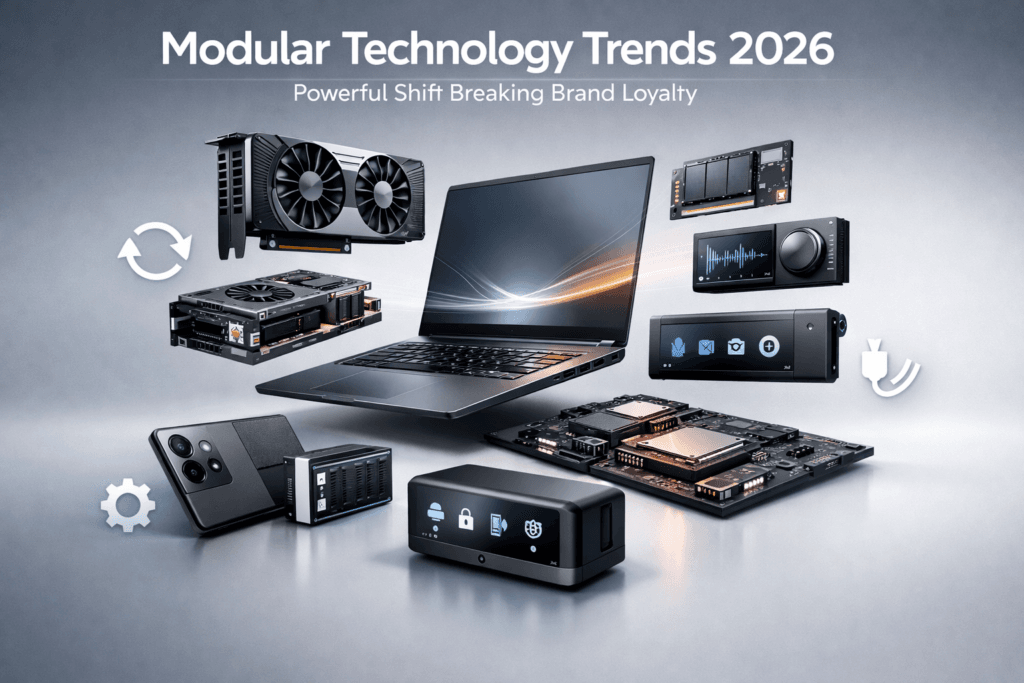
Modular Technology Trends 2026: Powerful Shift Breaking Brand Loyalty
Modular Technology Trends 2026: Powerful Shift Breaking Brand Loyalty For the first decade of the 21st century, consumers were taught to “choose

Hardware Innovation Slowdown in 2026: The Surprising Rise of Software Acceleration
Hardware Innovation Slowdown in 2026: The Surprising Rise of Software Acceleration For over a decade, consumer technology moved in visible leaps. Processors