
Cloud Gaming vs Local Hardware: Which Direction Is Gaming Headed?
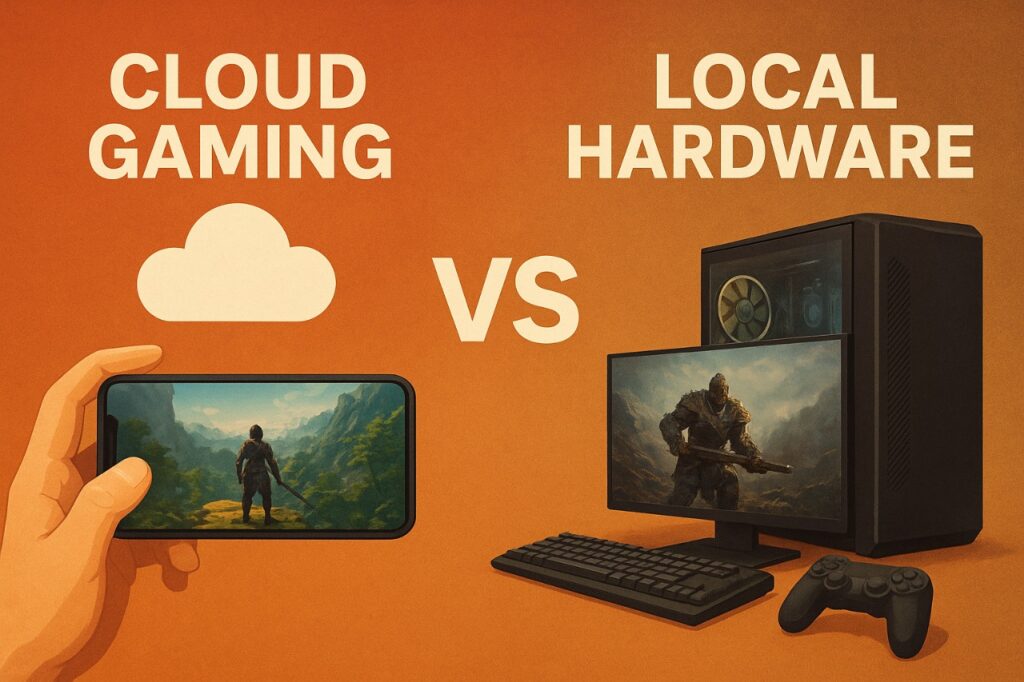
The future of gaming is rapidly evolving. As new technologies emerge, gamers face a pivotal question: should they stick with local hardware, or embrace the futuristic promise of cloud gaming?
Cloud gaming offers seamless, instant access to high-quality games without the need for expensive hardware upgrades. Meanwhile, local gaming—powered by high-performance PCs and consoles—remains the gold standard for control, immersion, and visual fidelity.
As 2025 progresses, the debate between cloud gaming vs local hardware has never been more intense. But with both sides offering compelling arguments, where is gaming really headed?
Scene-Setter
Imagine this: You’re sitting on a crowded train, and instead of a bulky gaming laptop or console, you pull out your smartphone and jump into your favorite AAA game. The graphics are sharp, the gameplay smooth, and there’s no noticeable lag. It feels like magic—after all, you’re streaming the game from a server miles away. Just a few years ago, this kind of experience seemed like a pipe dream. Today, it’s the reality thanks to cloud gaming services like Nvidia GeForce Now, Xbox Cloud Gaming, and Google Stadia. But when you get home, you notice your gaming rig powered by the latest NVIDIA RTX graphics card delivers a much more detailed, immersive experience. With stunning visuals and ultra-low latency, it’s a reminder of what local hardware can achieve.
Both forms of gaming have their strengths, but one thing is certain: the lines between the two are blurring, and the future of gaming could look radically different than it does today.
Big Reveal / Core Problem
For years, gamers have had to choose between the unmatched power of local hardware and the convenience of cloud gaming. Local hardware—whether it’s the latest PC, Xbox, or PlayStation—offers full control, optimal performance, and a deeply immersive experience. But it requires substantial investment, regular upgrades, and significant storage space. Cloud gaming, on the other hand, promises the ability to play high-quality games on almost any device, without the need for cutting-edge hardware. Yet, it’s still plagued by issues like latency, bandwidth limitations, and a smaller selection of supported titles.
The question remains: Will cloud gaming eventually overtake local hardware as the dominant form of gaming, or will the immersive, high-fidelity experience of local gaming continue to hold its ground? To answer this, we need to examine the key differences, challenges, and potential future trajectories of both technologies.
Deep-Dive Explanation
1. Misconceptions: What We Get Wrong About Cloud Gaming vs Local Hardware
Cloud gaming is often misunderstood. Many assume that because it’s streamed from the cloud, it can’t offer the same level of performance or visual fidelity as local hardware. While early cloud gaming systems had noticeable lag and lower graphics quality, services have improved dramatically. In fact, platforms like Nvidia GeForce Now and Xbox Cloud Gaming now support 4K streaming at 60 frames per second (FPS), offering visuals that rival high-end local setups.
Conversely, local hardware has its own set of misconceptions. Many gamers still believe that owning the latest GPU is a foolproof way to guarantee the best gaming experience. While local rigs provide raw power, they’re also subject to limitations such as storage space, maintenance costs, and game installation sizes. The reality is that maintaining a high-end gaming rig involves far more than just raw horsepower—it requires regular upgrades and troubleshooting.
2. Technical Reality: How Cloud Gaming and Local Hardware Actually Work
To truly understand the core differences between cloud gaming vs local hardware, we need to dive into the technical workings of both.
Cloud Gaming:
- How it works: Games are hosted on powerful servers and streamed to your device. Your device is essentially a “dumb terminal,” with little processing power needed. The game itself runs on a remote server, and only the video and audio are sent to your device.
- Key Technology: Streaming protocols (such as NVIDIA’s RTX streaming technology), data centers, and content delivery networks (CDNs) are key. Latency, or the time it takes for data to travel between the server and your device, is one of the major challenges here.
- Pros: No need for high-end hardware, instant access to games, cross-device play.
- Cons: Dependent on a fast, stable internet connection, potential latency, limited game library.
Local Hardware:
- How it works: Local gaming systems like PCs, consoles, or handhelds run games natively, processing all the data directly on the device.
- Key Technology: The performance of local hardware is largely determined by its GPU, CPU, and RAM. The higher the specs, the better the performance in terms of frame rate and graphics quality.
- Pros: Full control over performance, graphics, and settings.
- Cons: Expensive upfront costs, regular upgrades, maintenance required.
3. Industry Behavior: Why Brands Are Pushing Both Technologies
The gaming industry is split between these two technologies, but one thing is clear: both cloud gaming and local hardware are here to stay. Why?
- Cloud gaming is growing because it aligns with the rising demand for instant, flexible gaming experiences. Services like Xbox Game Pass and PlayStation Now offer players access to massive game libraries without the need for expensive hardware. Moreover, cloud gaming is viewed as a more sustainable option, with no physical devices to manufacture or ship.
- Local hardware remains dominant for those who crave the best possible experience. Brands like NVIDIA, Intel, AMD, and Sony continue to innovate in creating powerful systems that push the boundaries of what gaming can be. But they’re also adapting, incorporating cloud gaming capabilities to stay competitive. Xbox Series X and PS5 have integrated cloud gaming features to give players the flexibility to switch between streaming and local play.
The gaming industry is embracing a hybrid future, one that offers flexibility for players to choose between high-end hardware or the convenience of the cloud.
4. Future Trajectory: What’s Coming for Cloud Gaming and Local Hardware
Looking ahead, we can expect both technologies to continue evolving, but in different ways.
Cloud Gaming:
- Improved Latency: As internet infrastructure improves and 5G networks expand, latency issues will become less of a problem. The rise of edge computing will also allow games to be processed closer to the user, reducing lag.
- Hybrid Systems: Future cloud gaming platforms will likely blend local hardware and cloud capabilities. For example, you could download games for local play but switch to streaming when you’re on the go.
Local Hardware:
- More Power, Less Size: PCs and consoles will continue to shrink in size while becoming more powerful, thanks to advances in chip technology.
- Better Integration with Cloud: Local hardware will no longer be the sole option. Expect consoles like the PlayStation 6 or Xbox Series Z to integrate cloud gaming features, allowing for seamless switching between local play and cloud play.
In the next five years, both technologies will likely complement each other more than ever before.
Where Cloud Gaming and Local Hardware Fit in Everyday Life
Cloud Gaming:
- Commuters: Play on the go without carrying heavy hardware.
- Casual Gamers: Ideal for players who want access to a wide library of games without investing in powerful hardware.
Local Hardware:
- Hardcore Gamers: Perfect for those who want the best possible performance, graphics, and immersion.
- Content Creators: Powerful rigs for streaming, video editing, and game development.
Quick Snapshot Table: Use Cases for Cloud Gaming and Local Hardware
| Scenario | Ideal Tech Type | Benefit | Awareness Level |
|---|---|---|---|
| Commuting | Cloud Gaming | Play on any device, anytime | High |
| Hardcore Gaming | Local Hardware | Unmatched graphics & speed | Very High |
| Casual Gaming | Cloud Gaming | Instant access to games | Medium |
| Traveling | Cloud Gaming | No need to pack a console | High |
| Home Setup | Local Hardware | Superior graphics & control | Very High |
| Streaming/Content Creation | Local Hardware | High performance for editing | High |
Data-Backed Insight: What the Numbers Say
- According to Newzoo, cloud gaming subscriptions are expected to grow by 40% in 2025, driven by the popularity of services like Xbox Game Pass and Nvidia GeForce Now.
- NPD Group reports that despite the rise of cloud gaming, 70% of gamers still prefer to use local hardware for their primary gaming experience.
- The World Economic Forum estimates that by 2026, global internet infrastructure will enable 10-20ms latency for cloud gaming, making it competitive with local hardware in terms of responsiveness.
Human Impact: How the Gaming Landscape Affects Us
For everyday gamers, the choice between cloud gaming vs local hardware isn’t just about technical specifications—it’s about lifestyle. Cloud gaming offers accessibility, flexibility, and affordability. It means not having to upgrade your hardware every year to keep up with the latest games. On the other hand, local hardware provides the full gaming experience, one that immerses you in the world you’re playing, offering unrivaled sound, graphics, and control.
The future of gaming will require a balance between these two worlds, allowing gamers to decide what works best for them, whether it’s the freedom of the cloud or the power of local hardware.
Solution Framework / Buyer Guide: Which Gaming Setup Is Right for You?
| User Type | Recommended Setup | Key Features | Pros | Cons |
|---|---|---|---|---|
| Casual Gamer | Cloud Gaming Subscription | Instant access to games, no hardware | Affordable, flexible | Limited by internet speed |
| Hardcore Gamer | Custom PC / High-end Console | Maximum performance, high graphics | Best graphics, full control | Expensive, requires upgrades |
| Traveler | Cloud Gaming + Mobile Device | Play anywhere, no heavy gear | Lightweight, easy to transport | Relies on strong internet |
| Content Creator | High-end PC | Powerful specs for streaming and editing | Top-tier performance | Expensive, complex setup |
Counter-Perspective: Who Doesn’t Need Top-Tier Gear?
Not every gamer needs top-tier hardware or the latest cloud subscription. Casual gamers, mobile players, and those on a budget may find that budget-friendly options like Nintendo Switch, PlayStation Now, or even cloud gaming through a smartphone meet their needs. If you’re not looking for ultra-immersive graphics or performance, a simpler setup might be all you need.
Reddit / User Reality: What Are Gamers Really Saying?
| User Type | Feedback Summary | Relevance |
|---|---|---|
| Cloud Gamers | "Love playing on my phone during my commute, no lag!" | High |
| PC Gamers | "Nothing beats the power of my custom rig for ultra settings." | Very High |
| Casual Gamers | "Cloud gaming is perfect for me, I don’t need the latest GPU." | Medium |
| Commuters | "Great for long trips, but I wish the latency was lower." | Medium |
| Travelers | "Cloud gaming is a game changer for my vacations." | High |
Future Forecast: The Next Five Years
By 2026, we anticipate cloud gaming vs local hardware to evolve into a hybrid model. Expect local hardware to offer greater integration with cloud services, enabling seamless transitions between streaming and offline play. With 5G and advanced streaming protocols, cloud gaming will become a true contender for those seeking instant, flexible play, while local hardware will continue to offer unmatched performance for hardcore gamers.
Closing Narrative
The battle between cloud gaming vs local hardware is far from over. As both technologies continue to evolve, gamers will find new ways to enjoy their favorite titles, whether through the freedom of cloud gaming or the raw power of local systems. What’s clear is that the future of gaming is increasingly about choice—choice between performance, convenience, and experience. And as we move forward, one thing is certain: the gaming landscape of 2025 and beyond will be more diverse and accessible than ever before.
Vibetric Ending
At Vibetric, we’re dedicated to exploring the innovations that shape the world of gaming. Whether you’re a cloud gamer or a local hardware enthusiast, we’re here to break down the trends, choices, and technologies that define tomorrow’s gaming experiences. Stay tuned for the latest insights and in-depth analyses.
Wondering How Cloud Gaming Works? Here’s What You Need to Know
- Follow vibetric_official on Instagram for cutting-edge updates and reviews on the latest gaming tech.
- Bookmark Vibetric.com for expert breakdowns of the best gaming systems and trends.
- Stay connected with Vibetric as we dive deep into the future of gaming and the technologies that will define it.
Cloud Gaming vs Local Hardware — Frequently Asked Questions
- What’s the difference between cloud gaming and local hardware?
Cloud gaming streams games from the internet, while local hardware processes the games directly on your device. - Is cloud gaming the future of gaming?
It’s certainly a big part of the future, offering flexibility and accessibility, but local hardware will likely remain relevant for high-performance gamers. - Do I need a powerful PC to game?
No, with cloud gaming, you can game on low-end devices as long as you have a stable internet connection. - Can I play AAA games on my phone with cloud gaming?
Yes, services like Xbox Cloud Gaming and Nvidia GeForce Now allow you to stream AAA games on smartphones. - Is cloud gaming laggy?
Latency can be an issue, but advances in internet speeds and cloud technology are rapidly improving the experience. - Is local hardware more immersive than cloud gaming?
Yes, local hardware offers superior performance, graphics, and customization options, making it ideal for serious gamers. - What are the benefits of cloud gaming?
Convenience, accessibility, no need for expensive hardware upgrades, and instant play on multiple devices. - Can I play without an internet connection with cloud gaming?
No, cloud gaming requires a constant internet connection to stream the games. - Will cloud gaming replace consoles in the future?
Not entirely, but it could become a mainstream alternative, particularly for casual gamers and mobile players. - Are there any drawbacks to cloud gaming?
Yes, cloud gaming requires a fast, stable internet connection, and performance can vary depending on your location and the servers you connect to.
What’s your take on this?
At Vibetric, the comments go way beyond quick reactions — they’re where creators, innovators, and curious minds spark conversations that push tech’s future forward.
Next-Gen Smartphones Feel Dramatically Better in 2026 — Even If They Look the Same
Next-Gen Smartphones Feel Dramatically Better in 2026 — Even If They Look the Same The industrial design hasn’t changed much. The camera
OnePlus 15 Review 2026: Intelligent Performance in the AI Era
OnePlus 15 Review 2026: Intelligent Performance in the AI Era Performance used to be theatrical. Manufacturers showcased peak clock speeds, explosive benchmark