
Why Camera Islands Keep Getting Bigger Every Year
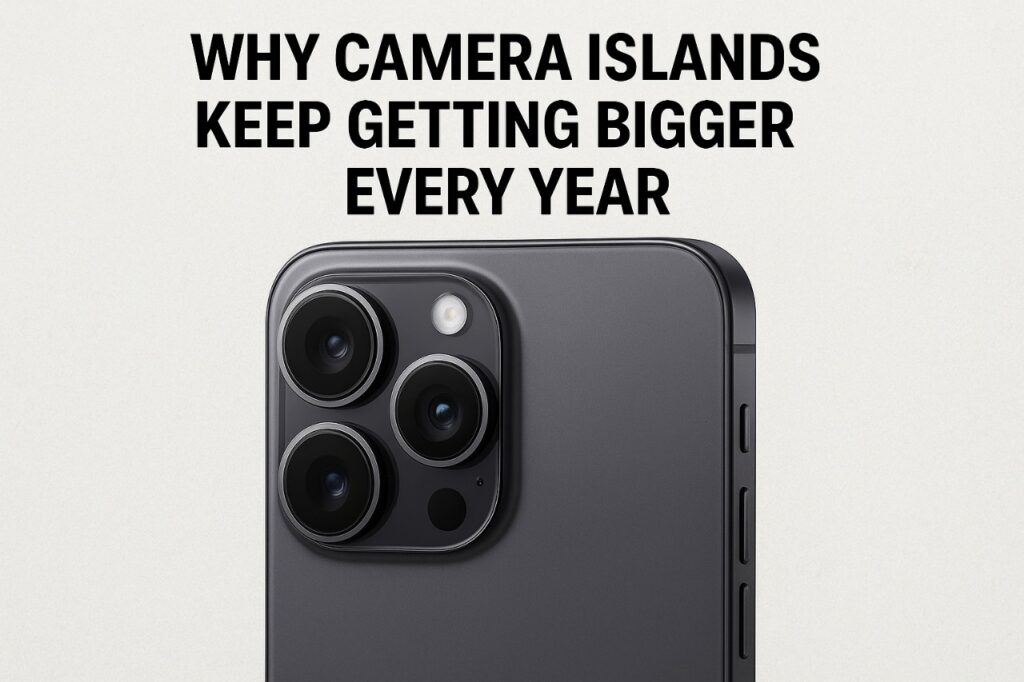
Smartphone design has always been a balance between elegance and function. But in 2025, something conspicuous dominates almost every device: ever-growing camera islands. They protrude, demand attention, and often define the phone’s silhouette.
Why are camera islands getting bigger every year? It’s more than marketing theatrics. The shift signals deeper changes in imaging technology, computational photography, and consumer expectations. In this short read, you’ll learn why this trend isn’t random, what it means for your pocket, and how brands are shaping perception with design.
⚙️ Core Insight (Depth + Clarity)
The expansion of camera islands is a response to three converging forces: hardware evolution, software demand, and aesthetic signaling.
First, sensors have grown in size to capture more light and improve low-light performance. Multi-lens setups require room for ultra-wide, telephoto, macro, and depth sensors—all stacked together. A thin strip simply cannot accommodate this complexity anymore.
Second, computational photography pushes the hardware further. AI-driven HDR, night modes, real-time bokeh, and multi-frame stacking require precise optical arrangements. Engineers design bigger camera islands to house optical image stabilization units, periscope lenses, and micro-LiDAR sensors, while maintaining thermal stability.
Third, there’s psychology at play. A prominent camera island signals capability. Consumers associate size with superiority—even if software delivers most of the improvement. The result: bigger islands make phones look “professional” and technologically advanced, influencing purchase decisions subtly but powerfully.
📊Bite-Sized Data Table
| Factor (2025) | Real Impact | Why It Expands Camera Island |
|---|---|---|
| Multi-lens Setups | High | Room for ultra-wide + telephoto + macro |
| Sensor Size | High | Larger pixels = better low-light shots |
| Optical Stabilization | Medium | Requires depth inside housing |
| Periscope Lens | Medium | Extra space for folded optics |
| AI Processing Modules | Medium | Physical arrangement affects software efficiency |
| Marketing Psychology | High | Bigger island signals “premium” |
🔍 Micro Analysis
A: The Real-World Impact
- Bigger camera islands often mean more protrusion on the back — affecting pocket fit and case compatibility.
- Multi-sensor setups deliver better zoom, low-light performance, and portrait photography.
- Devices with larger islands usually carry extra weight, but also improved thermal management for sustained camera usage.
- Users notice sharper details and richer dynamic range — but rarely see the complex engineering behind it.
- Cases and accessories now prioritize protection over aesthetics due to camera island prominence.
B: The Hidden Truth
- Brands exaggerate the visual impact of camera islands for perceived prestige.
- Not all improvements are hardware-based; software does most of the heavy lifting.
- Thermal constraints dictate size: stacking sensors too tightly risks overheating during prolonged use.
- A bigger island simplifies manufacturing tolerances for multi-lens alignment.
In reality, camera islands are both engineering necessity and marketing canvas — a compromise between optics, AI, and consumer perception.
🌍 Culture Angle
Camera islands reflect cultural obsession with photography. Social media, vlogging, and content creation have pushed users to prioritize imaging capability over sleekness. Phones with larger islands often dominate online discussions, unboxing videos, and product showcases. The modern consumer now equates bigger, more visible camera hardware with status, capability, and creativity. Subtlety has become secondary to perceived power.
🧠 Quick Vibetric Takeaway
- Camera islands grow because multi-lens setups require space.
- Bigger sensors and OIS modules drive vertical expansion.
- AI and computational photography dictate precise optical arrangements.
- Marketing psychology rewards prominent camera features.
- Cases, ergonomics, and thermal design all influence island size.
- Visual prominence has become a consumer expectation.
- Bigger isn’t just functional — it’s aspirational.
💬 Vibetric Verdict
Vibetric Verdict: Camera islands are the quiet heroes of modern smartphone photography. They carry the weight of hardware, software, and consumer perception in one bold silhouette. They aren’t just design quirks — they’re engineering compromises, aesthetic statements, and marketing tools rolled into a single protrusion.
The bigger the island, the more it promises. And as cameras continue to evolve, the island will keep expanding, quietly reshaping the way we think about the back of our phones.
🔗 Stay in the Loop
We don’t sell hype — we explain it.
- Follow @vibetric_official for grounded insights on smartphone trends, real-world testing, and clear-cut analysis.
- Bookmark vibetric.com to stay ahead of the tech curve.
- No hype. No bias. Just facts — the Vibetric way.
💬 What’s your take on this?
The comment section at Vibetric isn’t just for reactions — it’s where creators, thinkers, and curious minds exchange ideas that shape how we see tech’s future.

Sennheiser Momentum 5 Review (2026): Acoustic Engineering Meets Adaptive AI
Sennheiser Momentum 5 Review (2026): Acoustic Engineering Meets Adaptive AI Noise-canceling headphones have reached a point of saturation. Every flagship promises deeper

The Powerful Shift to NPU Computing in (2026): Why CPUs Are No Longer Enough
The Powerful Shift to NPU Computing in (2026): Why CPUs Are No Longer Enough For four decades, the CPU was the definitive