
The Truth About Budget Gaming Keyboards — Are They Worth It?
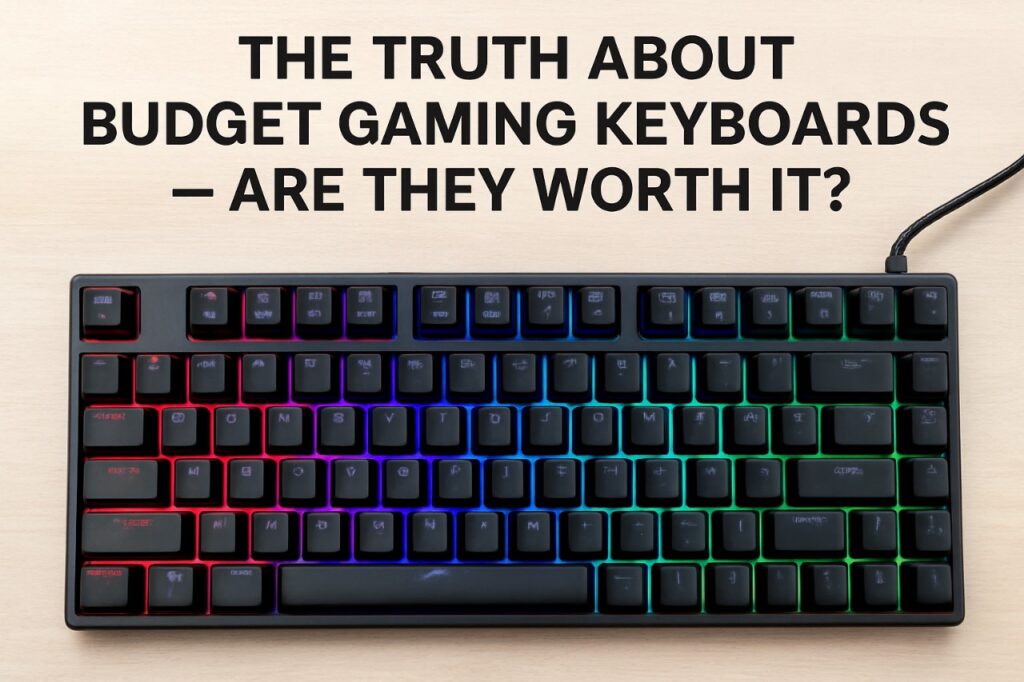
Every gamer dreams of that satisfying click — the kind that feels fast, responsive, and just right.
But not everyone wants to spend ₹10,000+ for it, especially when gaming setups already demand money for GPUs, monitors, and accessories.
That’s where budget gaming keyboards flood the market — promising “mechanical precision” and “RGB speed boost” for a fraction of the cost.
The question is simple but important — are they actually worth the money, or are you just paying for colored lights, aggressive branding, and the illusion of performance?
⚙️ Core Insight
Over the last few years, budget gaming keyboards have improved dramatically — but they still walk a fine line between performance and compromise.
Most under-₹3,000 models use mem-chanical switches — a hybrid of membrane and mechanical designs. They look mechanical and sound clicky, but they lack the true tactile feel, internal structure, and long-term durability of real switches like Cherry MX, Kailh, or Gateron.
So while they mimic the experience, the feedback, precision, and response time aren’t quite the same.
Manufacturers often market these keyboards with flashy RGB, macro keys, and “anti-ghosting,” but under the hood, the materials tell a different story — thinner plastic frames, less stable key stabilizers, and shorter switch lifespan (around 5 million presses vs. 50 million on premium boards).
This difference becomes very clear to gamers who type heavily or play fast-paced titles like Valorant or Apex Legends where every millisecond and keystroke matters.
Reddit users describe them perfectly:
“Budget gaming keyboards are like fast food — quick, flashy, but you know what you’re getting.”
That doesn’t make them bad — it simply means expectations need to match the price tag and the purpose you’re buying them for.
🎮 The Real Gains and Limits
Not all budget gaming keyboards are gimmicks — in fact, some stand out.
Brands like Redragon, Cosmic Byte, and Royal Kludge now deliver solid entry-level mechanical options with hot-swappable switches, aluminium top plates, and surprisingly decent software customization.
For casual or mid-level players, these keyboards provide 90% of the experience for about 40% of the cost, which is a huge win for budget-conscious users.
But the limitations still matter. Budget switches often feel uneven across keys, with some feeling crisp and others mushy. Stabilizers on larger keys like the spacebar, enter key, and shift keys can start rattling over time.
Durability is another trade-off — cheaper PCBs, solder points, and internal components mean higher failure rates after long-term use, especially under heavy gaming sessions or accidental spills.
🧠 What to Look For in 2025
If you’re shopping for budget gaming keyboards, focus on these essentials:
- Switch type: Look for Outemu or TTC mechanical switches — they’re reliable and affordable.
- Build: Aluminium top plates last longer than plastic.
- Customization: Software control or onboard memory for macros is a plus.
- Cable quality: Detachable or braided cables improve longevity.
- RGB lighting: Fun, but not performance-critical — don’t overpay for lights.
The right budget keyboard won’t make you a pro gamer, but it will improve comfort, accuracy, and immersion — all without breaking your wallet.
💬 Vibetric Verdict
Vibetric Verdict: Budget gaming keyboards have come a long way.
They won’t replace top-tier gear, but for most gamers, they deliver more than enough — if you choose wisely.
In 2025, it’s not about buying the most expensive keyboard — it’s about finding the one that feels right under your fingers and matches how you play.
🔗 Stay in the Loop
We don’t sell hype — we explain it.
- Follow @vibetric_official for honest reviews, performance insights, and grounded comparisons that skip the marketing noise.
- Bookmark vibetric.com to stay ahead of the tech curve.
- No hype. No bias. Just facts — the Vibetric way.
💬 What’s your take on this?
The comment section at Vibetric isn’t just for reactions — it’s where creators, thinkers, and curious minds exchange ideas that shape how we see tech’s future.
Minimalist Tech Design Trends 2026 — Why Clean, Powerful Devices Are Winning
Minimalist Tech Design Trends 2026 — Why Clean, Powerful Devices Are Winning For years, consumer technology competed on excess — more cameras,

AI Laptops in 2026: The Intelligent Shift Toward True Workstations
AI Laptops in 2026: The Intelligent Shift Toward True Workstations For years, laptops competed on portability versus power. Thin and light for