
Bluetooth LE Audio Earbuds 2026 — Why This Upgrade Finally Matters
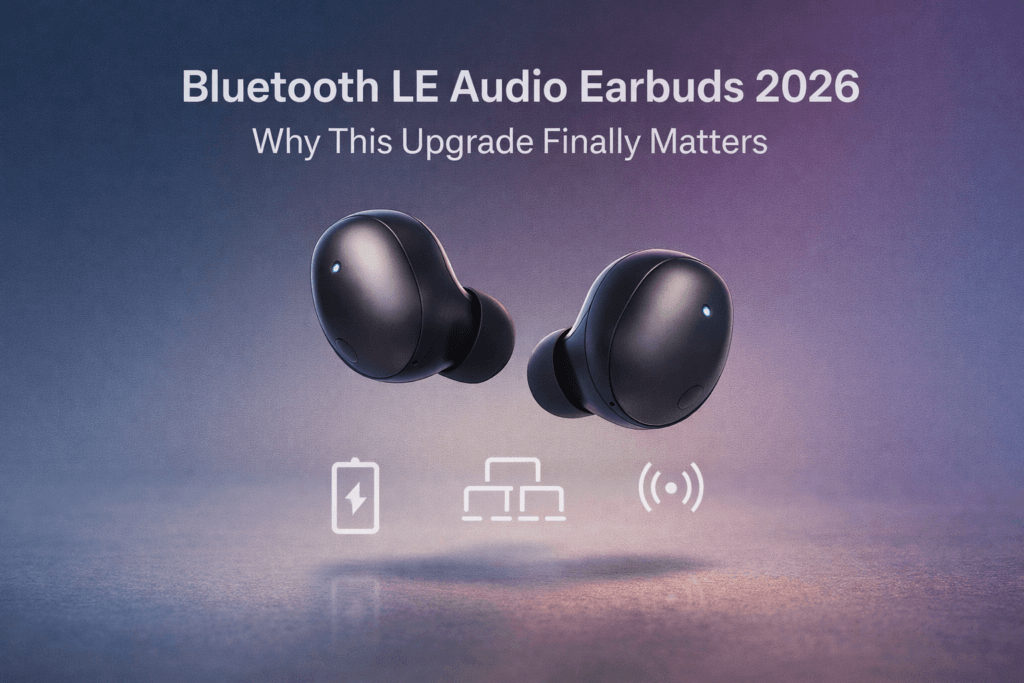
Wireless earbuds have evolved rapidly in design, battery efficiency, and acoustic tuning, yet for years the underlying transmission framework remained largely unchanged. That limitation quietly constrained how much real improvement users could actually experience. In 2026, the shift toward Bluetooth LE Audio earbuds 2026 marks a deeper transformation—not simply another codec upgrade, but a redesigned wireless audio architecture built around efficiency, multi-device behavior, and modern listening habits.
A Standard Built for Modern Listening Patterns
Traditional Bluetooth audio was developed when wireless listening meant occasional music playback rather than continuous daily usage. Today’s earbuds handle calls, gaming chat, streaming, navigation prompts, and cross-device switching throughout the day. Bluetooth LE Audio was engineered specifically for this always-connected environment, focusing on lower power consumption and greater connection stability.
At the center of the system is the LC3 (Low Complexity Communication Codec), which maintains high perceived audio quality while transmitting at lower bitrates than many legacy codecs. Instead of pushing more data, LC3 improves how audio is encoded according to human hearing sensitivity, allowing Bluetooth LE Audio earbuds 2026 to deliver clearer sound using less transmission power. This efficiency directly contributes to longer battery endurance and more reliable performance in crowded wireless spaces such as offices, airports, and public transport environments.
What Actually Changes Compared to Older Bluetooth Audio
The benefits of LE Audio become clearer when compared to the previous wireless audio framework.
| Feature | Traditional Bluetooth Audio | Bluetooth LE Audio |
|---|---|---|
| Primary codec approach | Higher bitrate legacy codecs | LC3 efficiency-focused codec |
| Power consumption | Moderate to high | Significantly lower |
| Earbud connection method | Relay between earbuds common | Independent synchronized streams |
| Multi-device flexibility | Limited seamless switching | Designed for multi-stream usage |
| Connection reliability in crowded areas | More dropouts possible | Improved signal resilience |
This structural upgrade explains why Bluetooth LE Audio earbuds 2026 are less about dramatic tonal differences and more about consistency—fewer dropouts, smoother switching, and more stable synchronization between left and right earbuds.
The Consumer Impact: Stability Over Spectacle
Many listeners expect each new audio generation to deliver noticeably louder output or dramatically different sound signatures. In practice, the biggest improvements from Bluetooth LE Audio earbuds 2026 will be experiential rather than immediately dramatic. Calls remain stable when moving between rooms, video playback maintains better lip-sync accuracy, and device switching happens with less interruption.
Because the transmission layer requires less power, manufacturers can allocate saved energy toward advanced features such as adaptive spatial audio processing, real-time environmental awareness systems, or extended battery runtime without increasing earbud size. Over time, this efficiency advantage will shape product design more strongly than any single acoustic hardware upgrade.
Multi-Stream Audio Quietly Redefines Wireless Flexibility
One of the most significant engineering shifts in LE Audio is multi-stream transmission. Earlier wireless earbuds often used a relay architecture where one earbud received the signal and forwarded it to the second unit. This introduced additional latency and increased the likelihood of synchronization issues. With multi-stream capability, both earbuds can receive independent synchronized audio feeds directly from the source device.
This architecture improves redundancy, lowers latency, and enhances reliability in environments with fluctuating signal strength. For users, the benefit appears simple: fewer connection glitches and smoother real-time audio performance, particularly noticeable during gaming, streaming, or live communication sessions.
Myth vs Reality: Higher Bitrate Is Not the Only Path to Better Sound
A persistent myth in wireless audio discussions suggests that better sound quality always requires higher transmission bitrates. Modern codec engineering shows that intelligent psychoacoustic compression can outperform higher-bitrate legacy approaches by prioritizing the audio information most perceptible to the human ear. LC3 demonstrates this principle effectively, delivering strong perceived fidelity while operating at lower data rates.
This efficiency means Bluetooth LE Audio earbuds 2026 are not trying to transmit more data—they are transmitting more meaningful data. The result is improved clarity in real-world wireless conditions where interference or signal fluctuations previously caused noticeable degradation.
Industry-Level Implications Beyond Earbuds
The transition to LE Audio also enables broader ecosystem capabilities, including broadcast-style audio distribution where a single transmitter can send synchronized audio streams to multiple receivers. This opens possibilities for shared listening environments such as public venues, transportation hubs, and educational spaces where users can connect directly to localized audio feeds without individual pairing procedures.
As smartphones, laptops, wearables, and entertainment systems adopt the same standard, cross-device audio movement becomes smoother and more predictable. Over the next few years, the benefits of Bluetooth LE Audio earbuds 2026 will become increasingly noticeable as more devices support the same transmission framework.
A Quiet Infrastructure Upgrade That Will Define the Next Decade
Major hardware breakthroughs often capture attention through visible design changes, yet infrastructure upgrades frequently have a deeper long-term impact. Bluetooth LE Audio represents a foundational shift that modernizes wireless listening for the multi-device era. Lower power requirements, improved connection resilience, and multi-stream flexibility collectively remove many of the long-standing constraints that shaped earlier earbud designs. As adoption expands, users may not notice a single dramatic moment of transformation, but the cumulative effect—longer battery life, fewer interruptions, and smoother device integration—will redefine everyday wireless audio expectations.
Stay Connected with Vibetric
- Follow our Instagram @vibetric_official for forward-looking wireless audio insights.
- Bookmark vibetric.com to track next-generation connectivity standards.
- Stay tuned for deeper analysis on technologies reshaping personal audio in 2026.
What’s your take on this?
At Vibetric, the comments go way beyond quick reactions — they’re where creators, innovators, and curious minds spark conversations that push tech’s future forward.
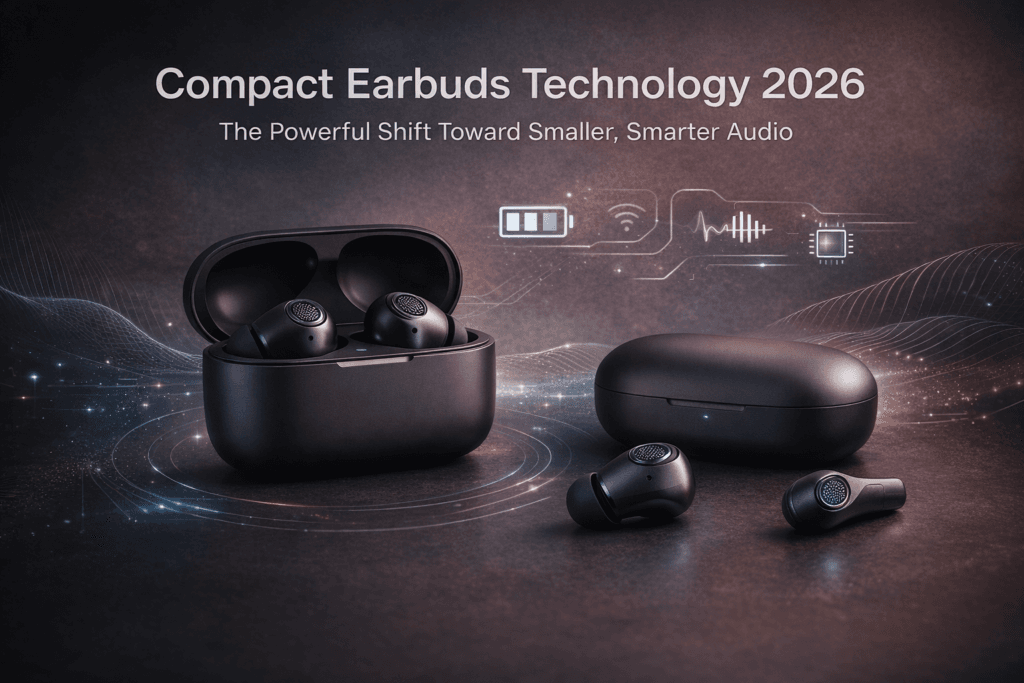
Compact Earbuds Technology 2026 — The Powerful Shift Toward Smaller, Smarter Audio
Compact Earbuds Technology 2026 — The Powerful Shift Toward Smaller, Smarter Audio Minimalism in audio design used to mean compromise. Smaller shells
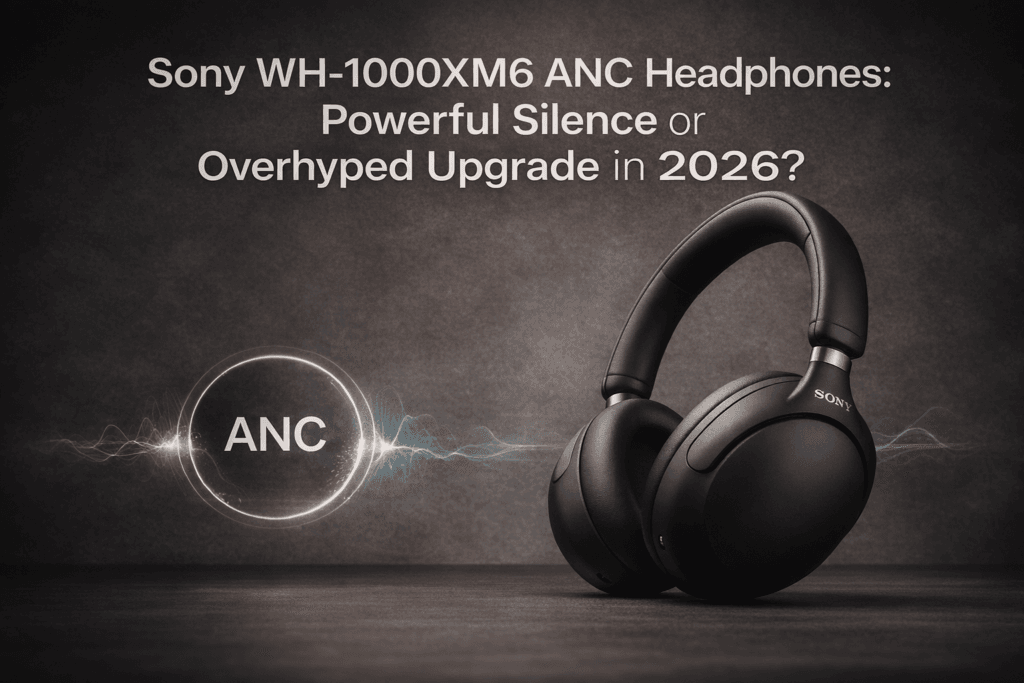
Sony WH-1000XM6 ANC Headphones: Powerful Silence or Overhyped Upgrade in 2026?
Sony WH-1000XM6 ANC Headphones: Powerful Silence or Overhyped Upgrade in 2026? For years, noise-canceling headphones have chased the same promise: silence on