
Bluetooth LE Audio Benefits: The Quiet Advantage Beyond Sound Quality
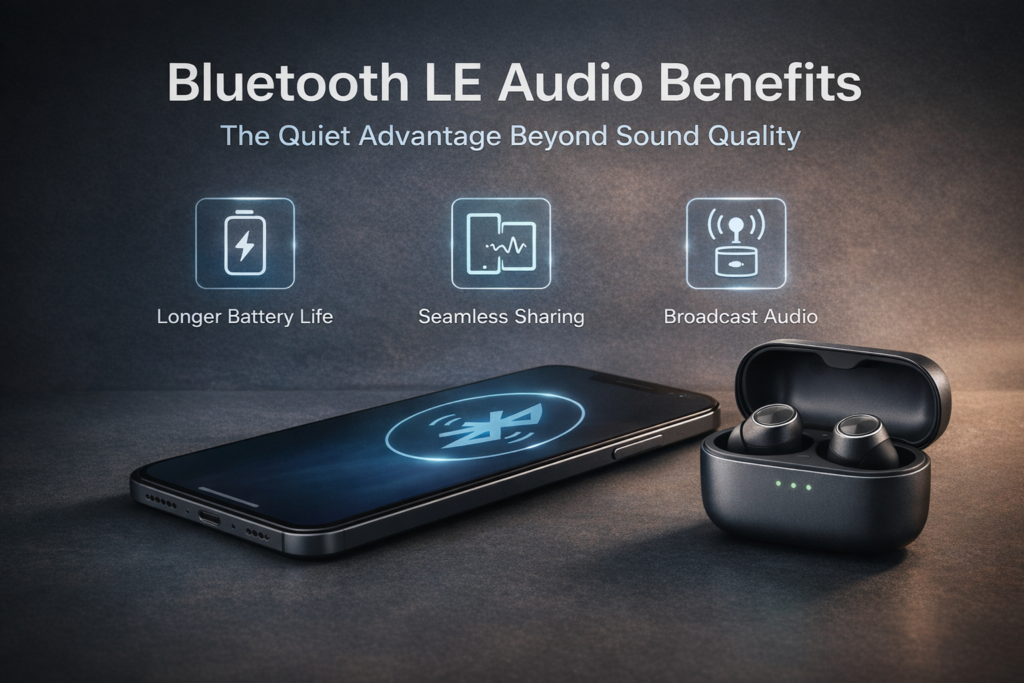
Most people stopped complaining about Bluetooth sound years ago. Music is clear. Calls are usable. Noise cancellation works. And yet, wireless audio still feels oddly fragile. Batteries die too fast. Sharing audio is clumsy. Public spaces rely on speakers that nobody really wants. Bluetooth LE Audio devices exist because those small annoyances never went away—they just stopped being discussed. The next upgrade cycle isn’t about impressing your ears. It’s about removing the moments that quietly break immersion.
The Subtle Stress of Wireless Audio You’ve Learned to Ignore
You probably don’t notice how often you manage your audio. Checking battery percentages. Re-pairing after switching devices. Giving up on sharing a video because sync is off. These are micro-frictions—tiny interruptions that add cognitive load.
Bluetooth LE Audio benefits target this layer, not the emotional thrill of sound quality. The goal isn’t to wow you. It’s to make audio behave like electricity: always available, predictable, and invisible.
Why the Industry Stopped Optimizing for “Better Sound”
Here’s the uncomfortable truth: classic Bluetooth audio already crossed the threshold of “acceptable” for most listeners. Incremental sound improvements stopped driving mass upgrades. What did keep breaking expectations was behavior—battery life, reliability, and scale.
Bluetooth LE Audio devices represent a strategic pivot. Instead of pushing more data faster, the system was redesigned to ask a different question:
How little energy and coordination does audio actually need to feel seamless?
That reframing is where nearly all Bluetooth LE Audio benefits originate.
The Engineering Reality That Changes Everything
At a technical level, LE Audio reclassifies sound from a continuous stream into a scheduled, low-energy service. This sounds abstract until you look at what it enables.
| System Shift | Downstream Effect |
|---|---|
| LC3 codec efficiency | Lower bitrates without perceived degradation |
| Isochronous channels | Multiple receivers stay time-aligned |
| LE power model | Reduced radio wake time |
| Broadcast architecture | One source, many listeners |
| “New setup feels worse” | Temporary disruption of motor adaptation |
None of these exist to impress audiophiles. They exist to make audio scalable.
Broadcast Audio: The Feature That Finally Makes Public Sound Personal
If Bluetooth LE Audio devices end up remembered for one capability, it won’t be codec charts—it will be Broadcast Audio.
Instead of pairing one-to-one, a single source transmits to unlimited listeners. No authentication loop. No device juggling.
This quietly solves problems that never had elegant answers:
- Airport announcements without echo chambers
- Museums ditching rented headsets
- Gyms eliminating wall-mounted speakers
- Cinemas offering personal mixes or accessibility tracks
These are not edge cases. They’re environments where sound has always been compromised. Bluetooth LE Audio benefits shift control back to the listener.
Battery Life Isn’t the Headline—Design Freedom Is
Yes, LE Audio uses less power. But the deeper consequence is optionality.
Manufacturers can now choose:
- Smaller earbuds with unchanged endurance
- Similar designs with meaningfully longer runtime
- Additional sensors without killing battery life
This flexibility matters because it compounds. Over product generations, Bluetooth LE Audio devices can evolve in form factor—not just specs. That’s a rare advantage in a mature category.
Myth vs. Reality: Where Expectations Go Wrong
| Perception | What Actually Improves |
|---|---|
| “It’s a sound upgrade” | It’s a systems upgrade |
| “Only premium gear benefits” | Budget devices gain the most |
| “Latency disappears” | Timing becomes predictable |
| “Classic Bluetooth is dead” | Dual-mode will dominate |
Understanding this gap explains why early reactions feel muted. Bluetooth LE Audio benefits reveal themselves through consistency, not spectacle.
Real-World Use Feels Boring—and That’s a Compliment
In practice, LE Audio doesn’t announce itself. It fades into routine.
- Commuting: earbuds last days longer with mixed calls and music
- Remote work: fewer reconnects when hopping between devices
- Shared spaces: two people listen without awkward workarounds
- Accessibility: hearing aids receive direct, energy-efficient streams
None of this photographs well. All of it improves daily experience.
What the Data Suggests Without Flashy Numbers
There’s no need for synthetic benchmarks to justify Bluetooth LE Audio benefits. The engineering logic is enough.
Lower energy consumption extends device lifespan. Predictable timing enables multi-user scenarios. Broadcast audio reduces infrastructure overhead in public spaces. These are structural advantages, not marketing claims.
Technologies that reduce waste—energy, time, attention—tend to win slowly and decisively.
The Human Impact: Less Management, Fewer Decisions
Every avoided pairing prompt is a small relief. Every day without battery anxiety is a quiet win. Over time, Bluetooth LE Audio devices reduce the need to think about audio.
That matters more than it sounds. Cognitive load accumulates. Removing it changes how people relate to their devices—not emotionally, but habitually.
Who Actually Gains the Most from LE Audio Right Now
| User Profile | Why It Matters |
|---|---|
| Everyday listeners | Fewer failures, longer battery life |
| Professionals | Stable multi-device workflows |
| Gamers | Consistent sync across sessions |
| Accessibility users | Native, efficient audio paths |
| Long-term buyers | Platform longevity |
If your current setup feels frictionless, urgency is low. If it doesn’t, Bluetooth LE Audio benefits feel immediate.
When the Advice Doesn’t Apply
LE Audio isn’t universal salvation. Wired audio still wins for critical listening. Older devices won’t gain support magically. Some platforms lag in enabling Broadcast Audio features.
And if sound quality alone motivates upgrades, LE Audio may feel underwhelming. It’s solving a different category of problem.
What Early Users Actually Notice
Across user discussions, the feedback is consistent—and understated.
| Pattern | Common Reaction |
|---|---|
| Fewer dropouts | “More stable overall” |
| Battery endurance | “Charging less often” |
| Audio sharing | “Finally usable” |
| Transition experience | “Nothing dramatic” |
| Compatibility gaps | “Depends on firmware” |
| Rollout pace | “Feels gradual” |
That tone—quiet approval—is typical of infrastructural improvements.
The Trajectory From Here
Bluetooth LE Audio devices won’t flip a switch overnight. Adoption will layer in. Dual-mode support will persist. But directionally, classic Bluetooth audio becomes the fallback.
As public spaces, accessibility tech, and multi-user environments adopt Broadcast Audio, Bluetooth LE Audio benefits expand beyond personal gadgets into shared infrastructure.
Closing the Loop: The Best Upgrade Is the One You Stop Managing
You check your earbuds less. You troubleshoot less. You think about sound less. That’s the real promise here. Bluetooth LE Audio devices aren’t trying to impress you—they’re trying to disappear. And in consumer technology, that’s usually the clearest signal that something important just changed.
Vibetric Ending
When technology stops demanding attention, it finally earns trust.
Wondering How Bluetooth LE Audio Works Beneath the Surface?
- Follow vibetric_official on Instagram to keep up with the latest insights into wireless audio and device ecosystems.
- Bookmark Vibetric.com we continuously update our analysis as Bluetooth LE Audio devices evolve.
Subscribe for ongoing, in-depth breakdowns and expert perspectives on next-generation connectivity.
The Questions People Ask Once the Hype Wears Off
They’re noticeable in behavior rather than spectacle. Most users report fewer dropouts, more predictable connections, and longer battery life before they ever think about sound quality changes.
Not necessarily. In many cases, sound quality feels similar to classic Bluetooth. The real improvement is that comparable quality is delivered using less data and power, which enables other system-level gains.
Only if the hardware already supports Bluetooth LE Audio at the radio level. Software updates alone can’t add LE Audio capability to unsupported chipsets.
In most real-world use, yes. Efficiency gains reduce radio usage, which adds up during long listening sessions, frequent calls, or mixed-use scenarios throughout the day.
Broadcast Audio is designed to minimize friction. In many implementations, users simply tune in rather than pair, though the exact experience depends on how platforms and venues deploy it.
LE Audio improves timing predictability, which helps reduce inconsistencies. However, ultra-low latency still depends on system optimization, codecs, and platform support.
No. Dual-mode support is expected to remain standard for years to ensure compatibility with older devices while LE Audio adoption gradually expands.
They’re a major beneficiary because LE Audio enables direct, efficient streaming. But the standard is equally relevant to earbuds, headphones, public venues, and shared audio use cases.
Yes, as long as devices follow the standard correctly. In practice, rollout speed and feature availability still vary by manufacturer and platform.
If sound quality alone drives your decisions, the upgrade may feel subtle. If battery life, stability, sharing, or future-proofing matter, Bluetooth LE Audio benefits become much more compelling.
What’s your take on this?
At Vibetric, the comments go way beyond quick reactions — they’re where creators, innovators, and curious minds spark conversations that push tech’s future forward.
Sennheiser Momentum 5 Review (2026): Acoustic Engineering Meets Adaptive AI
Sennheiser Momentum 5 Review (2026): Acoustic Engineering Meets Adaptive AI Noise-canceling headphones have reached a point of saturation. Every flagship promises deeper
AI Battery Optimization Is Finally Making Earbud Battery Life Reliable in 2026
AI Battery Optimization Is Revolutionizing Earbud Battery Life in 2026 The spec sheet still says ‘30 hours.’ What it doesn’t say is