
Bluetooth Codecs Explained — Which One Should You Care About?
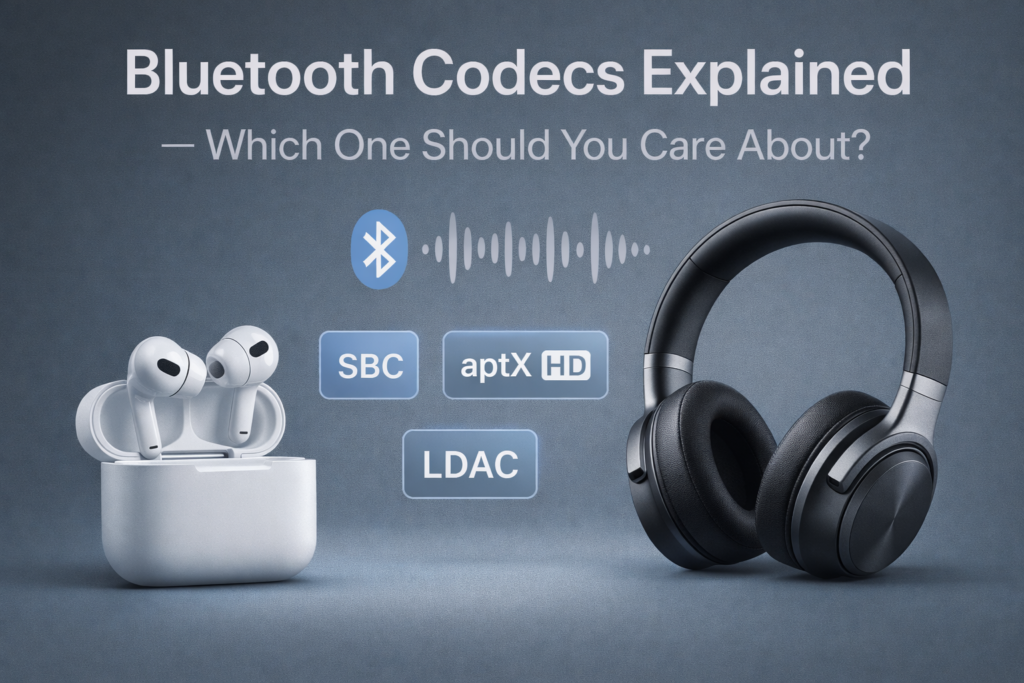
Wireless audio has become the default for headphones, earbuds, and speakers, but the quality of sound over Bluetooth isn’t just about the device—it’s about the codec. Bluetooth audio codecs are the translators between your source device and the headphone driver. They dictate how audio is compressed, transmitted, and reconstructed. Choosing the right codec can make the difference between tinny, flat sound and a rich, immersive experience.
The Technical Breakdown
At its core, a Bluetooth codec compresses audio for transmission and then decompresses it on the receiving device. The trade-off is always between fidelity and latency. Standard SBC (Subband Coding) is mandatory on all devices, but it’s often the weakest link, offering decent compatibility at the expense of efficiency and detail.
Higher-end codecs include:
- AAC: Popular in Apple devices, balances quality and battery efficiency. Performs well for streaming but can struggle with low-latency tasks.
- aptX / aptX HD / aptX Adaptive: Qualcomm’s suite provides better compression, higher bitrates, and lower latency. AptX Adaptive, in particular, adjusts dynamically for content and environment.
- LDAC: Sony’s high-resolution codec, capable of up to 990 kbps, prioritizes audio fidelity, making it ideal for hi-res streaming but may consume more power.
The key takeaway: the codec impacts not just quality, but also lag, battery life, and compatibility.
Latency and Gaming or Video Use
For casual music listening, codec choice often influences fidelity more than speed. But for gaming or video, latency becomes critical. Even a minor delay between audio and visuals can break immersion.
- SBC and AAC may introduce slight delays, noticeable in competitive gaming.
- aptX Low Latency and LDAC (in its lowest-latency mode) can reduce this lag, although the receiving device must support the same codec.
For creators or gamers, choosing a codec that minimizes latency is often more valuable than chasing the highest bitrate.
Compatibility Considerations
Bluetooth audio codecs aren’t universal. Apple devices favor AAC, while Android devices typically support aptX variants and LDAC. Selecting headphones with multiple codec support ensures cross-device compatibility. Without a matching codec on both the source and the headphones, the system defaults to SBC, which can severely limit both audio quality and performance.
Consumer Behavior and Perceived Quality
Many listeners believe higher bitrates automatically mean better sound. In reality, perception also depends on headphone quality, environment, and music production. A high-bitrate LDAC stream over inexpensive earbuds may sound worse than a mid-bitrate AAC stream through a well-tuned set of over-ear headphones. Bluetooth audio codecs are only one piece of the equation; the driver, fit, and acoustics remain crucial.
A Contrarian Angle: Less Can Be More
Some audiophiles argue that chasing the “best” codec is often overkill. The audible difference between AAC, aptX HD, and LDAC is subtle for most listeners, particularly in everyday environments. Comfort, driver quality, and ANC performance can impact the listening experience far more than codec choice. In other words, codec hype should be contextualized rather than taken at face value.
Closing Insight
Bluetooth audio codecs define the technical ceiling of wireless sound, but real-world experience depends on a combination of device support, headphones, and listening environment. The right codec enhances fidelity, reduces latency, and ensures efficient transmission, yet it doesn’t replace strong drivers or ergonomic design. Understanding codecs allows listeners to make informed choices without falling for marketing exaggeration.
Keep Listening with Vibetric
- Follow our Instagram @vibetric_official for clear, engineer-level audio explanations.
- Bookmark vibetric.com to compare headphones and codec performance in real scenarios.
- Stay updated on reviews that go beyond specs to assess actual listening experience.
What’s your take on this?
At Vibetric, the comments go way beyond quick reactions — they’re where creators, innovators, and curious minds spark conversations that push tech’s future forward.
AI Audio Tuning in 2026: The Intelligent Shift Redefining Sound
AI Audio Tuning in 2026: The Intelligent Shift Redefining Sound The next major leap in audio isn’t louder drivers or wider frequency
Ray Tracing in 2026: The Powerful Shift From Experimental to Standard Graphics
Ray Tracing in 2026: The Powerful Shift From Experimental to Standard Graphics The technology spent years as a benchmark showcase. Now it’s