The Truth About Battery Ratings — What They Don’t Tell You
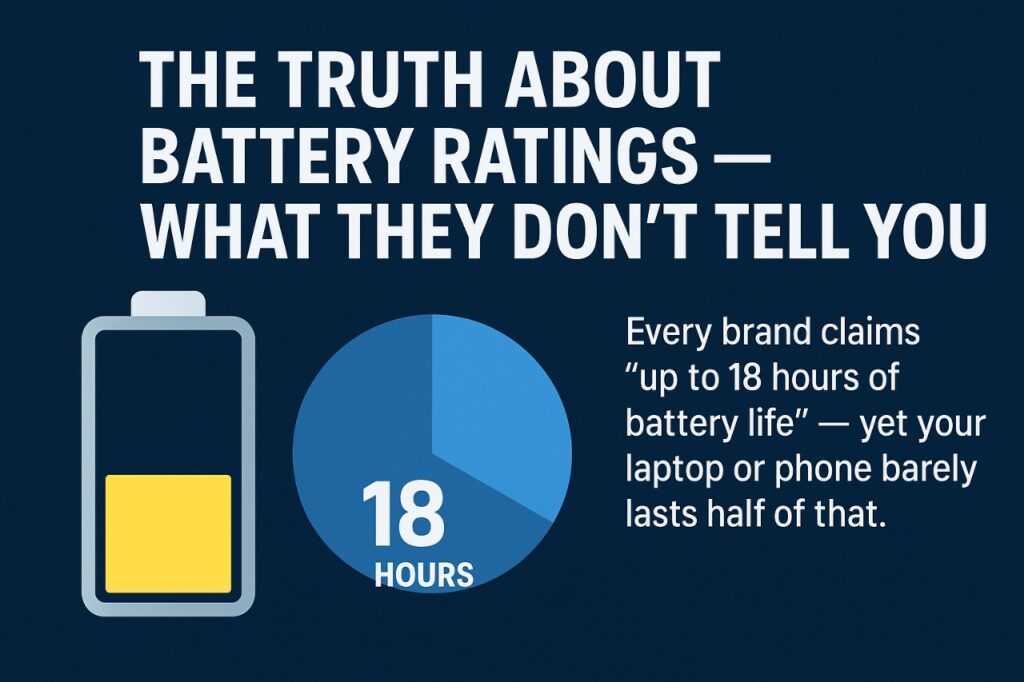
Every brand claim “up to 18 hours of battery life” — yet your laptop or phone barely lasts half of that.
So what’s going on? The truth is, battery ratings rarely reflect real-world use, and the numbers you see on the box are often the best-case scenario, not the average one.
In 2025, battery life has become one of the most overused selling points in tech marketing. From smartphones to AI laptops, every company wants to prove their device lasts longer — but most of these claims fall apart once you actually start using the product like a normal person.
⚙️ The Core Insight
Battery ratings are usually measured under controlled lab conditions — low brightness, Wi-Fi off, and minimal background tasks.
That’s not how anyone actually uses a device in 2025.
The moment you open Chrome with 15 tabs, stream video in HDR, or connect to 5G, that “18 hours” promise quickly drops to 7 or 8.
Real users on forums say it best:
“My laptop was rated for 17 hours — I barely get 6.”
The problem isn’t that brands lie outright — it’s that they test in unrealistic conditions.
Even the testing standards (like MobileMark or video playback loops) haven’t evolved fast enough to reflect modern workloads that include AI tasks, background syncing, and high-refresh displays.
As devices become more powerful, the gap between advertised battery life and real battery life continues to grow. Performance chips like Apple’s M-series or Intel Ultra processors are efficient — but when pushed with multitasking and AI-driven tasks, they consume far more power than lab tests account for.
🔋 The Reality Behind the Numbers
- “Video playback” tests are often done at just 150 nits brightness — far dimmer than what most people use daily.
- Benchmarks ignore CPU/GPU spikes from multitasking, AI inference, or web apps that constantly refresh in the background.
- Manufacturers disable features like background sync, adaptive brightness, or performance boosts during testing to extend runtime.
That’s why battery size (mAh or Wh) doesn’t tell the full story either. Two laptops with the same 60 Wh battery can perform very differently depending on cooling design, chip tuning, and software optimization.
And let’s not forget — modern devices run smarter but heavier tasks. Features like live translation, face recognition, and adaptive refresh all add small but constant drains on battery life.
🧠 The Smarter Way to Judge Battery Life
The best way to judge battery life is not through the number on the box but through consistent, real-world testing.
Look for independent battery reviews, endurance charts, and user experiences.
Focus on:
- Screen-on time: How long the device lasts during active use.
- Mixed-use tests: Combining streaming, editing, browsing, and calls gives a more realistic picture.
- Community reports: Reddit and forums often reveal real endurance figures that brands won’t share.
If your daily workflow includes multitasking, editing, or gaming — pick a device with at least 60 Wh (laptops) or 5000 mAh (phones). And make sure it supports fast charging — because charging speed often matters more than total capacity.
💬 Vibetric Verdict
Vibetric Verdict: Battery numbers are marketing.
Real endurance comes from optimization, not oversized claims.
The next time you read “all-day battery life,” remember — that’s in a perfect world, not yours.
Always trust tested usage, not lab promises.
🔗 Stay in the Loop
We don’t sell hype — we explain it.
- Follow @vibetric_official for performance breakdowns, battery reality checks, and honest insights that go beyond the spec sheet.
- No hype. No bias. Just facts — the Vibetric way.
💬 What’s your take on this?
The comment section at Vibetric isn’t just for reactions — it’s where creators, thinkers, and curious minds exchange ideas that shape how we see tech’s future.