
Bass Perception in Audio: Why It Feels Good Despite Hidden Inaccuracy
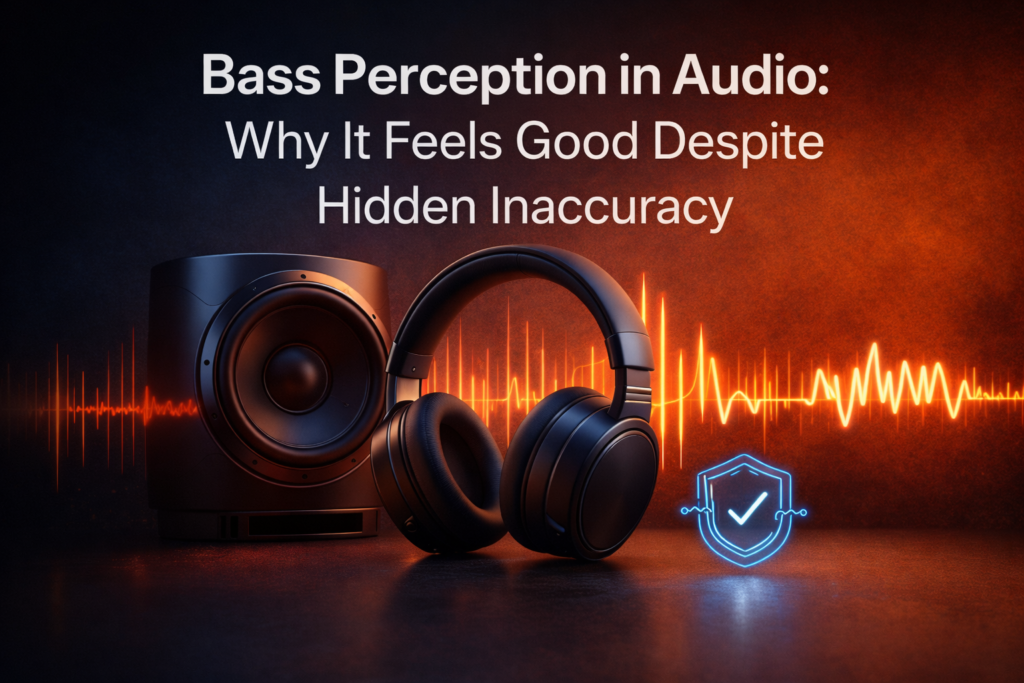
Bass has a strange power over listeners. It can make modest speakers feel exciting, turn simple beats into physical experiences, and convince people that a system sounds “better” within seconds. Accuracy rarely enters that first impression. Understanding bass perception in audio means accepting an uncomfortable truth: what feels good to human ears and bodies isn’t always what’s technically faithful to the recording.
This isn’t a failure of listeners. It’s biology, psychology, and modern audio design working in the same direction.
The Body Hears Bass Before the Brain Judges It
Low frequencies don’t behave like mids or treble. They interact with the body as much as the ear. Bass vibrations stimulate the chest, skin, and even bone conduction, creating a sensation that feels immersive and reassuring.
Because of this, bass bypasses critical listening faster than any other frequency range. You feel it before you analyze it. That immediacy is why bass-heavy sound signatures create instant satisfaction, even if they mask detail or distort balance.
Bass perception in audio is partly tactile. Accuracy becomes secondary when sound crosses into physical sensation.
Loudness, Warmth, and the Illusion of Quality
Human hearing is less sensitive to low frequencies at moderate volumes. To compensate, many audio systems boost bass so music sounds full without being played loudly. This isn’t manipulation—it’s adaptation to how ears work.
The problem appears when that compensation becomes exaggeration. Boosted bass increases perceived loudness and warmth, which listeners often interpret as higher quality. Subtle midrange details feel richer, even when they’re actually being overshadowed.
This is why two headphones with identical clarity can feel vastly different. The one with more bass often wins the emotional comparison, regardless of accuracy.
Accuracy vs Enjoyment: Where Bass Breaks the Tie
| Bass Character | Perceived Effect | Technical Reality |
|---|---|---|
| Elevated mid-bass | Warmth, punch | Can mask mids |
| Sub-bass emphasis | Depth, power | Needs control to stay clean |
| Flat bass response | Neutral, honest | Feels lean to many |
| Loose bass | “Big” sound | Reduced precision |
this snapshot shows why bass perception in audio is rarely about correctness. It’s about which compromises listeners find most pleasing.
Modern Tuning Is Designed Around Preference, Not Neutrality
Most consumer audio gear today is tuned using preference curves derived from listener studies. These curves consistently favor elevated bass because that’s what people enjoy over long sessions.
Neutral bass often sounds underwhelming to untrained ears, especially in noisy environments. Designers know this. They tune for impact, not studio accuracy, because satisfaction keeps products in use.
Bass perception in audio has become culturally conditioned. What once sounded “too much” now feels normal, simply because it’s everywhere.
Why Bass Masks Its Own Problems
One reason inaccurate bass goes unnoticed is masking. Strong low frequencies can hide distortion, compression artifacts, and even recording flaws. The ear focuses on energy rather than structure.
This masking effect creates a forgiving sound profile. Poor recordings feel more listenable. Cheap drivers sound more capable. Bass becomes a cover layer that smooths imperfections.
That forgiveness is comforting—but it also reduces transparency. Accuracy suffers quietly while enjoyment remains high.
The Emotional Shortcut Bass Provides
Bass connects directly to rhythm and movement. It reinforces tempo, emphasizes groove, and adds weight to musical intent. Even when exaggerated, it aligns with how humans emotionally interpret music.
This is why bass-heavy sound works across genres and cultures. It doesn’t require analytical listening. It invites physical response. Accuracy asks the listener to pay attention; bass lets the listener relax.
Bass perception in audio thrives because it lowers the effort required to enjoy sound.
The Contrarian Reality: Accurate Bass Is Harder to Love at First
Well-controlled, accurate bass doesn’t announce itself. It supports the music rather than dominating it. To listeners accustomed to boosted low end, this can feel disappointing or even “thin.”
But over time, accurate bass reveals texture—string resonance, drum decay, spatial cues. The experience becomes deeper, though less immediately exciting.
This is the divide few people talk about. Bass that feels good instantly isn’t always bass that rewards long-term listening.
Why Bass Keeps Winning Anyway
In everyday environments—commuting, shared spaces, background listening—accuracy struggles to survive. External noise competes with low frequencies first, pushing designers to exaggerate bass just to maintain presence.
As long as music is consumed casually, bass-forward tuning will dominate. It works faster, pleases more people, and survives imperfect conditions.
Bass perception in audio isn’t about ignorance. It’s about practicality meeting human instinct.
Learning to Separate Pleasure from Precision
There’s nothing wrong with enjoying bass-heavy sound. Problems arise only when enjoyment is mistaken for fidelity.
Recognizing why bass feels good gives listeners control. You can choose when to prioritize excitement and when to seek balance. Neither is superior—they serve different listening goals.
Bass doesn’t lie to your ears. It speaks directly to your body. Accuracy simply asks you to listen past that first sensation.
Stay In Sync with Vibetric
- Follow our Instagram @vibetric_official for deeper insight into audio perception and tuning.
- Bookmark vibetric.com to keep track of how listening preferences evolve.
- Stay updated as sound quality continues to balance science and sensation.
What’s your take on this?
At Vibetric, the comments go way beyond quick reactions — they’re where creators, innovators, and curious minds spark conversations that push tech’s future forward.
AI Audio Tuning in 2026: The Intelligent Shift Redefining Sound
AI Audio Tuning in 2026: The Intelligent Shift Redefining Sound The next major leap in audio isn’t louder drivers or wider frequency
AI Audio Tuning 2026 — The Revolutionary Shift Toward Self-Calibrating Sound
AI Audio Tuning 2026 — The Revolutionary Shift Toward Self-Calibrating Sound Personal audio has quietly shifted from fixed sound signatures to adaptive