
The Rise of ARM Laptops — Quietly Redefining Portability
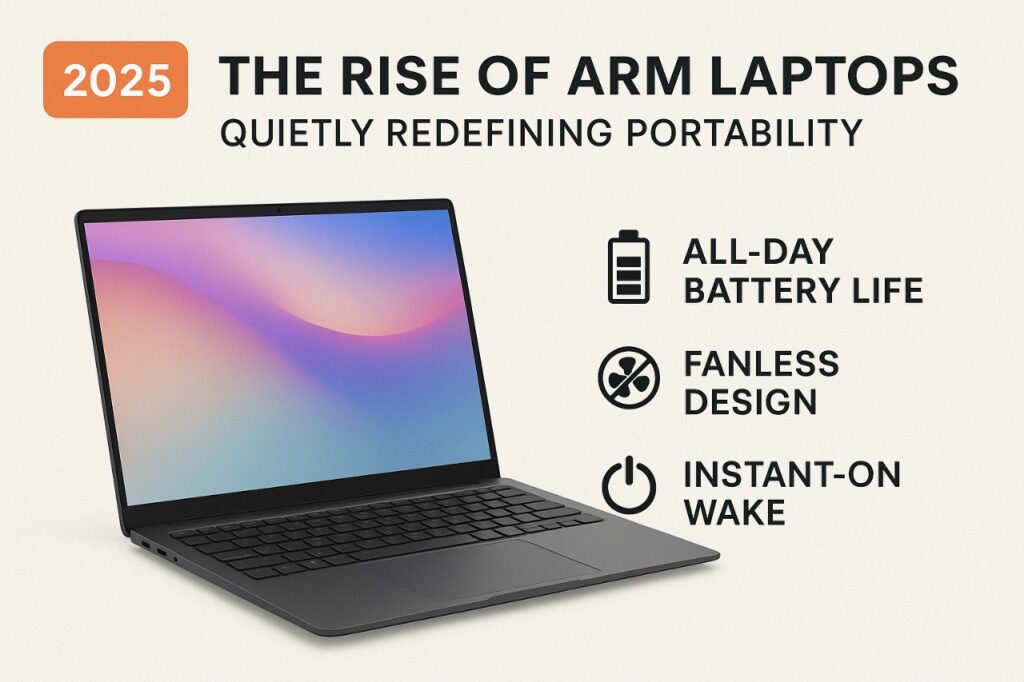
For years, the laptop industry moved in predictable cycles — thinner bodies, better screens, and incremental x86 performance bumps. But in 2025, something unusual happened: ARM laptops quietly slipped into the mainstream, and suddenly the conversation changed.
What started as an experiment on phones and tablets has evolved into the most important shift in portable computing since ultrabooks first appeared. ARM laptops are no longer niche; they’re redefining portability, battery life, thermals, and the expectations we place on our daily machines.
This isn’t a trend.
It’s a transition — and it’s happening faster than most people realize.
🧭 Why This Topic Matters
The move to ARM laptops isn’t about processors — it’s about the future of mobile computing.
Because once ARM proves it can deliver:
- all-day battery life,
- silent performance,
- instant responsiveness, and
- seamless AI acceleration…
…traditional laptop designs and x86 limitations start feeling outdated.
ARM is shaping:
- how long our laptops last,
- how cool they run,
- how fast they wake,
- and how software evolves around lightweight efficiency.
Understanding this shift helps consumers, creators, and professionals make future-proof decisions in an industry on the brink of a structural rewrite.
⚙️ What Exactly Is an ARM Laptop?
ARM (Advanced RISC Machine) processors use a reduced instruction set, designed for efficiency before brute force.
Unlike Intel or AMD’s x86 chips, ARM CPUs consume dramatically less power and generate far less heat.
That’s why ARM thrives in phones.
Now? It’s thriving in laptops too.
An ARM laptop is built around:
- Efficient cores for light tasks
- Performance cores for demanding apps
- Neural engines for AI workloads
- Ultra-low power architecture that maximizes mobility
This hybrid architecture is the reason ARM laptops are becoming the new reference for portable performance.
🔋 Battery Life That Redefines “All-Day”
Every ARM laptop shares one superpower:
insane battery efficiency.
We’re talking:
- 15–25 hours of real use
- Multi-day standby without drain
- Video playback that outlasts flights and commutes
- Cool operation even during heavy workloads
ARM laptops aren’t winning by being stronger — they win by being smarter with power.
In a world where we live online, often unplugged, that’s not a luxury.
It’s freedom.
🚀 Performance Isn’t About GHz Anymore
ARM chips use efficiency cores + performance cores — a hybrid strategy Apple Silicon perfected, and Qualcomm is now pushing into the PC world.
What this means:
1️⃣ Instant responsiveness
Apps open faster because ARM is designed for mobile-first responsiveness.
2️⃣ Better thermal behaviour
No more fans blasting at 90% during Chrome tabs.
3️⃣ Performance where it matters
Modern workloads — AI tools, multitasking, video calls, online apps — run smoother because ARM optimizes what real users do, not synthetic benchmarks.
4️⃣ Integration over raw speed
ARM laptops thrive on hardware–software synergy, something x86 has always struggled to match.
🧠 AI at the Core — Not an Afterthought
Every ARM laptop comes with one secret weapon:
a built-in neural engine.
Whether it’s Apple M-series, Qualcomm Snapdragon X-Elite, or future Google designs, ARM laptops handle AI tasks on-device, not through cloud servers.
This enables:
- Real-time transcription
- Face/object recognition
- Offline language models
- Studio-grade background removal
- Image enhancement
- Predictive performance scheduling
On ARM, AI becomes native, not bolted on.
This will define the next era of consumer laptops.
🌐 Software Compatibility — The Transition Phase
Let’s address the concern most people bring up:
“Will my apps work on ARM laptops?”
Short answer: Yes, and increasingly better every month.
- Apple solved this through Rosetta, making the transition nearly invisible.
- Windows on ARM is now optimized with powerful emulation and native support.
- Major tools — Adobe, Microsoft 365, DaVinci, Chrome, VS Code, Blender — are rapidly shipping ARM-native versions.
We’re past the early days of “big apps won’t run.”
We’re in the era of native ARM ecosystems.
🔍 Why ARM Laptops Are Gaining Momentum in 2025
ARM laptops didn’t grow because of hype.
They grew because the modern workflow changed.
✔ Cloud apps dominate
ARM thrives on lightweight, connected computing.
✔ Battery life became a priority
Mobile professionals want runtime, not fans.
✔ AI workloads exploded
ARM’s neural cores handle tasks even high-end x86 CPUs struggle with.
✔ Heat and portability matter more
ARM laptops stay cool even in tight, thin designs.
✔ The smartphone generation expects instant performance
ARM delivers phone-like responsiveness.
This is why traditional laptops suddenly feel… clunky.
🧩 What Most Reviews Don’t Tell You
Most reviewers focus on benchmarks that don’t reflect real usage.
Here’s what truly matters:
- ARM laptops feel faster because they wake instantly
- They maintain performance longer due to better thermals
- AI tools run smoother thanks to dedicated NPUs
- They last drastically longer unplugged
- They degrade slower because they generate less heat
- They represent the direction software is evolving toward
ARM isn’t winning synthetic numbers —
ARM is winning the experience.
📊 ARM vs x86 — A Real-World Comparison
| Feature | ARM Laptops | x86 Laptops |
|---|---|---|
| Battery Life | 2× to 3× longer | Shorter under load |
| Heat | Cool to warm | Often hot |
| Fan Noise | Usually, silent | Audible under load |
| AI Performance | Strong due to NPUs | Limited without GPUs |
| Responsiveness | Instant-wake, snappy | Variable |
| Software Support | Rapidly improving | Mature |
| Portability | Much lighter, slimmer | Slightly heavier |
🧠 Expert Insights
- ARM-based processors are designed around efficiency-first logic, giving them a structural advantage in battery life and heat management.
- Apple Silicon proved that tightly integrated ARM designs can outperform traditional CPUs in real-world workloads.
- Qualcomm’s Snapdragon X Elite is now pushing Windows laptops into a new efficiency category previously dominated by Apple.
- ARM laptops are built for AI-native workflows — something x86 is struggling to retrofit.
- The transition to ARM will accelerate as major developers ship ARM-native apps and cloud workflows expand.
🔮 The Future — ARM as the New Default
We’re heading toward an era where:
- ARM becomes the standard for everyday laptops
- x86 stays relevant mostly for high-end gaming or workstation-level workloads
- Software ecosystems shift toward mobile-like efficiency
- AI-driven applications become the center of user experience
- Laptop designs become thinner, lighter, cooler, and quieter
ARM isn’t here to compete.
It’s here to take over portability.
💬 Vibetric Verdict
ARM laptops are redefining what a portable computer should be:
lighter, cooler, smarter, and built around AI-first workflows.
They represent the future of mobile productivity, where performance is measured not by watts consumed, but by work done efficiently.
In 2025, choosing an ARM laptop isn’t futuristic —
it’s the most practical upgrade you can make.
🔗 Stay in the Loop
We help you choose smarter, not louder.
- Follow @vibetric_official on Instagram for deep dives, breakdowns, and clarity in a noisy tech world.
- Bookmark Vibetric.com for for expert reviews, trend analysis, and buyer guides.
No fluff. No bias. Just honest performance — the Vibetric way.
❓ FAQs
- Are ARM laptops better than traditional x86 laptops?
Not universally — but for portability, battery life, and everyday workloads, ARM laptops are significantly better.
x86 still wins in heavy gaming, advanced 3D tools, and specialized software.
ARM laptops dominate when efficiency and mobility matter.
- Will my apps work on ARM laptops?
Yes — the vast majority will.
Apple solved compatibility with Rosetta, while Windows on ARM now has:
- improved app emulation,
- growing ARM-native app libraries, and
- strong support from major platforms like Adobe, Microsoft, and Google.
Every month, the compatibility gap gets smaller.
- Why are ARM laptops known for amazing battery life?
ARM processors use low-power, mobile-first architecture designed to sip energy instead of consuming it.
This lets ARM laptops deliver 15–25 hours of real-world usage with minimal heat and zero fan noise.
- Are ARM laptops good for creators?
Yes, especially for:
- photo editing
- light-to-moderate video editing
- AI-assisted content workflows
- productivity apps
- graphic design
For heavy 4K/8K editing or 3D workloads, x86 workstations still hold an advantage — but the performance gap is shrinking as ARM NPUs improve.
- Do ARM laptops overheat less?
Absolutely.
ARM chips run cool even under load because they use more efficient cores and advanced thermal control.
Most ARM laptops don’t need fans — meaning silent operation and slower long-term wear.
- Are ARM laptops good for gaming?
Casual gaming works fine.
But AAA gaming still favors x86 machines with powerful GPUs.
ARM is catching up, but it’s not a gaming-first architecture yet.
- Why are tech brands pushing ARM laptops so aggressively?
Because ARM enables:
- longer battery life
- lighter designs
- integrated AI performance
- lower heat output
- tighter hardware–software optimization
These benefits match the modern user’s expectations better than legacy x86 approaches.
- What’s the biggest limitation of ARM laptops right now?
Windows app compatibility is still evolving.
Most mainstream apps work, but niche tools, older enterprise software, and hardware-dependent applications may need updates or might run slower under emulation.
- Does ARM affect laptop longevity?
Yes — positively.
Since ARM chips stay cooler and consume less power, they:
- degrade slower,
- maintain sustained performance longer, and
- offer better battery health over years of use.
- Are ARM laptops worth it in 2025?
For most people: yes.
If you want long battery life, quieter operation, AI-ready performance, and true portability, ARM laptops are the most forward-looking choice on the market.
💬 What’s your take on this?
The comment section at Vibetric isn’t just for reactions — it’s where creators, thinkers, and curious minds exchange ideas that shape how we see tech’s future.
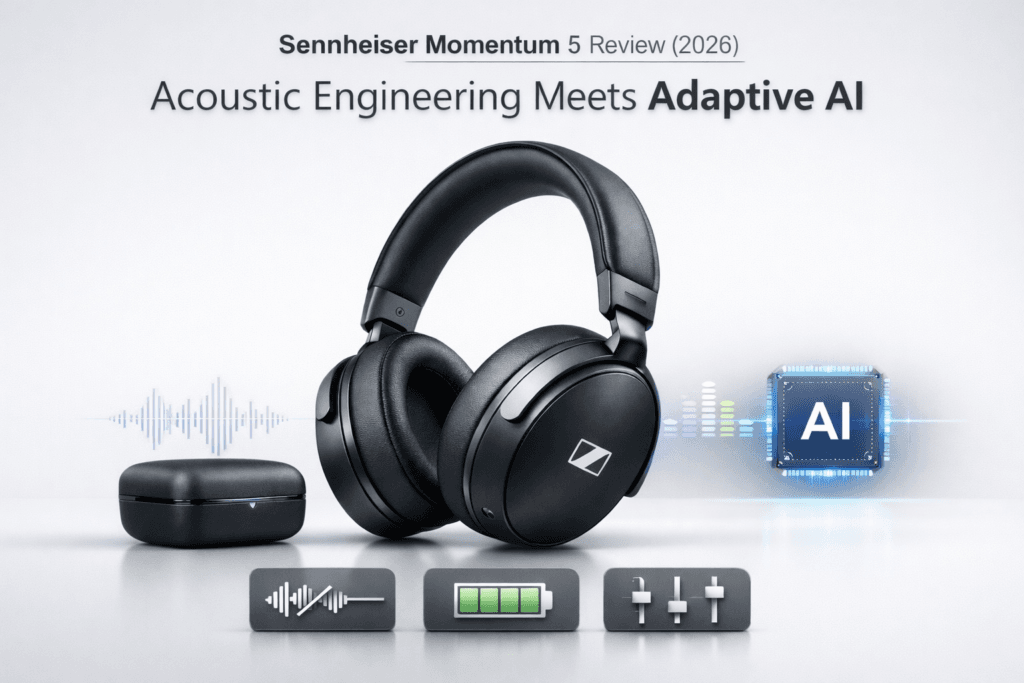
Sennheiser Momentum 5 Review (2026): Acoustic Engineering Meets Adaptive AI
Sennheiser Momentum 5 Review (2026): Acoustic Engineering Meets Adaptive AI Noise-canceling headphones have reached a point of saturation. Every flagship promises deeper
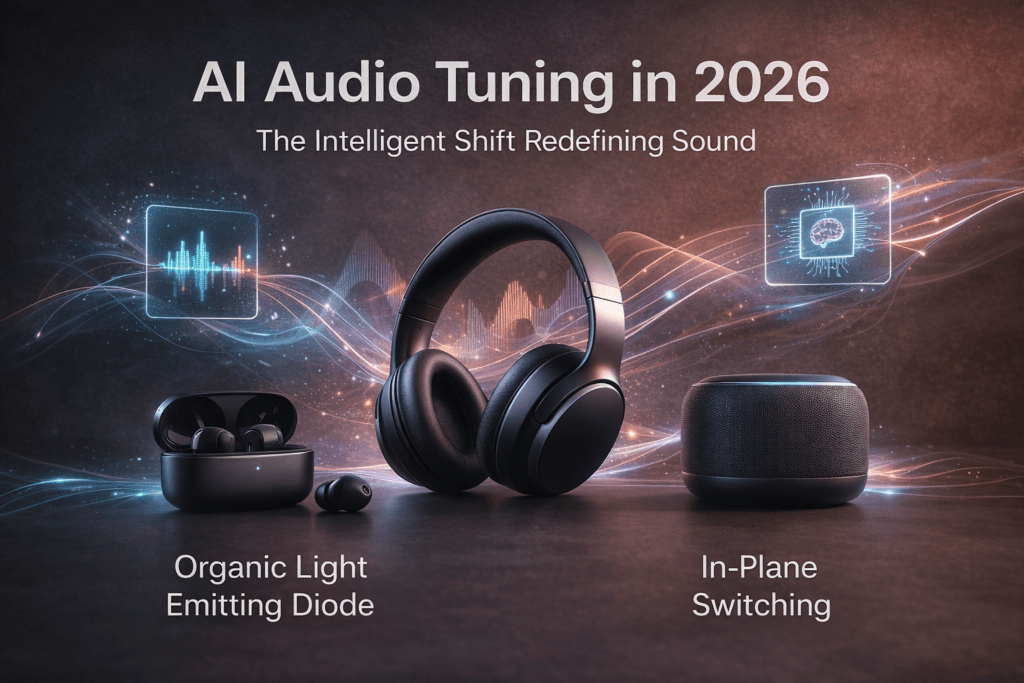
AI Audio Tuning in 2026: The Intelligent Shift Redefining Sound
AI Audio Tuning in 2026: The Intelligent Shift Redefining Sound The next major leap in audio isn’t louder drivers or wider frequency