
Apple Vision Pro 2 — AR Headset for Students or Just a Luxury Toy?
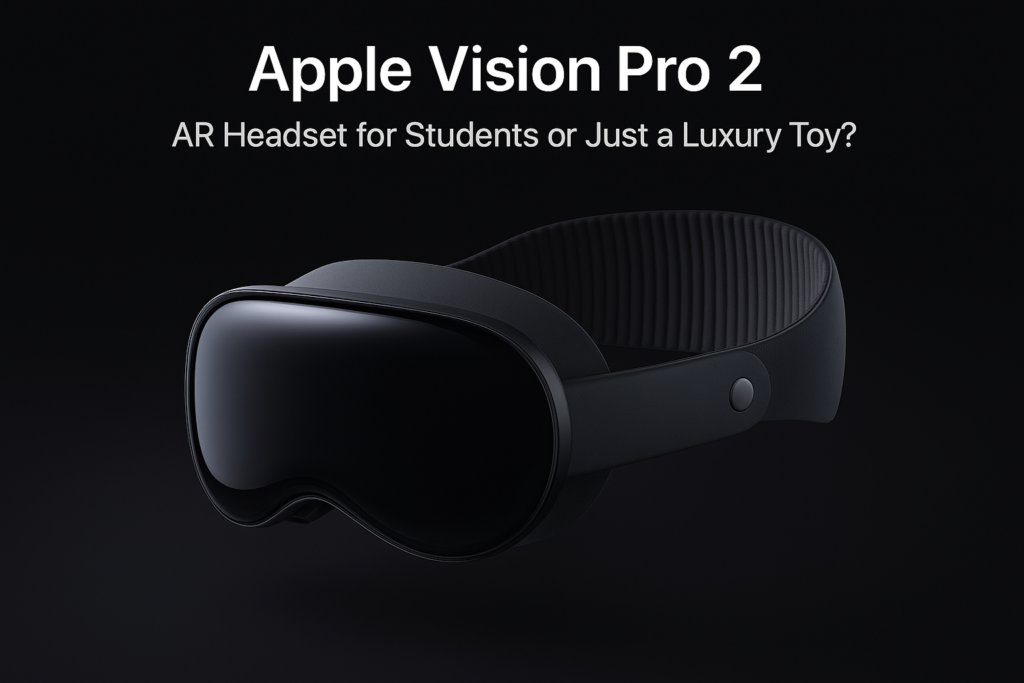
Augmented Reality (AR) has long been a futuristic concept, but with the launch of the Apple Vision Pro 2, the dream of a digital world seamlessly merging with the real one seems closer than ever. Yet, as we stand on the cusp of this new era, a question lingers—will the Vision Pro 2 serve as a practical tool for students, educators, and professionals, or is it simply an over-engineered luxury gadget aimed at high-end consumers?
Before you decide, let’s dive into the complexities of this device and uncover its true value.
The Vision of Tomorrow
Picture yourself sitting at a desk surrounded by textbooks, notes, and your laptop screen. But instead of the cluttered physical space, your study material floats in front of you in immersive, interactive 3D holograms. You’re reading, watching, interacting, all with the swipe of your hand or a simple voice command. This is what the Apple Vision Pro 2 promises—a blend of the digital and physical worlds that could transform how we learn, create, and interact with information.
However, this future doesn’t come without a price. The Vision Pro 2’s futuristic promise comes wrapped in an extravagant package that raises some serious questions about its value—especially for the student demographic.
Not Just a Toy, But a Heavy Investment
The Apple Vision Pro 2 is undeniably a marvel of technology. Its spatial computing capabilities make it one of the most advanced AR headsets on the market, boasting a combination of eye-tracking, advanced visual fidelity, and real-time 3D interactions. But here’s the rub: is it really built for students, or is this a tool designed more for those who can afford to be early adopters of cutting-edge tech?
Let’s break this down.
Deep-Dive Explanation
Misconceptions: What We’ve Been Led to Believe
Many perceive the Apple Vision Pro 2 as a luxury device—something designed solely for gamers, tech enthusiasts, or businesses with deep pockets. This perception has grown from the Vision Pro’s high price tag, which is rumored to fall somewhere in the $3000–$4000 range, and its consumer-targeted marketing. But can this headset really break through as a tool for academic use?
It’s true that the Vision Pro 2 doesn’t immediately scream “student-friendly” in the traditional sense. The steep learning curve, cost, and specialized apps may deter students who need more basic tools for daily learning. However, AR is known to have significant potential in educational environments—especially in areas like interactive simulations, immersive learning, and hands-on virtual labs.
Technical Reality: The Engineering Behind the Vision Pro 2
Apple has significantly enhanced the Vision Pro 2 compared to its predecessor. The headset is equipped with Apple’s most advanced chipsets, including the M3 processor, delivering not only AR, but also the ability to run full-fledged apps seamlessly. This means students could potentially use AR to visualize complex scientific concepts, or engineers could design objects and manipulate them in real time.
The high-fidelity display and depth-sensing cameras allow users to interact with holographic objects in a way that’s far more natural than previous AR attempts. The spatial computing environment that the Vision Pro 2 creates could elevate the student experience, especially in technical fields like medicine, architecture, and engineering.
But at the same time, these advanced features come at a price: the need for powerful infrastructure, and a completely new paradigm of content creation, both of which might take years to evolve.
Industry Behavior: Why Brands Market AR the Way They Do
Apple’s vision for the Vision Pro 2 isn’t just about appealing to students—it’s about setting a new standard in spatial computing that could eventually disrupt the entire tech ecosystem. Its appeal to students, especially those in STEM fields, is secondary to the broader cultural and technological shifts Apple is trying to catalyze.
This is evidenced by the strategic decision to debut the device as an all-encompassing AR solution that integrates with Apple’s larger ecosystem—Macs, iPads, and iPhones. The goal is to place Vision Pro 2 as the ultimate “second screen” that can replace traditional forms of media consumption, not just for students but for professionals in all industries.
Apple’s pricing and marketing strategy seems aimed at capturing the high-end market first, where the device is seen as an investment for a future that will likely be realized in the next five to ten years. For students, the Vision Pro 2 remains an aspirational product—something to watch rather than immediately invest in.
Future Trajectory: Is AR Education the Future?
The question remains: will the Apple Vision Pro 2 evolve to the point where it is an essential tool in the student toolkit? While the Vision Pro 2 is a step towards mainstream AR, its current form is far from being a must-have for everyday students. However, as AR tech advances and becomes more affordable, educational institutions may begin to adopt AR for courses that benefit from immersive experiences.
Expect to see AR-enabled education systems emerge in niche fields like medical training, architectural design, and even fields like history or literature, where immersive, context-based learning could become a norm. As the content ecosystem matures, the Vision Pro 2—or its successors—could become a critical part of this new learning paradigm.
Real-World Examples
- Medical Students Using AR for Anatomy
Imagine a medical student studying human anatomy. Instead of flipping through pages of a textbook, they could wear the Vision Pro 2 and interact with 3D models of human organs. They can zoom in, rotate, and explore the body from every angle, potentially gaining a deeper understanding of anatomy than they would from traditional methods.
- Engineering Students Designing in 3D
An engineering student could use the Vision Pro 2 to model complex structures in real time, adjusting and testing designs in a virtual environment before they ever build a physical prototype. This immersive, hands-on approach could revolutionize practical learning, particularly in engineering and product design.
- Virtual Reality Field Trips for History Classes
Students studying history could take virtual field trips to ancient Rome, the Great Wall of China, or the moon—immersing themselves in the environment rather than reading about it. Such learning experiences could deepen engagement and help students better retain historical facts and concepts.
Quick Snapshot: Real-World Scenarios
| Scenario | Potential Benefit | Feasibility |
|---|---|---|
| Medical students learning anatomy | High engagement and retention with 3D models | Feasible with content adaptation |
| Engineering students modeling in 3D | Instant testing and modification of designs | Feasible, but requires specialized software |
| History students on virtual field trips | Immersive learning in historical contexts | Feasible with AR content development |
Will the Vision Pro 2 Change the Classroom?
Data on AR in education shows that immersive learning experiences significantly improve student engagement and retention. According to recent studies, students learning in immersive environments retain 80% more information than those using traditional textbooks. This points to a potential future where the Apple Vision Pro 2 could indeed play a transformative role in education.
The Psychological Shift
Imagine being able to study in a world where all distractions fade, and you’re fully immersed in your subject. AR headsets like the Vision Pro 2 could help students focus better by creating an environment tailored to their learning needs. However, this comes with potential downsides: the technology could exacerbate isolation, and some students might struggle with the “digital divide” of access.
Still, if used properly, the Vision Pro 2 could lead to an increase in productivity and understanding, as students have the ability to interact with complex subjects in a way that’s both intuitive and engaging.
Solution Framework / Buyer Guide
For everyday students: The Vision Pro 2 is likely too advanced, complex, and expensive for daily use. A more affordable AR headset might be a better entry point.
For creators/professionals: The Vision Pro 2 could be a game-changer, especially for those in design, architecture, or medical fields. The ability to work with 3D objects in real time could elevate creative projects.
For gamers/enthusiasts: The immersive potential for gaming and virtual worlds is undeniable, but whether the Vision Pro 2 is worth the cost depends on personal budget and priorities.
For future-proof buyers: Those looking to invest in cutting-edge technology may find that the Vision Pro 2 is a forward-thinking purchase that will pay dividends once AR becomes more ubiquitous.
Pros & Cons
| Pros | Cons |
|---|---|
| High-quality AR experience, suitable for professional use | Expensive, with a price point out of reach for most students |
| Excellent for immersive learning in niche fields | Requires content adaptation and software support |
| Future-proof technology, ideal for early adopters | Potential isolation and screen fatigue over time |
Is It All Just a Luxury?
For some, the Apple Vision Pro 2 might simply be a tech luxury—something that will sit on a shelf until AR technology matures and becomes more mainstream. It’s easy to get swept up in the excitement of new tech, but for many students, the day-to-day utility simply isn’t there yet.
Reddit / User Reality Section
Feedback from early adopters on Reddit highlights mixed reactions:
| User Type | Feedback Summary | Relevance |
|---|---|---|
| Students | AR feels gimmicky for most subjects; not enough practical applications yet | Low |
| Professionals | Game-changing for specific fields like medicine and design | High |
| Tech Enthusiasts | Expensive, but impressive tech with immense potential | Medium |
While some find the technology promising, many note that it’s too early to call the Vision Pro 2 a “must-have” for students. It remains a tool more suited for tech enthusiasts and professionals who see its potential for productivity or leisure.
What’s Next for the Vision Pro 2?
The Apple Vision Pro 2 is just the beginning. As the technology becomes more refined, expect prices to drop and content ecosystems to expand. Over the next 5–10 years, AR in education will likely become more common, and the Vision Pro 2—or its successors—could play an essential role in reshaping learning and interaction with digital content.
The Vision of the Future
Returning to that moment at your desk, with textbooks and notes in the air—what once seemed like a distant dream is slowly becoming reality. While the Apple Vision Pro 2 may not be for everyone today, it’s an exciting glimpse into a future where learning, creating, and experiencing the world happens in an entirely new way.
As the tech matures, its true potential will be unlocked—bringing immersive learning to the forefront of education. But for now, whether you’re a student, creator, or early adopter, the Vision Pro 2 remains a beautiful, powerful experiment waiting for widespread acceptance.
Vibetric Ending
The future of AR is unfolding, and while the Apple Vision Pro 2 is a significant leap forward, it’s not yet for the masses. Yet.
Wondering How the Apple Vision Pro 2 Will Evolve? Here’s What You Need to Know
- Follow vibetric_official on Instagram to keep up with the latest trends and insights into augmented reality and spatial computing.
- Bookmark Vibetric.com we continuously update our analysis as new developments emerge in the world of AR.
Subscribe for updates and receive ongoing, in-depth breakdowns and expert opinions on AR technology.
FAQs About the Apple Vision Pro 2: AR Headset for Students or Just a Luxury Toy?
- What is the Apple Vision Pro 2?
The Vision Pro 2 is Apple’s next-generation AR headset, designed to combine the digital and physical worlds with high-fidelity display and real-time 3D interactions. - Is the Vision Pro 2 suitable for students?
While the Vision Pro 2 offers immersive learning experiences, it may be too advanced and expensive for everyday students. It’s better suited for professionals and tech enthusiasts. - Can the Vision Pro 2 be used in education?
Yes, in fields like medicine, engineering, and design, where immersive 3D simulations are valuable. However, its current price and content ecosystem may limit its accessibility for most students. - How much does the Vision Pro 2 cost?
Rumors suggest a price range of $3000–$4000, making it a premium product aimed at professionals and early adopters. - Will AR replace traditional learning tools?
AR has great potential in education, but it’s unlikely to replace traditional learning methods entirely in the near future. Instead, it will complement them. - What are the main benefits of the Vision Pro 2 for professionals?
The device allows for highly interactive 3D visualizations and hands-on learning in fields like medicine, design, and engineering. - How long until AR becomes mainstream in education?
While AR is still in its early stages, expect it to gain momentum in the next 5–10 years, with more affordable devices and expanded content. - Will the Vision Pro 2 become more affordable?
As AR technology becomes more widespread and competitors enter the market, it’s likely that the price will come down over time. - Can I use the Vision Pro 2 for gaming?
Yes, the Vision Pro 2’s immersive AR capabilities make it ideal for gaming, though it may be more geared towards professional applications at launch. - What is the future of AR in education?
The future of AR in education looks promising, with immersive learning experiences poised to transform how subjects like history, science, and art are taught.
What’s your take on this?
At Vibetric, the comments go way beyond quick reactions — they’re where creators, innovators, and curious minds spark conversations that push tech’s future forward.
AI Intelligence Race in 2026: The Real Battle Beyond Speed
AI Intelligence Race in 2026: The Real Battle Beyond Speed For years, consumer technology sold us speed. Every keynote celebrated higher clock
Minimalist Tech Design Trends 2026 — Why Clean, Powerful Devices Are Winning
Minimalist Tech Design Trends 2026 — Why Clean, Powerful Devices Are Winning For years, consumer technology competed on excess — more cameras,