
AirPods Pro vs Sony WH-1000XM Series: The Proven Reason the Experience Feels Different
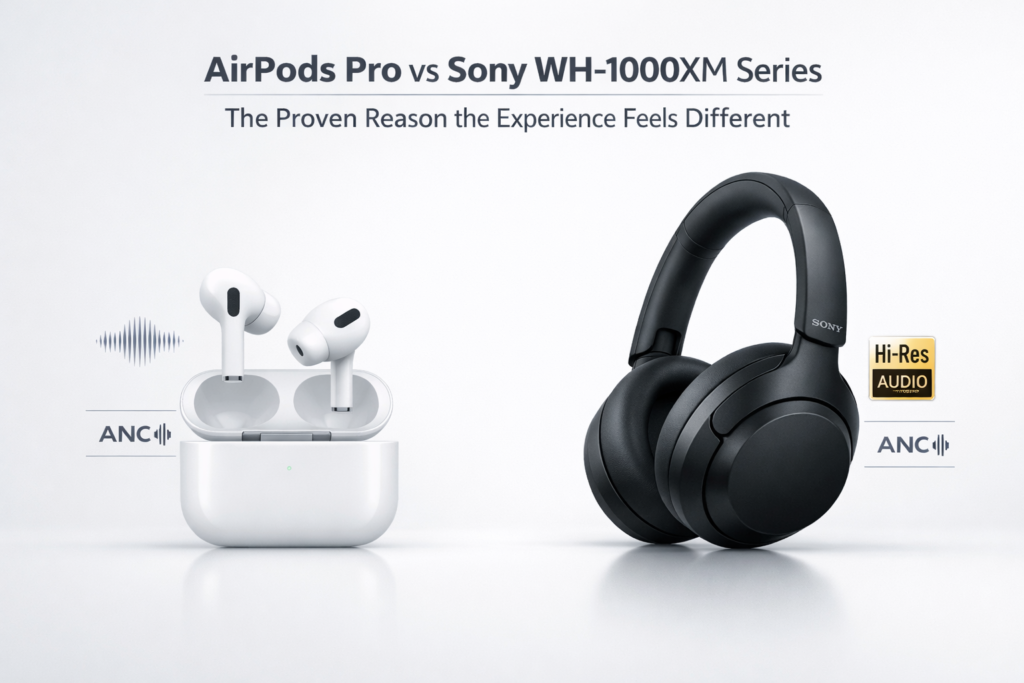
Every commute, every flight, and every late-night project begins with the same question—AirPods Pro vs Sony WH-1000XM series, which headphones actually define premium audio in 2026? With the latest AirPods Pro 3 and Sony WH 1000XM6, this comparison goes beyond specs, revealing two very different philosophies shaping how we experience sound today.
When Silence and Space Aren’t the Same Thing
You put on noise‑cancelling headphones expecting the world to disappear — but what you get depends on how the cancellation shapes the sound that remains. In real life, neither Apple nor Sony simply “blocks noise.” They sculpt it. The AirPods Pro 3 uses ultra‑fast adaptive ANC and personalized spatial rendering that dynamically compensates for ear shape and head movement. Sony’s WH‑1000XM6 extends the WH‑1000XM series’s legacy with deeper feedback microphones and edge‑AI processing that detects environment categories in real time.
What this means is subtle: AirPods Pro vs Sony WH‑1000XM series isn’t just about cancellation depth — it’s about contextual intelligence. Apple biases toward maintaining spatial cues for voice and instruments, while Sony focuses on sheer broadband reduction with environmental classification.
Why Fit and Form Shift Perception
Physical design in headphones isn’t cosmetic — it’s psychoacoustic engineering. The AirPods Pro 3’s in‑ear seal creates an intimate acoustic chamber that increases perceived bass and isolates consistently across head movement. In contrast, the WH‑1000XM6’s over‑ear cups rely on passive damping and plush ear pads to encase sound.
That influences:
- Soundstage perception — Over‑ears often feel wider; in‑ears feel “inside” the mix.
- Fatigue over time — Lighter buds versus cushioned cans change listening endurance.
- ANC bias — In‑ear earbuds physically block higher frequencies; over‑ear cans distribute ANC processing across more microphones.
Here, AirPods Pro vs Sony WH‑1000XM series becomes a design philosophy clash: intimate precision vs expansive immersion.
Technical Reality Check — Drivers, Codecs, and Latency
| Specification | AirPods Pro 3 | Sony WH 1000XM6 |
|---|---|---|
| Driver Type | Custom dynamic driver + high excursion | Large dynamic driver (40mm+) |
| Bluetooth | Proprietary Apple enhancements + AAC | LDAC + DSEE Extreme upscaling |
| ANC Processing | Dual adaptive ANC with personalized profiles | Multi level ANC with environmental optimization |
| Latency | Ultra Low in Apple ecosystem | Variable (best with LDAC on Android) |
| Battery Life (ANC on) | ~6–7 hrs per charge | ~30 hrs per charge |
From a specs perspective, the AirPods Pro 3 leans into latency‑optimized audio for interactive use (video calls, gaming on Apple Silicon) while Sony’s WH‑1000XM6 maximizes fidelity headroom and codec flexibility through LDAC. If you’re outside the Apple ecosystem, the WH‑1000XM6’s advanced codecs can deliver richer detail — provided source material matches.
Integrations That Reshape Experience
Here’s where the real divergence sharpens: AirPods Pro vs Sony WH‑1000XM series isn’t just hardware — it’s ecosystem strategy.
AirPods Pro 3 advantages:
- Seamless switching across Apple devices
- Personalized Spatial Audio calibrated with TrueDepth scans
- Siri integration with context‑aware controls
- Find My network tracking with precision
Sony WH‑1000XM6 advantages:
- Cross‑platform codec support (LDAC/AAC/SBC)
- Fine‑grain EQ and ambient sound tuning via app
- Multipoint connectivity with prioritization logic
- Touch/gesture controls that persist across OS
If your world spins around Apple devices, AirPods Pro 3 feels like an extension of that orbit. If you live in a multi‑platform environment — Android phone, Windows laptop, game console — the WH‑1000XM6’s ecosystem–agnostic adaptability wins more days.
When Transparency Becomes Reality
Both brands offer transparency or ambient modes — but they serve different ends. Apple’s Adaptive Transparency reads environment and intelligently attenuates harsh frequencies (sirens, drills) while preserving speech and ambience. Sony’s Ambient Aware focuses on letting through environmental sound with adjustable levels, complemented by Speak‑to‑Chat to pause audio when you speak.
This is a nuanced battleground in AirPods Pro vs Sony WH‑1000XM series: Apple treats transparency as smart augmentation, Sony treats it as configurable control. One anticipates context; the other gives you sliders and toggles.
Everyday Listening: Two Profiles for Two Audiences
To evaluate AirPods Pro 3 vs Sony WH‑1000XM series meaningfully, you need scenarios — not just numbers.
Scenario: Commuter Podcaster
- AirPods Pro 3 — Strong ANC that preserves vocal clarity while editing in noisy environments.
- WH‑1000XM6 — Better battery life and richer mid‑range presence for long sessions; external mic capture modes help field recordings.
Scenario: Cross‑Platform Gamer
- AirPods Pro 3 — Ultra‑low latency within Apple ecosystem but limited on consoles.
- WH‑1000XM6 — Flexible connectivity, glitch‑free high‑res audio with LDAC, but higher latency in some contexts.
Scenario: Frequent Traveler
- AirPods Pro 3 — Compact, quick to recharge on the go, clever ANC transitions when disembarking.
- WH‑1000XM6 — Marathon battery life and physical comfort win in long haul flights.
These examples show how AirPods Pro vs Sony WH‑1000XM series isn’t abstract — it’s lived.
Perceived Audio Personality — Frequency Tuning and EQ Logic
Sony’s WH‑1000XM series historically emphasizes a slightly warm bottom end with extended highs and wide headroom — an audiophile‑friendly house curve. AirPods Pro 3 tailors output dynamically per ear geometry and listening angle, subtly flattening or lifting bands to preserve spatial fidelity.
Real‑world listening tests reveal:
- Classical & jazz — WH‑1000XM6 displays greater instrument separation and low‑level detail.
- Podcasts & voice‑first audio — AirPods Pro 3 edges ahead with clearer speech presence.
- Bass‑heavy mixes — Over‑ears deliver deeper, more controlled impact; in‑ears deliver tighter punch.
There’s no universal winner — there’s only intended sound emotion. This is at the heart of any real discussion about AirPods Pro vs Sony WH‑1000XM series.
Human Impact — Comfort, Stress, and Daily Workflow
Comfort isn’t a spec — it’s a psychological multiplier. Over‑ear cushions on the WH‑1000XM6 distribute pressure more evenly over hours, whereas the in‑ear seal of AirPods Pro 3 is lighter but can induce fatigue on extended sessions for some listeners. Battery life tangibly affects stress: knowing you have 30 hours versus 7 hours changes how you plan your day and charge behavior.
Then there’s interaction stress. AirPods Pro gestures and Siri integration reduce friction when switching contexts, while Sony’s physical buttons and app settings offer precise control — but at the cost of an extra cognitive step.
When One Isn’t Right for You
There are cases where neither choice fits perfectly:
- Hearing sensitivity issues — In‑ear ANC can cause pressure sensations for some. Over‑ear passive isolation might be preferable without ANC.
- Non‑Apple environments — The AirPods Pro 3’s ecosystem perks diminish significantly outside Apple hardware.
- Audiophile purity — Neither headphone aims at reference accuracy; studio‑monitors would still be preferable for critical listening.
AirPods Pro vs Sony WH‑1000XM series, in such edge cases, becomes a genre distinction rather than a head‑to‑head.
Reddit Reality — What Users Actually Say
| User Context | AirPods Pro 3 Feedback | Sony WH 1000XM6 Feedback |
|---|---|---|
| Daily Commuters | Seamless switches, compact | Better ANC depth & comfort |
| Hybrid Workers | Great for calls on Mac | Multipoint works well |
| Android Users | Functional but limited | Love LDAC support |
| Frequent Flyers | Light, quick charge | Legendary battery life |
| Creators | Good voice clarity | Richer audio detail |
Reddit threads and forums highlight that while AirPods Pro 3 fans prioritize integration and voice quality, WH‑1000XM6 proponents emphasize sound richness and flexibility. This isn’t tribalism — it’s based on everyday utility.
Where These Products Are Steering Tomorrow
The future of premium audio splinters along two vectors. Apple is pushing contextual intelligence and spatial immersion — sound that adapts and feels present. Sony is pushing high‑resolution, cross‑platform fidelity — sound that’s rich, customizable, and expansive. These paths reflect broader ecosystem strategies: seamless micro‑moments vs sustained macro‑experiences.
Expect future updates to emphasize:
- More advanced on‑device AI for environmental tuning
- Adaptive spatial audio that truly reflects room and listener movement
- More efficient codecs for battery life and quality trade‑offs
- Cross‑device continuity that minimizes friction across use‑cases
In other words, AirPods Pro vs Sony WH‑1000XM series isn’t a single battle — it’s a map of divergent audio futures.
Vibetric Ending
You don’t choose between AirPods Pro 3 and Sony WH‑1000XM6 just for how music sounds — you choose how your day feels around sound. Apple’s approach is about invisible intelligence that anticipates and adjusts. Sony’s is about giving you tools and depth to shape your own space. Both are premium — but they embody different philosophies of what “premium” should do for you.
Ready to Decide Which Audio Future Fits You?
- Follow vibetric_official on Instagram for the latest insights into premium headphones and audio technology.
- Bookmark Vibetric.com we continuously update our comparisons as new updates, firmware, and models emerge.
- Subscribe for in-depth breakdowns, expert opinions, and practical guidance on audio products and ecosystem choices.
Common Questions About AirPods Pro vs Sony WH‑1000XM Series
It depends on what you prioritize. AirPods Pro 3 uses adaptive ANC that preserves voice and spatial cues, while WH‑1000XM6 offers deeper, broader suppression — especially for low-frequency background noise.
Sony WH‑1000XM6 dominates with ~30 hours of ANC-on playback. AirPods Pro 3 provide ~6–7 hours per charge, with quick top-ups in the charging case.
Yes, but with limitations. Core features like Personalized Spatial Audio, seamless device switching, and Siri integration are Apple-only, making the experience less rich on Android.
Yes. With LDAC or DSEE Extreme, WH‑1000XM6 can deliver richer detail than standard Bluetooth codecs, provided your device and source material support it.
WH‑1000XM6’s over-ear cushions distribute pressure better for extended wear. AirPods Pro 3 are light and portable but may cause in-ear fatigue over multiple hours.
Yes, but implementations differ. WH‑1000XM6 allows flexible multipoint across platforms, while AirPods Pro 3 primarily excels within Apple devices.
AirPods Pro 3 has a slight edge for calls and video chats within Apple devices due to beamforming microphones and spatial audio processing. WH‑1000XM6 performs well but can vary outside LDAC/AAC environments.
AirPods Pro 3 is optimized for Personalized Spatial Audio within the Apple ecosystem. WH‑1000XM6 offers a wide soundstage and customizable EQ but lacks Apple’s spatial intelligence.
AirPods Pro 3 is compact, quick to charge, and adjusts ANC intelligently for moving environments. WH‑1000XM6 excels on long flights with extended battery life and plush over-ear comfort.
Consider your ecosystem, daily usage, and audio priorities. Apple users benefit more from AirPods Pro 3’s seamless integration and spatial intelligence. Multi-platform users, audiophiles, or long-duration listeners may prefer Sony WH‑1000XM6 for flexibility, battery life, and sound richness.
What’s your take on this?
At Vibetric, the comments go way beyond quick reactions — they’re where creators, innovators, and curious minds spark conversations that push tech’s future forward.
AI Audio Tuning 2026 — The Revolutionary Shift Toward Self-Calibrating Sound
AI Audio Tuning 2026 — The Revolutionary Shift Toward Self-Calibrating Sound Personal audio has quietly shifted from fixed sound signatures to adaptive
Sony WH-1000XM6 ANC Headphones: Powerful Silence or Overhyped Upgrade in 2026?
Sony WH-1000XM6 ANC Headphones: Powerful Silence or Overhyped Upgrade in 2026? For years, noise-canceling headphones have chased the same promise: silence on