
How AI Is Quietly Changing the Way You Use Your Phone
AI smartphone experience are no longer defined by processors, megapixels, or display specs alone.
In 2025, something invisible has taken over — an intelligence layer that sits beneath every feature you use. You don’t see it. You don’t configure it.
But you feel it.
Every time your photos magically fix themselves, every time your battery lasts longer than expected, every time your keyboard predicts a full sentence — AI is quietly running the show.
This isn’t hype.
This isn’t sci-fi.
This is the new smartphone experience — and you’re already living in it.
🧭 Why This Topic Matters
Because the smartphone war has changed.
Brands aren’t competing on RAM or cores anymore — they’re competing on intelligence.
The phones that feel smoother, smarter, more “personal” win.
And the brands that master AI?
They win the next decade.
If you want to understand the future of mobile tech, you need to understand the invisible systems shaping your daily experience.
🌐The Shift: From Hardware Race to Intelligence Race
For years, Android vs Apple was a game of specs.
But that era is fading fast.
Today, smartphones share similar chip architecture, similar camera hardware, and similar displays.
So what separates a premium phone from a budget one?
The intelligence layer — AI.
- AI decides how efficiently your phone uses power.
- AI decides how stable your apps feel.
- AI decides how good your photos look — even with the same sensor.
- AI decides how fast your tasks complete.
- AI decides how personal your experience becomes.
This is the silent UI — powered not by what you see, but by how your phone thinks.
🎥Cameras: Where AI Became a Superpower
Your phone’s camera is no longer a camera.
It’s a mini photography studio powered by machine learning:
1. Computational Photography Rules Everything Now
You press the shutter once — the phone actually captures:
✔ multiple exposures
✔ depth data
✔ motion data
✔ color samples
✔ noise patterns
✔ detail maps
AI then fuses all of them into a single photo that looks dramatically better than reality.
2. Scene Detection Has Gone Mainstream
2025 cameras can identify:
- pets
- clouds
- vehicles
- city lights
- neon signs
- faces
- skin tones
- sunsets
- indoor ambience
All in milliseconds.
3. AI Fixes Your Mistakes
- Shaky hands → AI stabilizes
- Low light → AI brightens intelligently
- Backlit subject → AI balances exposure
- Wrong angle → AI corrects perspective
- Blurry shot → AI reconstructs detail
Your photos are now AI collaborations, not just captures.
🔋Battery Life: The Hidden AI Optimization Layer
Batteries haven’t improved dramatically.
But battery life has.
Why?
Because AI has become your personal power manager.
🔹 Adaptive power profiles
Your phone now learns when you:
- wake up
- commute
- game
- charge
- sleep
And adjusts power usage accordingly.
🔹 App preloading and freezing
The system predicts which apps you’ll open next — and which apps you won’t open for 10 hours.
🔹 Smart charging
100% charge is harmful long-term.
AI now slows charging overnight and peaks just before you wake up.
🔹 Background task scheduling
Updates, indexing, and syncs now run intelligently, not randomly.
Your battery isn’t bigger.
Your phone is simply smarter.
⚙️Performance: Why Phones Feel Faster Without New Chips
You’ve probably felt it — mid-range phones feel faster than ever.
That’s AI.
AI Now Controls:
- task scheduling
- thermal limits
- app opening priorities
- animation timing
- memory allocation
Instead of brute force power, phones now use supervised optimization — predicting how to stay fast without draining battery or overheating.
This is why a phone with a weaker chip can feel faster than a flagship from 3 years ago.
🎤Voice: The Quiet Evolution of Assistants
Voice assistants were once jokes.
Not anymore.
AI models now understand:
- full sentences
- mixed languages
- context
- accents
- fuzzy commands
- intent
And with on-device AI, responses are nearly instant.
Voice isn’t the future.
It’s already the silent shortcut you use without noticing:
- alarms
- reminders
- quick calls
- location searches
- text dictation
- smart home adjustments
The difference?
It finally works.
⌨️Typing: The AI You Use Every Second
Your keyboard is now one of the smartest apps on your phone.
It predicts:
- phrases
- tone
- context
- next sentences
And it learns your writing style with frightening accuracy.
Typing is no longer manual — it’s assisted intelligence.
📍Navigation: AI Maps Are Becoming Predictive
AI now predicts your movement patterns:
- your office route
- your favorite restaurants
- your commute timings
- traffic you usually face
- alternative routes you prefer
Maps now feel almost telepathic.
They offer suggestions before you search.
🔐Security: AI Is Your Personal Bodyguard
AI-driven security is now standard.
Face unlock now uses:
- depth sensing
- heat mapping
- blink detection
- silhouette matching
- anti-spoof systems
Fraud and spam detection uses AI too
Your phone auto-detects:
- scam calls
- suspicious apps
- malware behavior
- phishing messages
The digital world is more dangerous than ever.
AI is your frontline shield.
📲Personalization: Your Phone Now Adapts to You
This is the biggest change — and the least spoken about.
AI now customizes:
- home screen layouts
- app suggestions
- notification priority
- focus modes
- photo memories
- fitness recommendations
- auto-created playlists
Your phone is slowly becoming you.
🧠 Expert Insights
- Stock Android devices like Pixel excel at AI-driven fluidity because of tightly integrated on-device models.
- Apple’s A-series chips remain unmatched in neural processing power, enabling ultra-fast on-device inference.
- Samsung’s Galaxy AI pushes hybrid workflows — cloud + device — to balance speed and capability.
- Chinese brands like Xiaomi, Vivo, and Honor are rapidly adopting generative features, though long-term update support varies.
- AI enhancements now contribute more to camera quality than hardware sensors themselves.
- Battery gains in recent years are largely software-driven, not hardware-driven.
🛰️On-Device AI vs Cloud AI: The Real Battle
On-device AI
- faster
- private
- low latency
- works offline
Examples:
- transcription
- photo enhancement
- predictive typing
Cloud AI
- heavy tasks
- real-time translation
- model personalization
- generative features
The best phones use a hybrid system — and this hybrid is shaping the future.
💡The AI You Don’t Notice (But Use Daily)
You interact with AI at least 200+ times a day without realizing:
- auto-brightness
- noise cancellation during calls
- vibration tuning
- motion detection
- adaptive refresh rate
- auto-rotate fix
- spam detection
- file indexing
- keyboard learning
- memory optimization
AI is the invisible backbone of modern convenience.
🚀The Future: Where AI Smartphone Experience Is Headed
1. Fully conversational interfaces
Your phone becomes a chat-first operating system.
2. Real-time offline translation
No internet required.
3. AI-created videos from your clips
Zero editing skills needed.
4. Predictive UI
Your phone opens tools and apps before you tap.
5. Hyper-personal memories
Your gallery becomes a storytelling engine.
6. Health tracking with emotional analysis
Mood detection → lifestyle suggestions.
7. AI that understands context, not just commands
The future isn’t new apps.
It’s a new way of interacting with everything.
💬 Vibetric Verdict
AI isn’t a feature.
It’s the foundation of the modern smartphone experience.
Your phone isn’t getting faster because of silicon.
Your camera isn’t improving because of hardware.
Your battery isn’t lasting longer because of capacity.
It’s intelligence — quietly reshaping your experience.
The next smartphone war won’t be fought with specs.
It’ll be fought with AI.
And it has already begun.
🔗 Stay in the Loop
We help you choose smarter, not louder.
- Follow @vibetric_official on Instagram for grounded insights, real-world testing, and thoughtful analysis.
- Bookmark Vibetric.com for for expert reviews, trend analysis, and buyer guides.
No fluff. No bias. Just honest performance — the Vibetric way.
❓ FAQs
- Is AI just a marketing term for smartphones?
Not anymore. AI now controls core systems: battery, camera, performance, security, and typing.
- Do all phones use AI?
Yes — but flagship phones have more powerful neural engines, giving them better results.
- Does AI reduce battery life?
Actually, it improves it by learning your habits and optimizing background power usage.
- What’s the biggest impact of AI on phones today?
Cameras. AI contributes more to photo quality than the lens or sensor.
- Is on-device AI safer than cloud AI?
Yes. On-device AI keeps your data local and private.
- Will AI replace apps in the future?
Partially — many features will become conversational instead of app-based.
- Does AI work offline?
Most modern phones support offline AI tasks like translation, transcription, and photo editing.
💬 What’s your take on this?
The comment section at Vibetric isn’t just for reactions — it’s where creators, thinkers, and curious minds exchange ideas that shape how we see tech’s future.
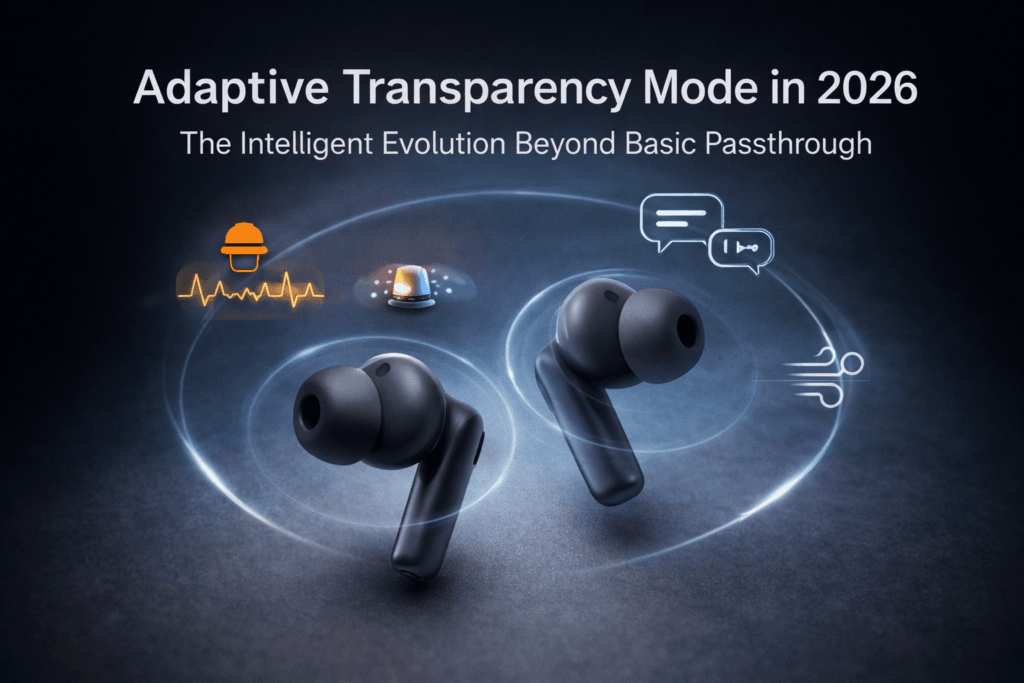
Adaptive Transparency Mode in 2026: The Intelligent Evolution Beyond Basic Passthrough
Adaptive Transparency Mode in 2026: The Intelligent Evolution Beyond Basic Passthrough Noise cancellation used to be the headline feature. Transparency was the

Powerful Signals AI Scaling Is Redefining Performance in 2026
Powerful Signals AI Scaling Is Redefining Performance in 2026 The hardware race that defined consumer tech for thirty years is decelerating. A