
AI Integration in Smart Devices 2026 Is Quietly Changing How Technology Behaves
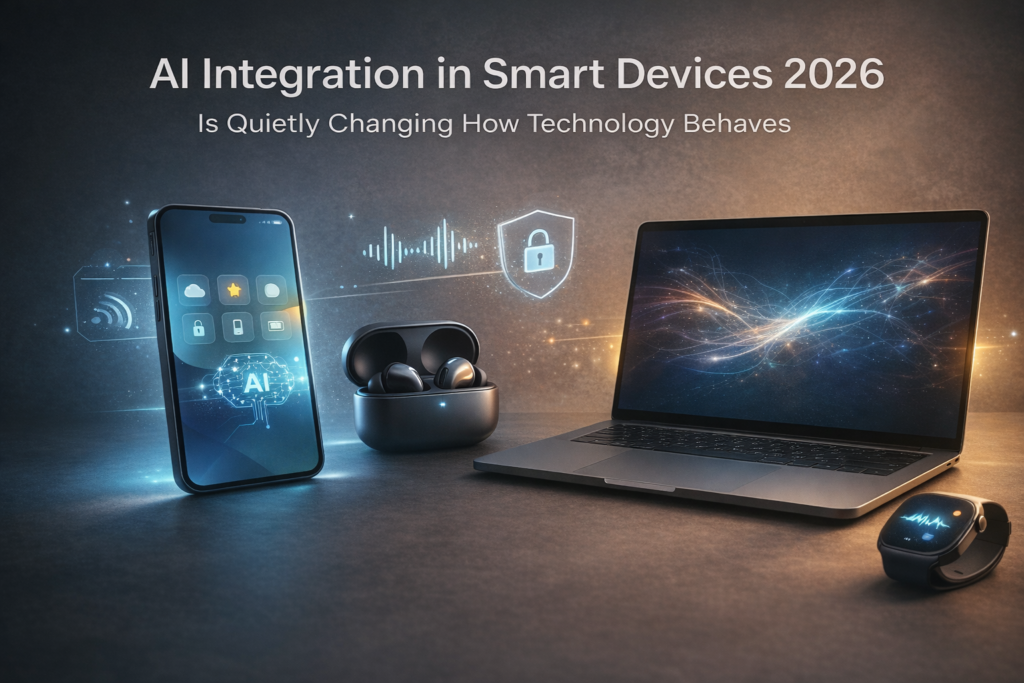
For years, smart devices asked us to adapt to them—tap here, configure there, learn their quirks. In 2026, that imbalance is finally breaking. Devices are no longer reacting to commands; they’re anticipating intent. The shift isn’t louder processors or flashier specs. It’s something subtler: intelligence baked into the design itself. Most people see AI as a software layer. The real change is happening deeper—and it’s already reshaping how devices behave when no one is watching.
The Moment Devices Started Acting Like Systems, Not Gadgets
Watch how a modern phone dims before your eyes strain, how earbuds reshape sound mid-conversation, or how a laptop reallocates power before the fan spins up. None of this feels dramatic. That’s the point. AI integration in smart devices 2026 isn’t announcing itself; it’s dissolving into the background. Engineers stopped treating AI as an add-on and started designing hardware, firmware, and interfaces around adaptive behavior from day one. Intelligence became structural.
This is the first generation where “smart” doesn’t mean cloud-dependent tricks. It means devices that sense, decide, and adjust locally—often before users notice a problem exists.
Everyone Talks About AI Features—The Real Shift Is Architectural
The common narrative says devices are smarter because models are bigger. That’s backwards. What changed in AI integration in smart devices 2026 is where intelligence lives.
Instead of funneling raw data to distant servers, modern devices rely on tightly coupled systems:
- On-device inference engines
- Dedicated neural accelerators
- Sensor fusion pipelines designed for prediction, not reporting
AI is no longer waiting for user input. It’s continuously modeling context: motion, environment, usage history, even behavioral rhythm. The device isn’t asking, “What did the user do?” It’s estimating, “What’s likely to happen next?”
That distinction changes everything—from battery life to privacy boundaries.
Why Intelligence Now Starts at the Sensor Level
Older smart devices treated sensors as passive data collectors. In 2026, sensors are intelligent participants.
Cameras pre-filter frames before processing. Microphones classify sound types before recording. Motion sensors infer intent rather than raw movement. This layered approach reduces latency, power draw, and unnecessary data storage. More importantly, it allows decisions to happen in microseconds, not milliseconds.
Micro-shift that matters:
AI integration in smart devices 2026 favors preemptive filtering over post-processing. Devices decide what not to care about as aggressively as what they do.
Quick Snapshot — Where Intelligence Now Lives
| Device Layer | Old Role | 2026 Role |
|---|---|---|
| Sensors | Raw input | Context-aware filtering |
| SoC | General compute | Predictive task routing |
| AI Engine | Optional accelerator | Always-on decision core |
| OS | Command execution | Behavior orchestration |
The Misconception That AI Is About “Doing More”
Consumers often expect AI to add features. In reality, the best implementations remove friction.
Take adaptive power management. Instead of static profiles, devices learn usage patterns across days, not minutes. They predict when performance spikes are likely—and pre-stage resources accordingly. The result isn’t speed benchmarks; it’s fewer slowdowns when it matters.
This is why AI integration in smart devices 2026 often feels invisible. Success is measured in absence: no lag, no overheating, no sudden battery drops.
How Market Pressure Forced This Evolution
Three forces collided to push this wave:
- Thermal ceilings — Performance gains couldn’t rely on brute force anymore.
- Privacy expectations — Always-on cloud intelligence became unacceptable.
- User fatigue — People stopped tolerating devices that needed constant micromanagement.
Manufacturers realized that smarter behavior had to come from better internal decision-making, not more user controls. AI moved inward.
Where This Architecture Quietly Changes Daily Routines
Picture a commuter wearing AI-enabled earbuds. Wind noise rises, traffic patterns shift, and the user starts speaking faster. The device doesn’t wait for a mode switch. It reshapes noise cancellation, mic focus, and audio gain in real time—locally.
Or a tablet used alternately for sketching and video calls. The system recognizes posture, app context, and stylus pressure trends. Display refresh, palm rejection, and power allocation shift automatically.
These aren’t headline features. They’re cumulative advantages—and they only work because AI integration in smart devices 2026 treats intelligence as continuous, not event-driven.
Data Without Drama: Why Fewer Metrics Matter More
There’s a reason manufacturers now emphasize responsiveness over raw specs. Intelligence isn’t about processing more data; it’s about making fewer, better decisions.
Key design principles emerging:
- Preference modeling over rule sets
- Short-term prediction over long-term logging
- Local learning loops instead of centralized profiles
This approach reduces dependency on massive datasets while increasing perceived intelligence. Devices feel personal without feeling invasive.
What This Means for Human Behavior
When devices adapt quietly, users stop thinking about them. That cognitive relief matters.
People report:
- Less decision fatigue
- Fewer interruptions
- Higher trust in automation
AI integration in smart devices 2026 shifts technology from attention-seeking to attention-preserving. That’s a psychological upgrade, not a technical one.
Choosing Devices in This New Intelligence Era
Not all “AI-powered” labels mean the same thing. Here’s how different users should evaluate them:
Everyday Users
Look for consistency, not features. Devices that behave predictably across weeks—not days—signal deeper integration.
Creators / Professionals
Prioritize systems that adapt to workload patterns. Intelligent resource allocation matters more than peak performance.
Gamers / Enthusiasts
Watch for latency management and thermal prediction. Smart scheduling beats raw clocks.
Future-Proof Buyers
Favor platforms designed around on-device learning. Software updates can enhance intelligence only if the hardware was built for it.
Dynamic Pros & Cons
| Aspect | Advantage | Trade-off |
|---|---|---|
| On-device AI | Faster response, privacy | Higher silicon complexity |
| Predictive systems | Smoother experience | Less manual control |
| Sensor-level intelligence | Lower power use | Harder to benchmark |
When This Advice Doesn’t Apply
There are still edge cases where heavy cloud reliance makes sense—large-scale data analysis, collaborative AI, or specialized professional tools. Not every device benefits equally from local intelligence. The danger is assuming all AI integration is equal. It isn’t.
What Users Are Quietly Saying Online
Across forums and long-term user threads, a pattern emerges: praise focuses less on features and more on feel.
User Reality Snapshot
| Theme | Common Sentiment |
|---|---|
| Battery behavior | “It lasts longer without me thinking about it.” |
| Performance | “No sudden slowdowns anymore.” |
| Trust | “It reacts how I expect.” |
| Complaints | “Hard to tell what it’s actually doing.” |
The irony? The better AI integration in smart devices 2026 becomes, the harder it is to market—because the value is experiential, not visible.
Where This Is Headed Next
Expect the next phase to focus on cross-device coherence. Intelligence won’t live in silos. Phones, wearables, and home devices will share context—not data—to act as a single adaptive system.
The winners won’t be those with the biggest models, but those with the cleanest feedback loops.
The Quiet Payoff of Smarter Design
Think back to the last time a device surprised you—in a good way. No alert. No tutorial. Just behavior that felt right. That’s the signature of this wave. AI integration in smart devices 2026 isn’t about wow moments. It’s about disappearing into usefulness.
And once you notice that, it’s hard to go back.
Vibetric Ending
Smarter technology doesn’t shout. It listens, predicts, and adjusts—long before you realize it needed to.
What’s Behind the Magic of AI Integration in Smart Devices?
- Follow vibetric_official on Instagram to keep up with the latest trends and insights into smart technology and device intelligence.
- Bookmark Vibetric.com we continuously update our analysis as new developments emerge in AI-powered hardware.
Subscribe for updates and receive ongoing, in-depth breakdowns and expert opinions on the future of connected devices.
The Questions Readers Ask Once the Hype Wears Off
Earlier implementations treated AI as a feature layer. In 2026, intelligence is embedded into hardware pipelines, operating systems, and sensor logic, allowing devices to adapt continuously rather than react episodically.
Less than before. Most real-time decisions now happen on-device, reducing latency and improving reliability, while the cloud is reserved for large-scale updates or optional services.
Not primarily. Architectural efficiency, sensor fusion, and predictive decision-making matter more than raw model size for everyday responsiveness.
Predictive power allocation allows devices to prepare for demand instead of reacting to it, which often results in smoother performance and fewer unnecessary power spikes.
In most cases, no. Modern systems analyze patterns locally and discard raw inputs quickly, prioritizing context awareness over long-term data storage.
Look for long-term behavioral consistency—fewer interruptions, stable performance, and adaptive behavior that improves over weeks, not just during demos.
Transparency can suffer. Because decisions happen automatically, users may feel less control or understanding over why a device behaves a certain way.
Only to a limited extent. Deep AI integration relies on dedicated accelerators and sensor-level design that software alone can’t replicate.
No. The same design philosophy is spreading across home automation, audio systems, and productivity hardware where responsiveness matters more than raw power.
Technology becomes less demanding and more supportive—quietly aligning with human behavior instead of forcing people to adapt to machines.
What’s your take on this?
At Vibetric, the comments go way beyond quick reactions — they’re where creators, innovators, and curious minds spark conversations that push tech’s future forward.
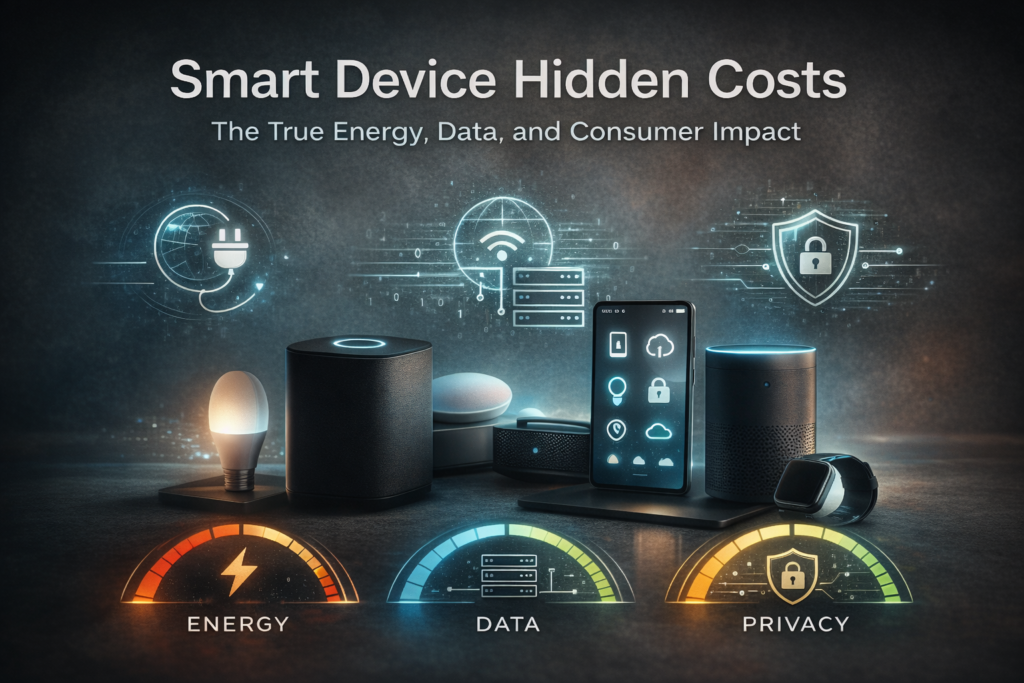
Smart Device Hidden Costs: The True Energy, Data, and Consumer Impact
Smart Device Hidden Costs: The True Energy, Data, and Consumer Impact Smart technology didn’t arrive as a disruption. It crept in quietly.
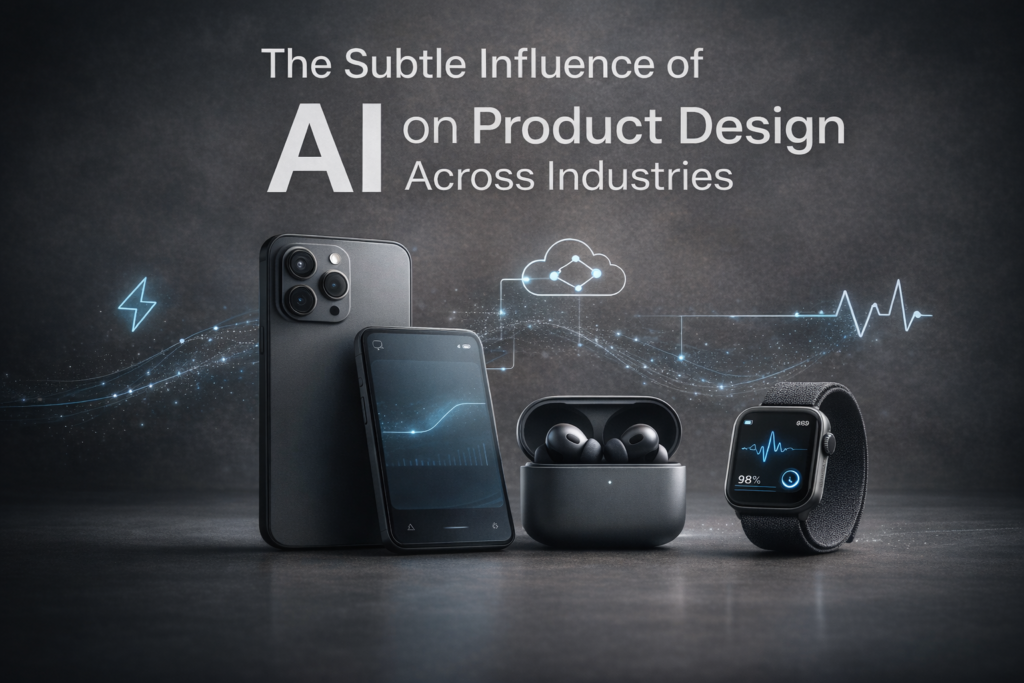
The Quiet, Hidden AI Influence on Product Design Across Industries
The Quiet, Hidden AI Influence on Product Design Across Industries Most people think product design changes when something looks radically different. A