
AI in Smartphones Marketing vs Reality: The Real Problem With Overhyped AI Claims
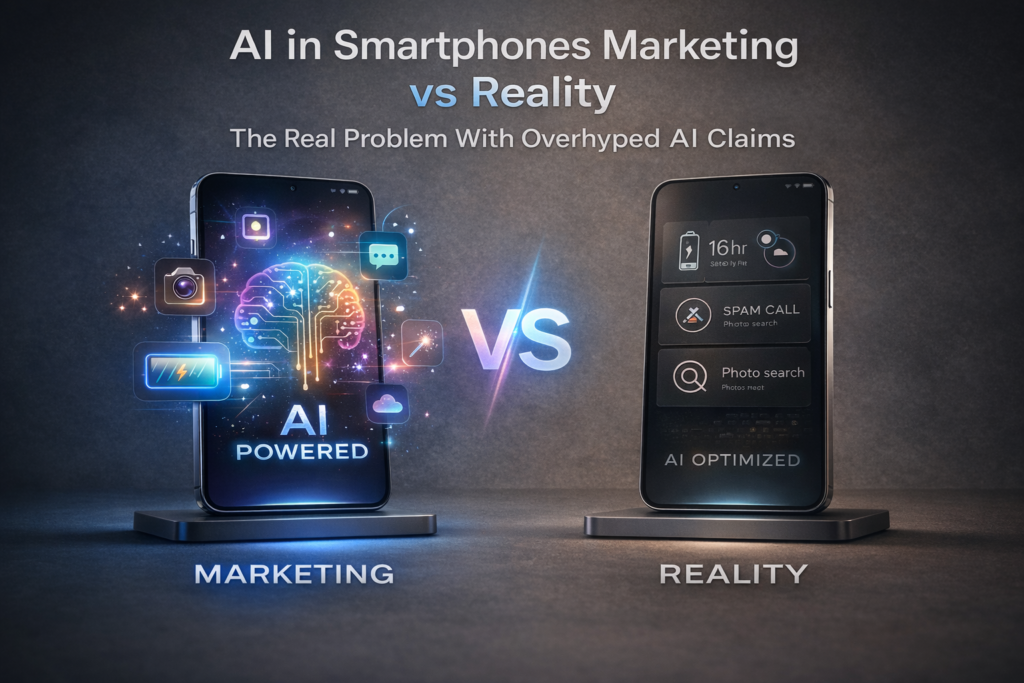
AI is everywhere in smartphone marketing right now. Every launch promises smarter cameras, intelligent battery management, context-aware assistants, and on-device magic that supposedly changes how you use your phone. But once the ads fade and daily routines kick in, a quieter question emerges: is AI on smartphones actually improving everyday use, or is it mostly branding gloss?
The honest answer sits between meaningful progress and exaggerated storytelling.
How AI Became the New Spec Sheet Buzzword
As performance gains slowed, smartphone marketing needed a new frontier. Clock speeds plateaued. Camera hardware matured. Battery tech advanced incrementally. AI filled the gap perfectly.
Unlike RAM or megapixels, AI is abstract. It’s difficult to measure, hard to benchmark consistently, and easy to frame as transformative. That ambiguity made it ideal for marketing.
This is where AI in smartphones marketing vs reality begins to diverge.
Where AI Genuinely Improves Daily Use
Some AI features deliver quiet but real value—often without users noticing them explicitly.
Camera processing is the clearest example. Scene detection, HDR stacking, night mode, and portrait separation rely heavily on AI models. Photos today are more consistent, forgiving, and usable across lighting conditions than ever before.
Battery optimization is another subtle win. AI-driven power management adapts background activity, learning which apps you actually use and which can be restricted. The result isn’t revolutionary battery life—but it’s more predictable endurance.
Spam detection, voice-to-text accuracy, call screening, and photo search are also legitimate improvements. These features don’t feel futuristic—but they reduce friction, which is the point.
Where AI Mostly Becomes Noise
The problem arises when every feature is framed as AI-driven, even when the impact is negligible.
“AI-enhanced performance” often means basic task scheduling. “AI-powered gaming” usually boils down to thermal throttling profiles. “Smart assistants” still struggle with context, intent, and follow-up questions.
Many AI features are technically present but practically irrelevant. They exist to populate launch slides, not to change behavior.
This gap defines the core tension in AI in smartphones marketing vs reality.
The Feature You Use vs the Feature You’re Sold
Most users interact daily with only a handful of AI-powered functions—camera processing, keyboard predictions, and background optimizations. Meanwhile, marketing highlights features users try once and forget.
This mismatch creates fatigue. When AI is everywhere, nothing feels special.
Ironically, the best AI features are the least advertised—the ones that quietly work in the background without demanding attention.
A Reality Check Snapshot
| AI Claim | Real-World Impact |
|---|---|
| AI camera modes | High, consistent improvement |
| AI assistants | Limited, situational |
| AI performance boosts | Marginal |
| AI personalization | Subtle but useful |
this table highlights how AI in smartphones marketing vs reality splits between genuine utility and inflated expectation.
On-Device AI vs Cloud AI Confusion
Another source of misunderstanding is where AI actually runs. Many features marketed as “on-device AI” still rely partially on cloud processing. This affects speed, privacy, and offline usability.
True on-device AI is improving—but it’s constrained by power, thermals, and silicon limits. Marketing often blurs that distinction, implying independence that doesn’t fully exist yet.
This fuels skepticism, even when progress is real.
AI Isn’t Replacing Apps—It’s Optimizing Them
One misconception is that AI will fundamentally change how we interact with smartphones. In reality, AI mostly optimizes existing workflows rather than replacing them.
Your phone isn’t smarter because it thinks differently—it’s smarter because it makes fewer mistakes. Less blur. Fewer spam calls. Better predictions. That’s evolutionary, not revolutionary.
Expecting AI to feel dramatic guarantees disappointment.
Why the Gap Feels Larger Than It Is
AI improvements are incremental and cumulative. Each update adds a small gain. But marketing frames each one as a breakthrough.
This mismatch between gradual progress and dramatic messaging is why many users feel underwhelmed—even when their phones are objectively better than before.
The issue isn’t AI capability. It’s expectation inflation.
The Honest Verdict
AI on smartphones is improving daily use—but not in headline-grabbing ways. Its biggest contributions are invisible, preventative, and unglamorous.
At the same time, AI in smartphones marketing vs reality remains skewed. Too many features are oversold, too many demos don’t translate into habit-forming value.
AI works best when you forget it’s there.
What Actually Matters Going Forward
The future of smartphone AI won’t be defined by flashy assistants or novelty features. It will be defined by reliability, privacy-respecting on-device processing, and deeper system-level integration.
When AI stops being marketed as a feature and starts behaving like infrastructure, the noise will fade—and the value will finally feel obvious.
Until then, skepticism isn’t cynicism. It’s just informed usage.
Read Between the Buzzwords with Vibetric
- Follow our Instagram @vibetric_official for grounded tech analysis.
- Bookmark vibetric.com for clarity beyond launch-stage hype.
- Stay informed as AI evolves from marketing language into everyday utility.
What’s your take on this?
At Vibetric, the comments go way beyond quick reactions — they’re where creators, innovators, and curious minds spark conversations that push tech’s future forward.
OnePlus 15 Review 2026: Intelligent Performance in the AI Era
OnePlus 15 Review 2026: Intelligent Performance in the AI Era Performance used to be theatrical. Manufacturers showcased peak clock speeds, explosive benchmark
Next-Gen Smartphones Feel Dramatically Better in 2026 — Even If They Look the Same
Next-Gen Smartphones Feel Dramatically Better in 2026 — Even If They Look the Same The industrial design hasn’t changed much. The camera