
AI Hardware Investment 2027: The Critical Shift Driving the Next Semiconductor Boom
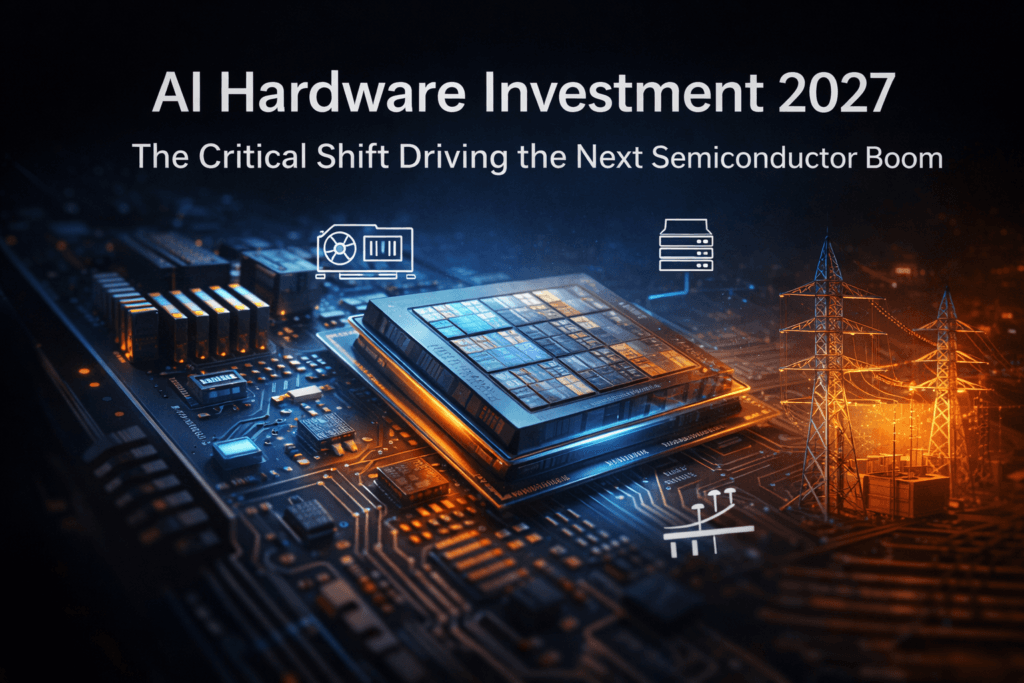
In 2023 and 2024, the AI conversation centered on models. In 2025 and 2026, it shifted toward infrastructure. By 2027, the real story isn’t software hype—it’s silicon, power grids, and fabrication capacity.
Money doesn’t chase headlines forever. It chases bottlenecks.
And right now, the largest bottlenecks in artificial intelligence aren’t algorithms. They’re chips, packaging, memory bandwidth, and energy delivery. That’s why AI hardware investment 2027 is shaping up to be one of the most decisive capital allocation trends of the decade.
The question isn’t whether money is flowing.
It’s where it’s concentrating—and why.
The Quiet Capital Rotation Few Retail Investors Notice
The early AI rally rewarded model builders and cloud platforms. But institutional capital has rotated downstream.
Today, major funding flows increasingly target:
- Advanced GPU production capacity
- High-bandwidth memory manufacturing
- Data center cooling infrastructure
- Semiconductor packaging innovation
- Edge AI chip startups
The shift is structural. AI demand is compute-bound. And compute lives in hardware.
By 2027, AI hardware investment 2027 will be less about speculative startups and more about scaling bottlenecks across the supply chain.
Silicon Is the New Oil — But Refining It Is the Real Moat
To understand where money is flowing, you have to map the stack.
- AI Accelerators and GPUs
Companies like NVIDIA and Advanced Micro Devices remain core beneficiaries. But the story is expanding beyond traditional GPUs.
Custom AI accelerators designed for inference efficiency are attracting enormous funding rounds. Hyperscalers are increasingly designing in-house silicon to control costs and optimize workloads.
- Foundries and Advanced Nodes
Manufacturing capacity at leading-edge nodes is tight. TSMC continues to dominate advanced fabrication, making foundry expansion one of the most strategic areas in AI hardware investment 2027.
Capital isn’t just funding chip design. It’s funding the ability to physically produce them.
- High-Bandwidth Memory (HBM)
AI models are memory-hungry. High-bandwidth memory suppliers like SK Hynix and Samsung Electronics are seeing elevated capital flows because memory throughput now directly limits AI performance.
The next gains won’t come from more cores alone—but from feeding those cores fast enough.
The Infrastructure Arms Race Behind the Models
AI doesn’t live on chips alone. It lives in data centers.
By 2027, investment in:
- Liquid cooling systems
- High-density rack designs
- Power delivery upgrades
- On-site renewable energy
will rival spending on GPUs themselves.
Large-scale operators are redesigning data centers for AI-first workloads. Air cooling is insufficient for next-gen accelerators. Liquid immersion and advanced thermal management are no longer experimental—they’re becoming necessary.
This is where AI hardware investment 2027 extends beyond semiconductors and into industrial engineering.
Why Edge AI Is Quietly Gaining Momentum
Cloud training dominates headlines. But inference at the edge is expanding rapidly.
Smart devices, robotics, autonomous systems, and industrial automation require:
- Efficient inference chips
- Low-power AI accelerators
- Integrated neural processing units (NPUs)
Startups focusing on edge AI hardware are drawing venture capital because centralized compute cannot scale infinitely. Latency, privacy, and bandwidth costs push intelligence closer to the device.
This is one of the least discussed but most strategic vectors of AI hardware investment 2027.
Real-World Capital Flow Scenarios
Consider three investor profiles shaping this wave:
Institutional Funds
Allocating toward semiconductor manufacturing capacity and energy infrastructure—long-cycle assets with defensible moats.
Venture Capital
Backing chip startups specializing in AI inference, custom accelerators, and chiplet architectures.
Corporate Strategic Investors
Hyperscalers investing vertically to reduce dependency on third-party GPU suppliers.
Each capital source behaves differently. But all converge on hardware constraints.
A Snapshot of Where Funding Is Concentrating
| Segment | Investment Intensity | Why It Matters |
|---|---|---|
| Advanced GPUs | Very High | Training bottlenecks |
| HBM Memory | Very High | Memory bandwidth limits AI scaling |
| Semiconductor Packaging | Rising Fast | 3D stacking and chiplets increase efficiency |
| Data Center Cooling | Accelerating | Thermal limits of high-density racks |
| Edge AI Chips | Growing | Decentralized inference demand |
| Power Infrastructure | Strategic | AI data centers are energy-intensive |
The table reflects structural necessity—not speculative enthusiasm.
The Energy Constraint Few Forecast Models Price In
AI workloads are power-hungry. By 2027, energy availability becomes a competitive variable.
Investment is flowing into:
- Grid upgrades
- On-site generation
- Nuclear partnerships
- Renewable-backed data campuses
Compute capacity without energy stability is stranded capital. That’s why AI hardware investment 2027 increasingly overlaps with utilities and industrial infrastructure.
Hardware isn’t just silicon.
It’s electrons.
The Human Impact: Who Benefits Beyond Chipmakers?
This wave influences:
- Electrical engineers
- Thermal systems designers
- Materials scientists
- Packaging specialists
- Power systems planners
The AI boom is expanding demand across engineering disciplines—not just software.
For professionals evaluating career pivots, hardware-adjacent expertise may prove more durable than model training specialization.
When the Narrative Overheats
There is risk.
Hardware cycles historically overshoot. Semiconductor expansions can lead to temporary supply gluts. AI spending could normalize after hyperscaler build-outs stabilize.
Not every startup in the AI hardware ecosystem will survive. Capital intensity is unforgiving. Manufacturing delays are common. Yield challenges are real.
Prudent investors recognize that AI hardware investment 2027 is concentrated—not evenly distributed across every company with “AI” in its pitch deck.
Operational Friction the Headlines Ignore
Across technical forums and investor communities, recurring patterns appear:
| Sentiment | Common Theme |
|---|---|
| Engineers | Memory and packaging are underappreciated constraints |
| Retail investors | Overexposure risk to a single GPU vendor |
| Data center operators | Power and cooling complexity rising |
| Semiconductor analysts | Capacity expansion risk post-2027 |
| AI researchers | Compute access defines research speed |
| Startup founders | Hardware fundraising cycles are longer |
The signal isn’t blind optimism. It’s cautious strategic positioning.
What Makes 2027 Structurally Different From 2023
In 2023, AI enthusiasm centered on application-layer software.
By 2027:
- Model sizes plateau for efficiency reasons
- Inference dominates training in volume
- Energy becomes a limiting factor
- Hardware specialization fragments the market
The market matures.
That’s why AI hardware investment 2027 is less speculative hype and more infrastructure commitment.
Infrastructure is harder to unwind.
Investor Framework: Where to Look Carefully
Long-Term Infrastructure Investors
Focus on fabrication, memory suppliers, and energy providers.
Growth Investors
Selective exposure to accelerator design companies and packaging innovators.
Venture Capital
Edge AI chips and custom inference silicon.
Conservative Allocators
Diversified semiconductor ETFs with exposure to manufacturing and materials.
The key is avoiding narrative traps and identifying structural bottlenecks.
The Deeper Economic Implication
AI hardware spending signals a new industrial cycle.
Unlike software booms, hardware expansion stimulates:
- Construction
- Utilities
- Raw materials
- Advanced manufacturing
It resembles infrastructure revolutions of the past more than a typical tech cycle.
And infrastructure cycles last longer.
Where This Wave May Break Next
By late 2027 and beyond, expect:
- Consolidation among AI chip startups
- Strategic partnerships between utilities and data center operators
- Further geopolitical emphasis on semiconductor sovereignty
- Increased regulation around energy-intensive AI operations
Capital follows friction.
And friction remains highest in hardware supply chains.
Vibetric Ending
The AI story began with chatbots. It continues with power grids and chiplets.
If you’re analyzing the future of artificial intelligence purely through software, you’re missing half the equation.
AI hardware investment 2027 isn’t a side narrative. It’s the structural backbone of AI’s next growth phase.
Silicon determines scale. Energy determines sustainability. Infrastructure determines longevity.
By 2027, the market won’t ask whether AI is transformative.
It will ask who controls the hardware that makes it possible.
What’s Next for AI Hardware Investment 2027? Stay Ahead of the Curve
- Follow vibetric_official on Instagram to keep up with the latest trends and insights into AI infrastructure and semiconductor markets.
- Bookmark Vibetric.com we continuously update our analysis as new developments emerge in AI hardware ecosystems.
Subscribe for ongoing, in-depth breakdowns and expert investment perspectives on the evolving AI hardware landscape.
Strategic Clarifications for Capital Allocators
Because compute bottlenecks, memory constraints, and energy demands are limiting AI scalability, pushing capital into physical infrastructure.
Yes, but memory, packaging, and cooling infrastructure are becoming equally critical.
Energy availability directly impacts data center scalability, making utilities a strategic component.
Not necessarily. Decentralized inference demand is rising due to latency and privacy requirements.
Possible. Semiconductor cycles historically overshoot before stabilizing.
Yes. Multiple regions are investing heavily in semiconductor independence and AI infrastructure.
Startups carry execution and capital risk. Large manufacturers face cyclical demand risks.
Growth may normalize, but structural AI compute demand is likely to remain elevated.
What’s your take on this?
At Vibetric, the comments go way beyond quick reactions — they’re where creators, innovators, and curious minds spark conversations that push tech’s future forward.
Hardware Innovation Slowdown in 2026: The Surprising Rise of Software Acceleration
Hardware Innovation Slowdown in 2026: The Surprising Rise of Software Acceleration For over a decade, consumer technology moved in visible leaps. Processors
Minimalist Tech Design Trends 2026 — Why Clean, Powerful Devices Are Winning
Minimalist Tech Design Trends 2026 — Why Clean, Powerful Devices Are Winning For years, consumer technology competed on excess — more cameras,