
AI Battery Optimization Is Revolutionizing Earbud Battery Life in 2026
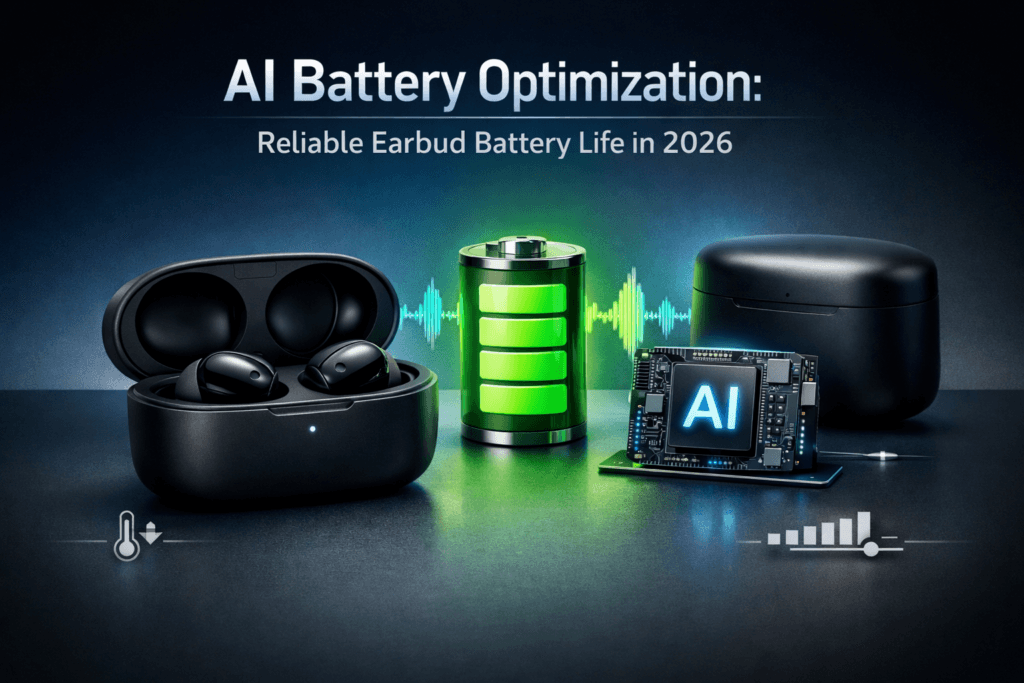
The spec sheet still says ‘30 hours.’ What it doesn’t say is that a machine learning model running on a dedicated low-power core is the reason those hours are actually achievable.
The Number on the Box Was Never the Full Story
Battery life ratings in consumer audio have always been optimistic engineering. Manufacturers test at moderate volume, with ANC off or in a fixed state, in temperature-controlled conditions. Real-world usage — commute noise, gym environments, video calls on variable codecs — routinely shaved 20 to 35 percent off rated figures. Buyers learned to mentally discount the spec. That discount is now smaller, and AI battery optimization is the primary reason.
The shift didn’t come from better battery chemistry. Lithium-ion cell density in the earbud form factor has improved incrementally, not dramatically. What changed is how intelligently the system manages every watt it already has.
What Listeners Actually Do Versus What Engineers Test For
There’s a fundamental mismatch between lab test methodology and real listening behavior. Engineers measure static scenarios. Listeners are dynamic — they pause playback to speak, toggle ANC when they enter a quiet room, take calls that switch the codec, turn volume up on a subway platform and forget to turn it back down.
AI battery optimization addresses this mismatch directly by modeling the user rather than the environment. Inference running on the chip isn’t predicting what the battery will do — it’s predicting what the listener will do next, and pre-positioning the system’s power state accordingly. A user who consistently pauses playback every eight minutes gets a different power profile than one who plays continuously for forty-five.
This is behavioral modeling applied to hardware management, and it’s a different category of optimization from anything prior-generation earbuds were doing.
The distinction between ‘adaptive’ and ‘AI-optimized’ matters here. Adaptive systems react to current conditions. AI battery optimization systems anticipate future conditions based on learned patterns. The power savings compound differently over time because one is always one step behind.
Where the Inference Actually Runs
The engineering constraint that makes this interesting is thermal and physical. Earbuds operate in a chassis smaller than a walnut with a battery measured in milliamp-hours, not milliwatt-hours. Running meaningful inference on that platform without consuming the headroom you’re trying to create requires dedicated silicon architecture — specifically, low-power neural processing units that operate in the microwatt range during inference.
Current implementations separate workloads deliberately. Audio processing, ANC computation, and codec handling run on established DSP cores. The battery optimization model runs on a smaller, slower, but dramatically more efficient inference core that can remain active during playback without registering meaningfully on the power budget. The model’s outputs — adjusted processor clock states, ANC depth modulation, transmitter power scaling — are fed as parameters to the primary audio pipeline.
The result is a system where AI battery optimization is invisible to the listener but structurally present in every component decision the firmware makes.
| Optimization layer | Traditional approach | AI-optimized approach |
|---|---|---|
| ANC power draw | Fixed depth, fixed consumption | Depth scaled to detected ambient noise level |
| Processor clock speed | Static profile per use mode | Dynamic scaling based on predicted workload |
| Bluetooth transmit power | Constant within codec range | Adjusted per real-time signal quality model |
| Codec selection | Negotiated once at connection | Re-evaluated as call or content type shifts |
| Idle power state | Timer-based sleep threshold | Behavior-predicted micro-sleep windows |
The Case Against Trusting the Algorithm Completely
There is a legitimate concern embedded in this shift that the industry hasn’t fully surfaced. When AI battery optimization becomes opaque firmware — which it inevitably does in consumer products — users lose meaningful visibility into why their earbuds behave differently across sessions. A pair that sounds noticeably different at hour six than hour one isn’t malfunctioning. It’s executing its model. But listeners have no interface for that information.
The deeper issue is model drift over firmware updates. An optimization model trained on population-level listening data reflects the average user’s behavior, not any individual’s. Users with atypical patterns — very high volume preferences, extended single-session use, frequent codec switching — may find that AI battery optimization underperforms static power management for their specific case. The algorithm optimizes for the mean. Edge cases still lose.
Efficiency as a Feature, Not a Footnote
What makes this moment notable isn’t the technology itself — it’s that AI battery optimization has become a differentiator that premium earbud manufacturers are now required to have an answer for. Two years ago it was a roadmap item. Today it’s a specification category that shapes purchase decisions at the enthusiast tier.
The next competitive frontier isn’t squeezing more milliamp-hours into a stem. It’s whose model generalizes best across the widest range of real-world listening behaviors while remaining transparent enough that users understand what the system is doing on their behalf. Battery life is no longer just a chemistry problem. It’s a data problem — and the brands treating it that way are pulling ahead.
Keep Up with What’s Actually Moving
- Bookmark Vibetric — the next firmware update that rewrites your battery behavior won’t announce itself.
- Follow Vibetric_Offical on Instagram for sharp takes on audio tech before it goes mainstream.
- Share this with someone still judging earbuds by the number on the box.
What’s your take on this?
At Vibetric, the comments go way beyond quick reactions — they’re where creators, innovators, and curious minds spark conversations that push tech’s future forward.
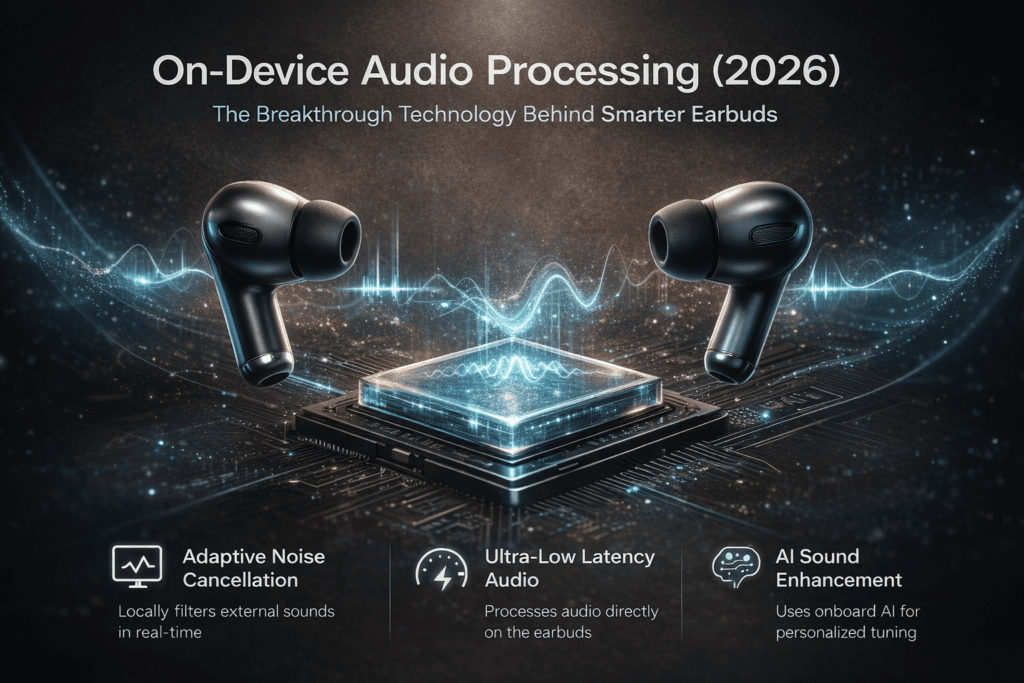
On-Device Audio Processing (2026): The Breakthrough Technology Behind Smarter Earbuds
On-Device Audio Processing (2026): The Breakthrough Technology Behind Smarter Earbuds A commuter taps play on the subway. The train roars into the
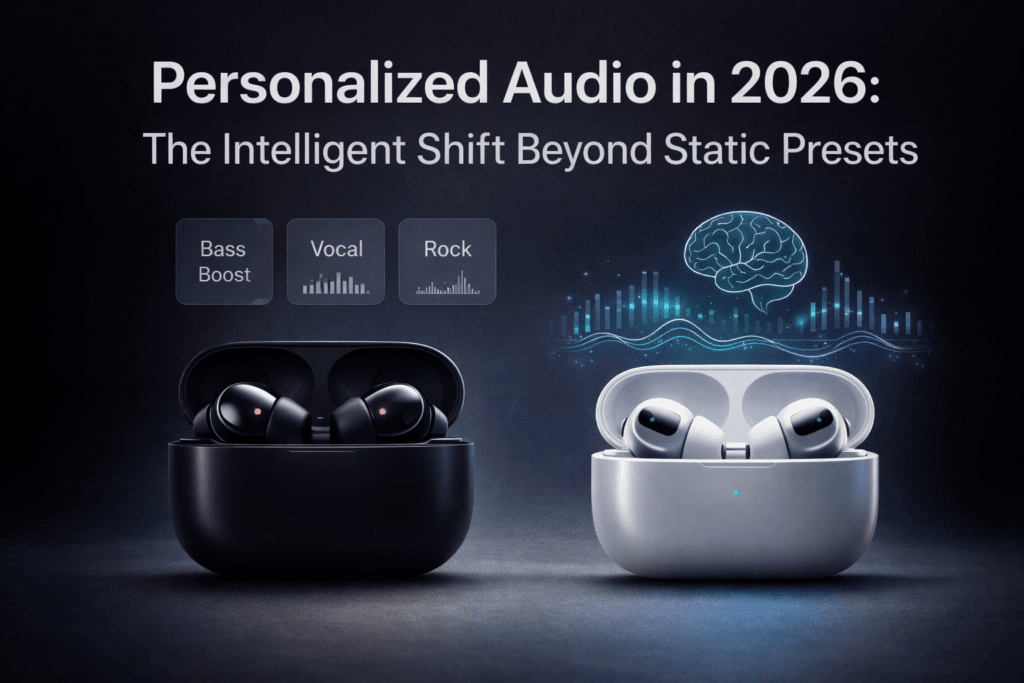
Personalized Audio in 2026: The Intelligent Shift Beyond Static Presets
Personalized Audio in 2026: The Intelligent Shift Beyond Static Presets For years, audio customization meant choosing a label. “Bass Boost.”“Vocal.”“Rock.”“Podcast.” These presets