
AI Audio Tuning in 2026: The Intelligent Shift Redefining Sound
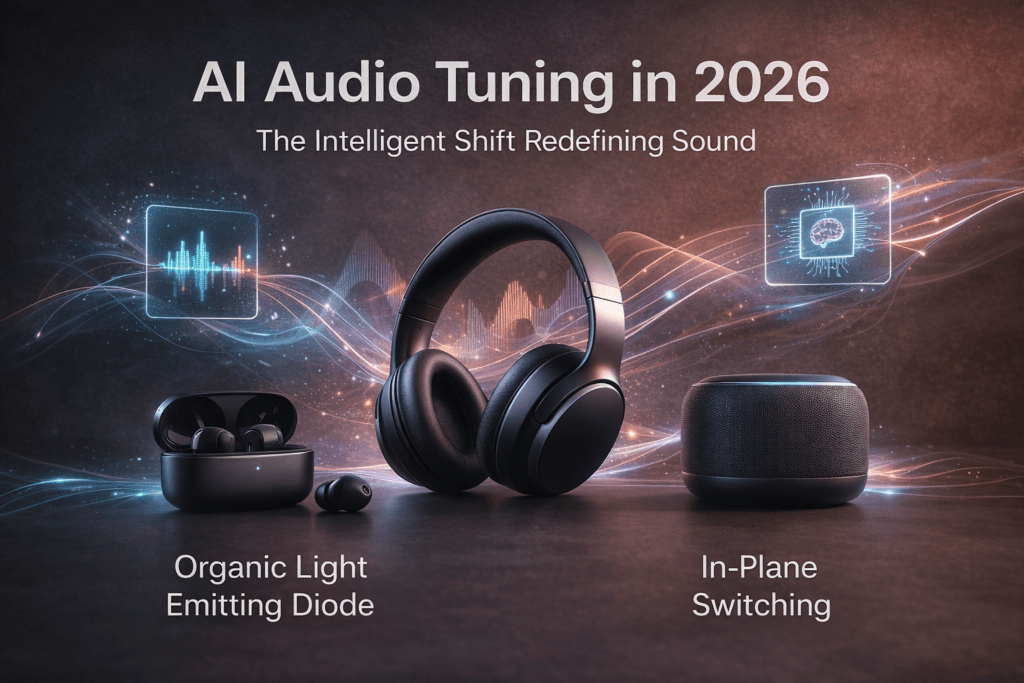
The next major leap in audio isn’t louder drivers or wider frequency graphs. It’s adaptability.
For decades, sound systems were tuned once — inside controlled labs — and then shipped to millions of unpredictable environments. Living rooms, airplanes, offices, crowded streets. The assumption was that a fixed acoustic profile could serve everyone reasonably well.
That assumption is now being challenged.
AI audio tuning marks a structural shift from static calibration to dynamic interpretation. Sound is no longer just engineered at the factory. It’s being recalculated in real time.
From Brand “Sound Signatures” to Algorithmic Personalization
Audio brands historically differentiated themselves through signature tuning. Warm bass emphasis. Neutral studio balance. Sparkling treble detail.
Those identities were intentional and fixed.
AI audio tuning introduces a new paradigm: sound that evolves based on user behavior and context. Instead of one sonic identity, devices can now model listening patterns — preferred genres, volume habits, environmental noise exposure — and adjust accordingly.
The philosophical shift is significant.
When personalization becomes algorithmic, tuning stops being a one-time decision. It becomes a continuous process.
That raises a deeper question: does adaptive optimization strengthen product identity — or dilute it?
| Traditional Audio Design | AI Audio Tuning Approach |
|---|---|
| Fixed EQ profile | Context-aware adaptive EQ |
| Manual sound presets | Automated environment detection |
| Static stereo image | Dynamic spatial recalibration |
| Reactive noise cancellation | Predictive acoustic modeling |
The hardware still performs the physical reproduction. The intelligence determines how that reproduction is shaped moment to moment.
Why Listeners Feel the Difference Instantly
Most people won’t study DSP architecture or model weights.
They’ll notice fewer interruptions.
Switch from a quiet room to a busy commute, and clarity boosts without manual intervention. Transition from dialogue-heavy content to orchestral music, and tonal balance adjusts subtly. Move your head during spatial playback, and the soundstage realigns in real time.
AI audio tuning reduces friction between environment and content.
And when friction disappears, technology becomes invisible. That invisibility is the hallmark of mature infrastructure.
Hardware Isn’t Being Replaced — It’s Being Multiplied
There’s a misconception that intelligent tuning can compensate for weak hardware.
It cannot.
Driver quality, acoustic chamber design, and amplifier stability remain foundational. AI layers enhance output by correcting for variables — but they require accurate baseline reproduction to work effectively.
In fact, as AI audio tuning becomes more sophisticated, hardware demands increase. Faster processors, low-latency sensors, and high-resolution microphones are essential to avoid phase distortion or timing errors during real-time adjustment.
Intelligence doesn’t remove the need for engineering excellence.
It amplifies it.
A Subtle Risk: Over-Automation
Automation always carries trade-offs.
If algorithms constantly optimize for predicted preference, sonic character may converge toward a mathematically safe middle ground. Audiophiles often value distinct tuning philosophies — warmth, neutrality, analytical precision.
When AI audio tuning continually adapts, does that distinctiveness erode?
Moreover, machine learning systems operate on probabilistic inference. They infer taste from patterns, but musical appreciation is emotional and sometimes unpredictable. A user may want aggressive bass during a workout and pristine neutrality during focused work.
True sophistication will require intelligent flexibility — not rigid automation.
Beyond Music: A Broader Acoustic Future
AI audio tuning isn’t limited to consumer headphones.
Its implications extend into augmented reality, remote collaboration, gaming immersion, and even hearing assistance technologies. Personalized hearing profiles, adaptive dialogue enhancement, and context-sensitive soundscapes could redefine how audio supports daily life.
The trajectory suggests devices are transitioning from playback tools to acoustic companions — systems that interpret rather than simply reproduce sound.
That shift mirrors a larger movement in technology: from passive hardware to adaptive software-defined platforms.
The Direction Ahead
The era of wattage-driven marketing and static frequency graphs is fading. In its place, intelligence is becoming the differentiator.
As AI audio tuning matures, the brands that succeed will be those that balance personalization with transparency — offering control without overwhelming complexity. The future of sound will not be defined solely by hardware specs, but by how intelligently devices interpret context.
Sound once depended on physics alone.
Now it also depends on perception.
And perception is increasingly being modeled, refined, and tuned in real time.
Stay in Sync with Vibetric
- Follow our Instagram @vibetric_official for deep, signal-first insights on AI audio tuning evolution.
- Bookmark vibetric.com to track how intelligent sound systems are reshaping listening.
- Return regularly for analysis that cuts through feature noise and focuses on structural change.
What’s your take on this?
At Vibetric, the comments go way beyond quick reactions — they’re where creators, innovators, and curious minds spark conversations that push tech’s future forward.
AI Battery Optimization Is Finally Making Earbud Battery Life Reliable in 2026
AI Battery Optimization Is Revolutionizing Earbud Battery Life in 2026 The spec sheet still says ‘30 hours.’ What it doesn’t say is
Compact Earbuds Technology 2026 — The Powerful Shift Toward Smaller, Smarter Audio
Compact Earbuds Technology 2026 — The Powerful Shift Toward Smaller, Smarter Audio Minimalism in audio design used to mean compromise. Smaller shells