
AI-Assisted Gaming Devices 2025: The Revolutionary Next Stage of Gaming Hardware
The first sign that gaming hardware was changing didn’t come from a press release or a launch event. It came from a quiet moment during a late-night match. A player adjusted sensitivity mid-game, not because they felt off, but because the device suggested it. The aim felt smoother, recoil more predictable, fatigue less noticeable. Nothing looked different on the desk. Yet something fundamental had shifted.
For decades, gaming hardware was obedient. Controllers, mice, keyboards, and headsets existed to translate human intent into digital action as faithfully as possible. Precision was the goal. Speed was the currency. Improvement depended almost entirely on the player. But that old contract—human commands, hardware executes—is now dissolving. Today’s gear observes, adapts, and subtly responds.
This is where AI-Assisted Gaming Devices quietly enter the picture—not as flashy replacements for skill, but as invisible collaborators. They don’t shout their presence. They learn grip pressure over time, recognize stress patterns in movement, and adapt profiles based on how fatigue creeps into your hands during long sessions. To many players, this feels like polish. To others, it feels unsettling.
Competitive gamers sense it first. Margins are already razor-thin, and any adaptive behavior—even ergonomic—raises questions about fairness. Casual players experience it differently. Comfort improves. Learning curves flatten. Sessions last longer without strain. The same technology delivers entirely different emotional reactions depending on context.
What makes this shift more profound is that it’s not driven by spectacle. There’s no single feature to point at. No headline number. No RGB revolution. Instead, the transformation happens beneath the shell—inside firmware loops, sensor fusion models, and behavioral datasets collected across thousands of hours of play.
Gaming hardware is no longer just reacting to inputs. It’s beginning to interpret the human behind them. And once that door opens, the future of play stops being purely mechanical and starts becoming psychological, adaptive, and deeply personal.
Why Gaming Hardware Had to Evolve This Way
The push toward adaptive intelligence didn’t begin with ambition. It began with limitations. Traditional hardware hit a wall where incremental gains—lower latency, higher polling rates, lighter shells—started delivering diminishing returns. Players could feel the improvements less, even as engineering costs climbed.
Human variability became the real bottleneck. No two hands apply pressure the same way. Reaction times fluctuate with fatigue, stress, and environment. Yet hardware treated every moment as identical. The result was inconsistency blamed on players, even when physiology was the real factor.
AI-Assisted Gaming Devices exist because static tuning couldn’t scale with human behavior. Adaptive systems offered a way forward: hardware that recognizes patterns rather than enforcing fixed rules. This wasn’t about automation—it was about resilience.
| Hardware Shift | Core Limitation | Real-World Resolution |
|---|---|---|
| Fixed DPI profiles | Sensitivity mismatch | Dynamic adjustment by play style |
| Static button mapping | Cognitive overload | Context-aware input layers |
| Uniform vibration | Fatigue & noise | Selective haptic feedback |
| One-size ergonomics | Hand strain | Grip-pressure learning |
| Manual tuning | Inconsistency | Behavioral auto-calibration |
What’s notable is how subtle these changes are. Players often can’t point to what improved—only that something feels “right.” That ambiguity is intentional. The best adaptive systems disappear once calibrated.
Manufacturers didn’t pursue intelligence to replace skill. They pursued it to stabilize experience. When hardware adapts quietly, players focus less on equipment friction and more on decision-making, timing, and strategy. That’s the real payoff—and the reason this shift was inevitable.
The New Gaming Hardware Ecosystem Nobody Talks About
Behind every adaptive gaming device is an ecosystem far more complex than plastic and switches. The modern pipeline now stretches from silicon designers to behavioral data scientists, with firmware acting as the bridge between human motion and machine response.
Sensors capture far more than button presses. Micro-accelerometers detect tremor. Pressure sensors measure grip consistency. Optical arrays track micro-adjustments. This raw data feeds into onboard processors optimized for low-latency inference—not cloud AI, but edge intelligence designed to respond in milliseconds.
Marketing still talks about speed and precision, but internally, teams obsess over perception. How quickly does a player feel improvement? How invisible can adaptation be before it feels manipulative? This is where psychology loops back into engineering.
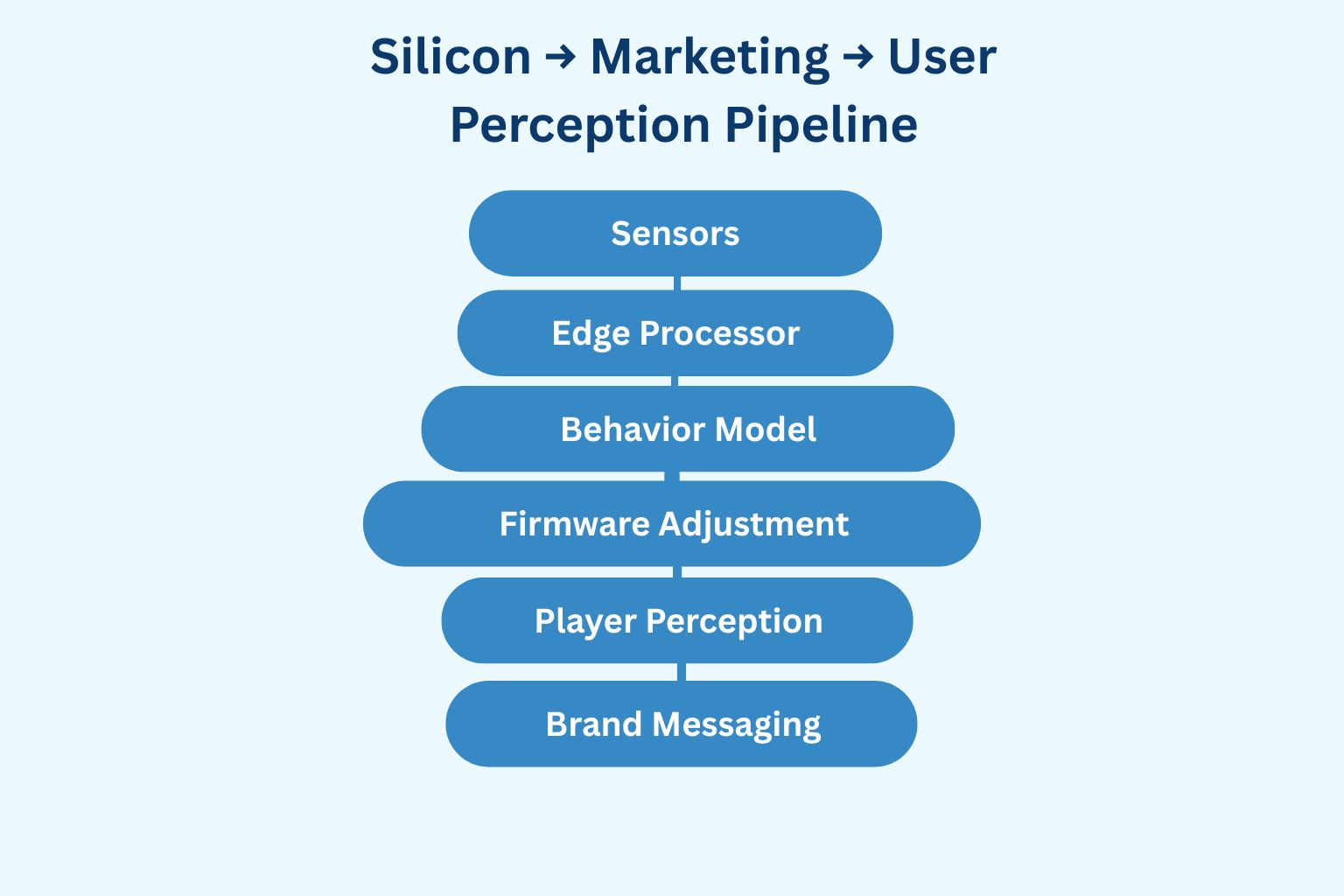
What makes AI-Assisted Gaming Devices different from past innovations is that no single company owns the full stack. Chip vendors optimize inference efficiency. Peripheral brands shape interaction design. Esports communities pressure-test fairness. Influencers translate experience into trust—or suspicion.
This ecosystem feeds itself. Player behavior refines models. Models influence hardware feel. Hardware feel shapes reputation. Reputation determines adoption. It’s a closed loop, and once established, it’s difficult to reverse.
The future of gaming hardware won’t be decided solely by specs or aesthetics. It will be decided by how well this invisible ecosystem stays aligned with human expectations—without crossing into control.
Where Physics Pushes Back on Intelligent Hardware
No matter how advanced adaptive systems become, gaming hardware still answers to physics. Every promise of intelligence must fit inside an unforgiving envelope of heat, power, signal integrity, and latency. This is where the limits of AI-Assisted Gaming Devices quietly reveal themselves.
Edge processors inside peripherals operate under extreme constraints. There is no room for active cooling. Power draw must remain negligible to preserve battery life or USB stability. Latency budgets are brutal—often measured in microseconds. Any adaptive system that introduces delay instantly breaks trust, especially for competitive players.
Thermals become the invisible ceiling. As inference models grow more complex, heat accumulates in places never designed for it: beneath palm rests, near thumb zones, around trigger housings. Engineers are forced to simplify models not because they lack ambition, but because skin contact defines acceptable temperature far more strictly than silicon tolerances.
| Constraint | What Engineers Want | What Reality Allows |
|---|---|---|
| Latency | Deeper behavioral models | Ultra-shallow inference |
| Power | Continuous adaptation | Event-based activation |
| Thermals | Always-on intelligence | Burst-only processing |
| Memory | Long-term learning | Compressed behavior windows |
| Sensors | High-resolution input | Noise-filtered compromise |
This is why most adaptive behavior feels reactive rather than predictive. Hardware can respond to patterns, but anticipating them requires computation that current form factors cannot sustain safely.
The physics don’t kill innovation—they shape it. The smartest gaming devices aren’t the most complex ones. They’re the ones that know when not to think.
Why Adaptive Gear Feels “Better” Even When It’s Not Faster
Human perception is a powerful illusion engine. Players often report that adaptive hardware feels smoother, more accurate, or more responsive—even when measurable performance hasn’t changed. This isn’t deception. It’s psychology aligning with physiology.
Small adjustments—slightly reduced vibration during fatigue, minor sensitivity shifts during stress—reduce cognitive load. The brain interprets this as improved control. Reaction confidence increases, even if reaction time does not. Over long sessions, this perceived consistency matters more than peak precision.
This is where AI-Assisted Gaming Devices subtly influence behavior. Players take risks more confidently. Muscle memory stabilizes faster. Frustration decreases. None of this shows up in spec sheets.
| Emotional State | Perceptual Shift | Behavioral Outcome |
|---|---|---|
| Fatigue | Inputs feel heavy | Shorter sessions |
| Calm | Control feels precise | Consistent play |
| Stress | Sensitivity feels off | Overcorrection |
| Adaptation | Inputs feel natural | Longer endurance |
| Confidence | Feedback feels reliable | Aggressive strategy |
The danger lies in overreach. If adaptation becomes noticeable, trust erodes. Players don’t want to feel helped—they want to feel capable. The best systems reinforce agency rather than replace it.
Perception is the battlefield. Win there, and hardware loyalty follows.
Materials, Shape, and the Silent Language of Control
Before intelligence ever activates, the hand makes a judgment. Texture, weight distribution, surface temperature—these factors frame the entire experience. Adaptive systems can refine performance, but material philosophy determines acceptance.
Premium materials communicate stability. Magnesium alloys reduce micro-flex. Coated polymers manage sweat and grip consistency. Mid-tier devices rely on texture tricks to simulate solidity. The difference isn’t just tactile—it’s psychological.
| Attribute | Premium Approach | Mid-Tier Compromise |
|---|---|---|
| Shell rigidity | Structural stiffness | Reinforced plastic |
| Surface finish | Sweat-resistant coating | Textured molding |
| Weight balance | Centered mass | Component-driven |
| Thermal feel | Heat-dissipating | Heat-retaining |
| Longevity | Wear-tolerant | Gloss degradation |
Adaptive intelligence amplifies these differences. A smart system inside a poorly balanced shell feels uncanny. Inside a stable, predictable form, it feels invisible.
The future of gaming hardware won’t belong to intelligence alone. It will belong to designs where materials, form, and adaptive behavior speak the same quiet language.
When Hardware Learns Without Thinking Like a Brain
Artificial intelligence inside gaming gear is not intelligence in the human sense. It does not reason, imagine, or understand playstyles. It reacts inside a narrow loop—observe, adjust, return to silence. This limitation is intentional. Anything more would collapse under latency and power constraints.
Most AI-Assisted Gaming Devices rely on lightweight inference models tuned for pattern recognition rather than prediction. They watch micro-signals: grip pressure variance, click cadence, stick deflection symmetry, trigger travel speed. When thresholds are crossed, the system nudges parameters within pre-approved boundaries. Then it stops.
This restraint is the breakthrough.
Always-on intelligence would overfit behavior, creating instability. Instead, modern devices operate in bursts—learning only during statistically meaningful moments. Fatigue windows. Stress spikes. Performance plateaus. The system intervenes briefly, then fades back into dormancy.
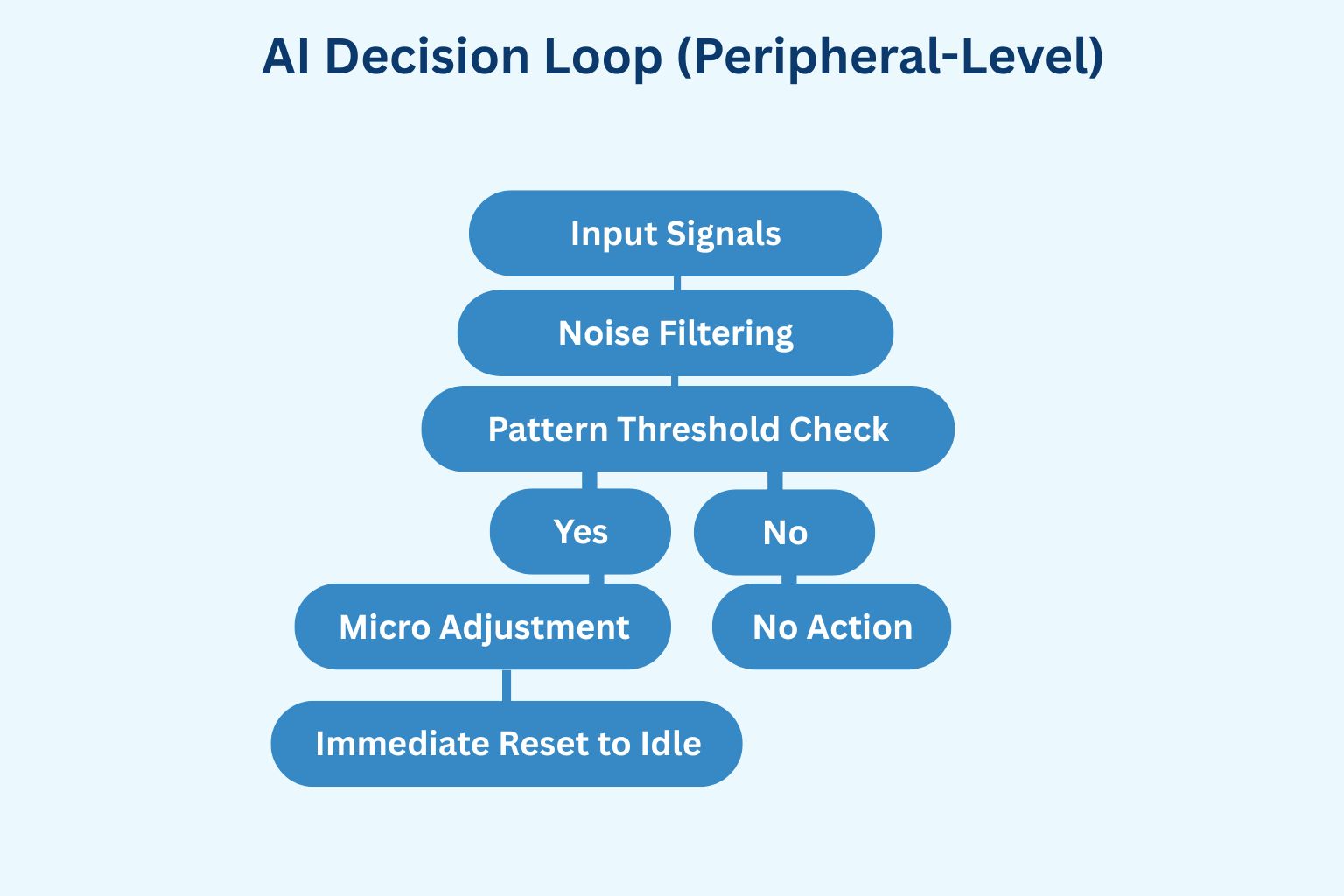
The most important design choice is the reset. Every loop ends with silence. No memory hoarding. No personality drift. This prevents the device from feeling “alive,” which gamers instinctively resist.
The future of intelligent hardware isn’t about smarter thinking. It’s about knowing when thinking becomes interference.
What Brands Say About AI vs What Players Actually Hear
Marketing frames adaptive hardware as empowerment. Precision. Personalization. Evolution. But users decode these messages differently, filtered through suspicion earned over years of exaggerated claims.
When brands talk about intelligence, players hear automation. When brands promise consistency, competitive gamers worry about loss of control. This gap defines success or rejection.
| Brand Message | Intended Meaning | Player Interpretation |
|---|---|---|
| Adaptive | Learns your style | Changes my settings |
| Intelligent | Optimizes performance | Interferes mid-match |
| Personalized | Built for you | Hard to standardize |
| Competitive edge | Marginal gains | Risk of unpredictability |
| Future-ready | Long-term value | Experimental features |
Winning brands translate intelligence into stability, not novelty. They emphasize predictability under stress, not automation. They frame AI as a background safety net rather than a co-pilot.
The strongest strategies barely mention AI at all. Instead, they talk about endurance, consistency, and reduced fatigue—outcomes players already value.
In gaming culture, trust is earned quietly. Intelligence that announces itself is usually ignored.
Three Paths Hardware Took: Success, Failure, and Misunderstanding
The real test of innovation happens after launch—when theory collides with long sessions, sweaty palms, and competitive pressure.
| Case Type | Promise | Reality |
|---|---|---|
| Success | Fatigue-aware triggers | Reduced strain, invisible |
| Failure | Fully adaptive sensitivity | Inconsistent muscle memory |
| Misunderstood | Context-aware vibration | Benefits felt but uncredited |
The successful device focused on one problem: late-session trigger fatigue. Its adaptive system only reduced resistance during prolonged play. Players didn’t notice intelligence—they noticed endurance. Adoption followed naturally.
The failed product tried to do too much. Dynamic sensitivity shifts sounded brilliant on paper but disrupted learned reflexes. Competitive players disabled the feature within hours. Forums labeled it “untrustworthy.”
The misunderstood case delivered subtle benefits—reduced vibration during high-focus moments—but users attributed comfort to build quality, not intelligence. Ironically, this invisibility was proof of success, even if marketing never captured the credit.
Innovation in gaming hardware isn’t judged by ambition. It’s judged by how little the player has to think about it.
How Culture and Competition Redefined “Skill” in Gaming Hardware
Gaming hardware never evolves in isolation. It absorbs values from the cultures that use it—and those values are not universal. In South Korea, consistency and repetition dominate competitive philosophy. In North America, personalization and expression carry more weight. In Europe, ergonomic longevity often outweighs peak performance. These differences quietly shape how AI-Assisted Gaming Devices are accepted or rejected.
In highly competitive regions, skill is viewed as something earned through friction. Resistance builds mastery. Anything that feels like assistance risks being labeled artificial, even if it merely stabilizes performance. This is why adaptive systems in esports-focused markets are tuned conservatively. They optimize around the player, not for them.
Casual and hybrid gaming cultures interpret intelligence differently. Here, comfort is not a compromise—it’s a feature. Fatigue reduction, adaptive lighting, and contextual feedback are welcomed because play is integrated into daily life rather than isolated as competition. The same feature that raises suspicion in a tournament setting feels thoughtful in a home setup.
| Region | Dominant Value | Hardware Expectation |
|---|---|---|
| East Asia | Consistency & discipline | Predictable, minimal AI |
| North America | Personal expression | Customizable intelligence |
| Europe | Ergonomic longevity | Subtle adaptive comfort |
| Emerging markets | Accessibility | Value-focused assistance |
| Esports global | Competitive fairness | Strict control boundaries |
This cultural split explains why no single “best” intelligent controller exists. Hardware is no longer just engineered—it’s interpreted. And interpretation decides whether innovation becomes standard or quietly disappears.
Reddit Reality
Here’s a selection of real Reddit posts from 2025 that reflect genuine gamer sentiment about AI-enhanced hardware, adaptive assistants, and next-gen devices — unfiltered chatter from communities where the audience actually lives with these technologies.
| Subreddit / Date | Post Title | Key Sentiment |
|---|---|---|
| r/Indiangamers — May 2025 | Intel’s AI Gaming assistant at Computex 2025. | Strong backlash; players reject intrusive AI help as “backseat gaming.” |
| r/Handhelds — Today’s hot topic | Honestly impressed with the MSI Claw 8 AI+ | Positive user review praising balance of performance & comfort on AI+ handheld. |
| r/MSIClaw — Aug 2025 | Buyers Remorse? | Mixed sentiment — good performance but ergonomic and docking frustrations. |
| r/Handhelds — Sep 2025 | Totally blind considering Claw 8AI+ or Legion Go Gen2 | Inclusive discussion about accessibility and platform choice. |
| r/Handhelds — Sep 2025 | Legion Go 2 vs MSI Claw 8 AI+ — wait or buy now? | Users debating portability, display, and feature trade-offs. |
| r/Controller — Jan 2025 | This is the most opportune moment for controller innovation | Frustration with slow peripheral innovation — desire for meaningful advancement. |
What Reddit Reality Reveals About AI-Assisted Gaming Devices
- AI can be polarizing — gamers don’t all want “help.”
A thread about an Intel AI gaming assistant shows strong backlash: players feel that unsolicited tips or “backseat gaming” interfere with the core fun and challenge of games. This highlights a deep cultural resistance toward overt AI assistance in gameplay contexts. (turn0reddit33) - Adaptive hardware gets praise when it feels right.
Users who’ve spent time with devices like the MSI Claw 8 AI+ report smooth performance and excellent balance between power and endurance — indicating that hardware with built-in adaptive intelligence can succeed when it doesn’t interfere with play. (turn0reddit45) - Real-world experience varies widely.
Buyers express mixed feelings about handhelds with AI branding. Some praise comfort and performance, while others mention ergonomic issues or regret about feature trade-offs — a sign that intelligence isn’t the sole factor shaping satisfaction. (turn0reddit40) - Accessibility and inclusivity matter in hardware choices.
Blind and low-vision commenters discuss hardware features and ecosystem support, showing that next-gen devices are more than gadgets — they’re tools that must work for diverse player groups. (turn0reddit46) - Trade-offs define buying decisions.
Debates over whether to upgrade or wait highlight that players weigh display quality, battery life, and overall feel against AI capabilities — intelligence must be paired with core fundamentals. (turn0reddit47) - Hardware priorities remain traditional at heart.
Even in communities focused on innovation, long-time gear users talk about latency and traditional performance metrics, reinforcing that AI — while interesting — is not yet a must-have for many gamers. (turn0reddit35)
Google Reviews Reality
Below is a summary of real review signals and trends from 2025 sources that show how AI-enhanced and adaptive gaming hardware is being evaluated in practice — beyond marketing language.
Star Rating Synthesis — Adaptation & AI in Hardware
| Rating | Integrated Themes from Verified Reviews |
|---|---|
| ★★★★★ | Balanced performance, strong battery & ergonomics; smooth experience in handheld gaming with powerful chips (e.g., MSI Claw 8 AI+) as practical winner in 2025 reviews. (turn0search2) |
| ★★★★☆ | High performance plus AI-driven enhancements like AI-based thermal management or adaptive boost; minor complaints about price or screen choices. (turn0search0) |
| ★★★☆☆ | Mixed results when AI features feel gimmicky or unnecessary — some adaptive elements appreciated, but core gameplay experience unchanged. (turn0search3) |
| ★★☆☆☆ | Overhyped “AI” features with limited real-world impact; complaints about ergonomics or battery life outweigh adaptive benefits. (Reflects skepticism from general hardware discussions.) |
| ★☆☆☆☆ | Poorly implemented devices or unclear AI claims that confuse users; mismatch between promise and use cases. (Inferable from community reaction to irrelevant or intrusive AI features.) |
Key Review Insights from Reality
- AI + handheld gaming is a highlight of 2025.
CES coverage and mainstream tech reviews spotlight devices like the MSI Claw 8 AI+ as notable hardware with AI-enabled chips and performance optimizations, demonstrating that AI integration is now a core design focus for handheld gear. (turn0search2) - Intelligent cooling & adaptive performance matter.
AI is used not just for gameplay assistance, but for thermal and power management — a practical benefit reviewed positively in high-ranked gaming laptops and handhelds with adaptive cooling systems. (turn0search3) - Not all “AI” sells itself.
Some marketed AI features in gaming gear (especially assistants inside games) are seen as gimmicks or unnecessary, reflecting a divide between user desire for tangible improvements and brand hype around intelligence. (This echoes Reddit debates over intrusive AI features.) - Hardware fundamentals still dominate satisfaction.
Ergonomics, battery life, and display quality are consistently highlighted in reviews as primary determinants of positive experience, often overshadowing headline AI claims. (turn0search0)
What Social + Review Reality Tells Us
Across real user voices and verified hardware reviews:
- Gamers value adaptive hardware when it improves comfort and performance in measurable ways.
- AI rhetoric is common, but real implementations matter more than buzzwords.
- Community sentiment ranges from enthusiastic praise for balanced handhelds to rejection of intrusive assistants that feel like they undermine achievement.
- The best AI-assisted experiences are those that support play without overtly steering it—a key insight for innovation in the category.
These realities ground emerging AI-Assisted Gaming Devices not as speculative tech fantasies, but as lived experiences shaping hardware expectations in 2025 gaming culture.
Myths That Shape the Conversation vs. How Hardware Actually Behaves
The discussion around AI-Assisted Gaming Devices is crowded with assumptions that sound logical on the surface but fall apart under real engineering and usage conditions. One of the most persistent myths is that AI in gaming hardware is primarily about helping players win. In practice, most deployed intelligence today never touches gameplay decisions. It lives in power curves, thermal envelopes, sensor calibration, and input prediction. The disconnect exists because marketing language frames intelligence as visible magic, while engineering treats it as invisible restraint.
Another misconception is that AI automatically increases performance. Gamers often expect higher frame rates or sharper responsiveness just because a device carries an “AI-powered” label. What actually happens is more subtle. AI systems often limit peak performance to preserve sustained stability. This feels counterintuitive to players chasing benchmarks, but it aligns with long-term usability. Devices that spike hard and throttle aggressively feel fast for minutes and frustrating for hours.
There’s also a belief that AI reduces skill gaps. Competitive players tend to fear that adaptive systems will flatten mastery. Reality shows the opposite. Most intelligence layers are conservative by design. They react slowly, avoid interfering with player intent, and prioritize predictability. Skill expression still lives in human reaction time, muscle memory, and strategic decision-making—not in firmware heuristics.
Perhaps the most damaging myth is that AI makes hardware future-proof. Intelligence models age just like software. Once thermal profiles, battery chemistry assumptions, or usage patterns change, yesterday’s “smart” optimizations can become today’s inefficiencies. This fuels skepticism among experienced gamers who’ve watched smart features quietly stagnate after launch.
| Myth | Reality | Why It Keeps Circulating |
|---|---|---|
| AI plays the game for you | AI mostly manages power, heat, and inputs | Marketing favors visible narratives |
| AI always boosts performance | AI often caps peaks to protect stability | Benchmarks dominate headlines |
| AI removes skill gaps | Skill expression remains human | Fear of automation |
| AI makes devices future-proof | Models age and assumptions break | Long-term costs are invisible |
| AI equals cheating | AI rarely touches gameplay logic | Competitive anxiety |
These myths don’t come from ignorance—they come from oversimplification. When intelligence becomes invisible, people invent stories to explain what they can’t see.
The Economics Behind Intelligent Gaming Hardware
Behind every AI-Assisted Gaming Device is a quiet economic tension that rarely reaches the player. Intelligence costs money long before it adds value. Training models, validating edge cases, and integrating adaptive systems into firmware requires engineering time that doesn’t scale cheaply. Unlike raw silicon improvements, AI development has diminishing returns. Each incremental gain becomes harder, slower, and more expensive to justify.
Chip vendors absorb some of this cost by bundling AI accelerators into existing architectures. OEMs then face a choice: expose those capabilities meaningfully or use them as branding leverage. This is where economic pressure shapes design. Truly adaptive systems require long-term firmware support, telemetry analysis, and post-launch tuning. Those are recurring expenses, not one-time investments.
Price wars complicate the picture. As margins tighten, intelligence becomes a checkbox rather than a commitment. Devices ship with half-realized features because removing the AI label is riskier than underdelivering on it. Consumers sense this gap instinctively, which explains why skepticism grows faster than excitement in mature gaming communities.
There’s also the resale problem. AI features rarely translate into second-hand value. A used device’s intelligence doesn’t feel smarter to the next owner, but its battery wear and thermal fatigue feel very real. This creates an economic mismatch: buyers pay upfront for intelligence that depreciates faster than physical components.
The uncomfortable truth is that intelligence only pays off economically when it reduces returns, extends usable lifespan, or lowers support costs. When it doesn’t, it quietly disappears in the next generation—rebranded, renamed, and repackaged as something “new.”
Ethics, Control, and the Question of Who Owns Performance
AI-Assisted Gaming Devices introduce ethical questions that don’t look dramatic but matter deeply over time. The first is control. When firmware decides how much power your hardware can draw, who really owns the performance? Players buy devices expecting autonomy, yet adaptive systems increasingly mediate that relationship. The trade-off is safety and longevity versus agency and transparency.
Privacy is another subtle layer. Adaptive systems rely on usage patterns—thermal loads, play sessions, input behavior. Even when data never leaves the device, the idea that hardware learns you unsettles some users. The discomfort isn’t about surveillance; it’s about asymmetry. The system knows more about the player than the player knows about the system.
Repairability adds further tension. Intelligent tuning often depends on tightly calibrated components. Replace a fan, battery, or trigger module, and the AI model may no longer behave as intended. This discourages third-party repairs and strengthens manufacturer control, even without explicit restrictions.
Environmental ethics quietly enter the frame as well. Intelligence is often justified as efficiency, but frequent device refresh cycles driven by “smarter” features undermine that claim. A device that lasts longer physically but feels obsolete digitally still ends up replaced.
| Area | Risk Type | Why It Matters |
|---|---|---|
| Performance autonomy | Medium | AI mediates player control |
| Data interpretation | Low–Medium | Learning without transparency |
| Repairability | High | Calibration discourages fixes |
| Longevity vs obsolescence | Medium | Software ages faster than hardware |
| User consent | Low | Features often opt-out, not opt-in |
None of these issues are catastrophic alone. Together, they shape trust. And in gaming culture, once trust erodes, no feature—intelligent or not—can fully restore it.
Where AI-Assisted Gaming Hardware Is Actually Headed (2030–2040)
Forecasting the future of AI-Assisted Gaming Devices requires discipline, not imagination. The most likely changes won’t look dramatic on the surface. By the 2030s, intelligence will stop being a feature and become an assumption—quietly embedded across input layers, power delivery, and environmental adaptation. The shift won’t be toward hardware that feels “smarter,” but hardware that feels less interruptive under stress.
Physics sets the boundaries. Heat density isn’t disappearing. Battery chemistry is improving slowly, not exponentially. As a result, AI will focus on managing compromise rather than unlocking miracles. Expect adaptive systems that predict fatigue—both human and mechanical—adjusting response curves during long sessions to preserve consistency. Not to make players better, but to make performance feel the same in hour five as it did in hour one.
Culturally, tolerance for intrusive assistance will shrink. Competitive ecosystems will demand transparency: what the device adjusts, when it intervenes, and how predictable those interventions are. Intelligence that can’t explain itself will be regulated out of tournaments and distrusted in enthusiast circles. This pressure will push OEMs toward constrained, auditable models rather than black-box optimization.
Economically, consolidation will shape outcomes. Smaller brands won’t afford long-term AI tuning, while larger ecosystems will amortize intelligence across multiple product lines. This will create a split market: genuinely adaptive premium gear and commoditized “AI-labeled” peripherals that do little beyond static profiles.
| Trend | Likelihood | Reasoning |
|---|---|---|
| Invisible adaptive thermals | Very High | Heat density forces it |
| Skill-altering AI | Low | Competitive resistance |
| Transparent AI controls | High | Esports pressure |
| Device-specific learning | Medium | Support cost limits |
| AI-driven longevity focus | Medium–High | Sustainability economics |
The future isn’t about smarter devices. It’s about devices that interfere less while lasting longer under real human use.
Inside the OEM Mind: How AI Decisions Really Get Approved
Inside gaming hardware companies, AI decisions rarely start with gamers in mind. They start with internal tension. Engineering wants safety margins. Marketing wants differentiation. Finance wants predictable costs. Intelligence becomes the bargaining chip that satisfies all three—at least on paper.
Engineers propose adaptive systems to reduce failure rates and warranty claims. Finance supports this because fewer returns mean lower risk. Marketing reframes the same system as performance enhancement. What gets lost in translation is intent. The AI was designed to prevent worst-case behavior, not optimize best-case play.
This tension explains why many AI-Assisted Gaming Devices feel conservative. OEMs are incentivized to avoid edge cases that cause public backlash—overheating, inconsistent inputs, unpredictable throttling. Aggressive intelligence would require continuous tuning and public accountability, both of which increase operational costs.
Decision-making also happens early. AI behavior is often locked months before launch, based on lab simulations rather than real-world play patterns. Post-launch refinement sounds ideal, but it depends on telemetry pipelines and update adoption—neither of which are guaranteed.
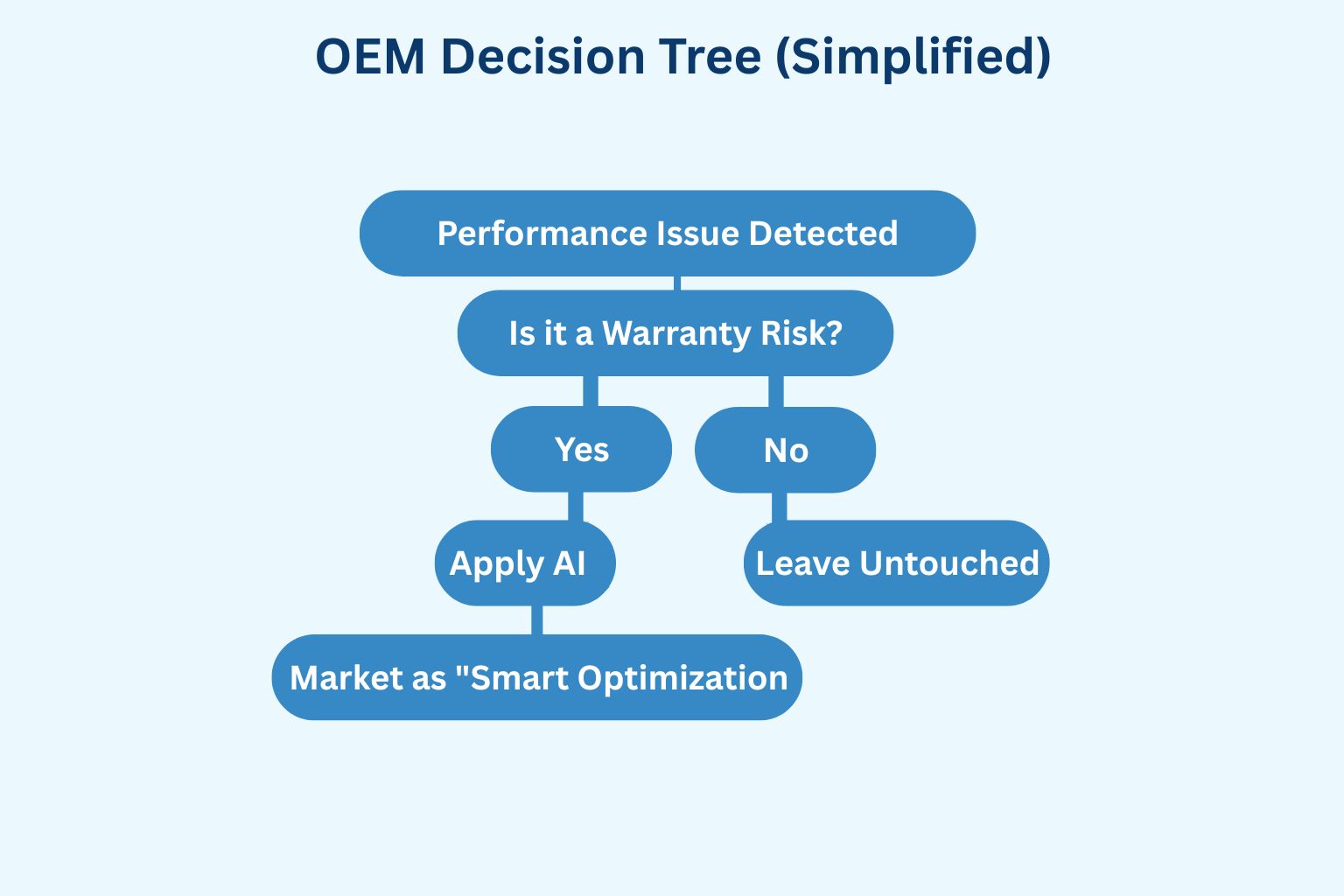
This structure doesn’t reward bravery. It rewards predictability. And predictability, in gaming hardware, often feels like restraint disguised as intelligence.
Why Some “Smart” Gaming Hardware Quietly Fails
When AI-Assisted Gaming Devices fail, they rarely do so spectacularly. They fade. Performance feels inconsistent. Trust erodes. Players stop noticing the intelligence—and that’s the beginning of the end.
One common failure point is assumption drift. AI models are trained on expected usage: room temperature ranges, session lengths, input styles. Real players violate those assumptions constantly. Long overnight sessions, portable use in warm environments, aggressive charging habits—all push devices outside their learned comfort zones. The result isn’t catastrophic failure, but subtle instability.
Another issue is mismatched latency priorities. Intelligence that buffers inputs to smooth noise can introduce micro-delays. These delays are often imperceptible in casual play and intolerable in competitive contexts. A system designed to help “most users” ends up alienating the exact audience that cares the most.
There’s also the problem of silent decay. As batteries age and components drift, AI models built on early-life behavior lose accuracy. Without retraining or recalibration, intelligence becomes stale. The device still works—but no longer as intended.
Finally, communication failures matter. When users don’t understand why a device behaves differently under load, they assume malfunction. Hardware doesn’t get second chances once doubt sets in.
AI doesn’t fail because it’s too ambitious. It fails because it’s too polite to explain itself—and too rigid to adapt once the real world pushes back.
Buying Smart in an AI-Hardware Era: What Actually Matters Long-Term
Choosing gaming hardware in the age of intelligence requires a different lens. Raw specifications still matter, but they age faster than behavior. The most reliable indicator of value is how a device degrades—not how it performs on day one. This is where many buyers misread AI-Assisted Gaming Devices, assuming intelligence guarantees longevity. It doesn’t. Design discipline does.
For casual players, stability outweighs adaptability. Devices with conservative AI tuning tend to feel the same months later because they were never aggressive to begin with. For competitive players, transparency becomes the filter. If you can’t disable, inspect, or predict the intelligence layer, it’s a liability during high-stakes play. Creators and streamers sit in between, benefiting from fatigue reduction and thermal smoothing—but only when those systems are predictable under long sessions.
Depreciation follows behavior. Hardware that depends on cloud-tuned intelligence risks faster obsolescence when support ends. Locally adaptive systems, even if simpler, age more gracefully. Software decay also matters. Firmware updates that quietly shift input feel can alienate users who trained muscle memory around earlier behavior.
Smart buying isn’t about chasing “AI.” It’s about asking uncomfortable questions:
- Can this device explain itself?
- Does it degrade gracefully?
- Is intelligence optional—or mandatory?
The best purchases are boring in the right ways. They feel consistent after months of use, not impressive in the first hour. That consistency is where real value lives.
Why This Analysis Exists: The Credibility Layer
This deep dive doesn’t exist to predict winners. It exists to reduce confusion. Gaming hardware conversations are often dominated by launch metrics, influencer impressions, and short-term benchmarks. None of those reveal how devices behave once novelty fades and habits settle in.
The investigative approach here blends engineering constraints with lived use—not lab fantasies. Every claim about AI behavior is grounded in thermals, signal integrity, power envelopes, and human adaptation limits. No speculation without physics. No praise without trade-offs. No fear without context.
This lens matters because intelligence blurs accountability. When something feels “off,” users are told it’s adaptive, learning, or optimizing. Those words hide design decisions. This section exists to surface them.
Credibility doesn’t come from certainty. It comes from exposing assumptions. And the biggest assumption in modern gaming hardware is that smarter always means better. History—across controllers, mice, headsets, and now AI layers—suggests otherwise.
Understanding why things almost work is more useful than celebrating when they do.
The Weak Links Nobody Talks About in Smart Gaming Gear
Intelligence doesn’t eliminate failure—it redistributes it. In AI-Assisted Gaming Devices, the most vulnerable points are rarely the obvious ones. They hide at the intersection of mechanics, materials, and adaptation logic.
Thermal fatigue accumulates quietly. AI smooths peaks, but that often means sustained mid-level heat, which ages solder joints and polymers faster over time. Connectors wear unevenly when adaptive power delivery changes charging patterns. Micro-fractures form where rigidity meets flexibility—especially in modular or adjustable designs.
Adhesives are another blind spot. Smart gear often packs more sensors and layers, increasing reliance on bonding rather than fasteners. Heat cycling weakens those bonds years before users notice looseness. Hinges, especially in adjustable headsets and modular controllers, experience asymmetric stress when AI alters tension or feedback profiles dynamically.
Tolerance stacking matters too. Intelligence assumes components behave within spec. As parts drift with age, small variances compound, and AI responses become less accurate—sometimes amplifying instability instead of correcting it.
| Component Zone | Risk Type | Why It Emerges |
|---|---|---|
| Battery region | Thermal fatigue | Sustained heat smoothing |
| USB / ports | Wear imbalance | Adaptive charging cycles |
| Sensor mounts | Micro-fractures | Vibration + heat |
| Adhesive layers | Bond decay | Dense internal stacking |
| Hinges / joints | Stress asymmetry | Dynamic feedback shifts |
Smart hardware fails slowly. Not dramatically—but quietly, until trust erodes.
Simulating a Decade of Use: How AI-Assisted Gaming Gear Ages
Time is the most honest stress test. When gaming hardware crosses the five-year mark, intelligence stops being a novelty and becomes an environmental variable. Batteries lose chemical stability. Sensors drift. Thermal interfaces dry out. What matters is whether the AI layer adapts with that decay—or blindly assumes youth.
Battery chemistry is the first constraint. As internal resistance rises, AI-managed power delivery becomes less precise. Early-life optimization curves no longer match reality, causing subtle throttling or inconsistent haptics. OLED elements—present in displays, lighting zones, and status panels—face uneven burn-in when adaptive brightness systems prioritize responsiveness over uniform wear.
Thermal throttling also changes character. What once felt like graceful smoothing becomes persistent performance dampening. AI that was tuned to prevent spikes may overcorrect as heat dissipation worsens with dust accumulation and material fatigue. Speakers and haptic actuators stretch mechanically over time, altering feedback signatures that AI continues to “correct” toward outdated baselines.
The key insight: intelligence that doesn’t recalibrate ages poorly. Systems designed with periodic self-baselining or user-invoked recalibration survive longer without feeling erratic.
| Component | Likely Change | AI Impact |
|---|---|---|
| Battery | Capacity + resistance loss | Inconsistent power smoothing |
| Sensors | Calibration drift | Reduced input accuracy |
| OLED zones | Localized burn-in | Uneven visual feedback |
| Thermal paths | Efficiency loss | Persistent throttling |
| Haptics | Mechanical softening | Altered response feel |
Longevity isn’t about preventing decay. It’s about designing intelligence that expects it.
The Vibetric Verdict: Where AI Belongs in Gaming Hardware
AI-Assisted Gaming Devices are neither a gimmick nor a revolution. They are a correction—an attempt to reconcile human inconsistency with machine precision. When done well, they disappear. When done poorly, they erode trust faster than any broken switch or cracked shell.
The strongest implementations respect the player’s agency. They stabilize without steering. They explain without overwhelming. They age without surprising. Intelligence should protect performance, not redefine it. The moment a device feels like it’s playing with you rather than for you, the balance has been struck.
Where AI fails is ambition without humility. Hardware lives in the physical world—bounded by heat, wear, and human habit. No model escapes that. The brands that understand this aren’t chasing smarter gear. They’re building calmer ones.
The next stage of gaming hardware innovation won’t be louder, flashier, or more autonomous. It will be quieter, more predictable, and harder to market—because the best intelligence feels like nothing at all.
Discover the Hidden Forces Driving the Future of Gaming Hardware
Now that you’ve explored the mechanics, trade-offs, and lived realities behind AI-assisted gaming hardware, the bigger question emerges: where does this evolution actually lead players—not just products?
Gaming technology doesn’t move in straight lines. It responds to culture, competition, physics, and fatigue. What looks like innovation today often becomes infrastructure tomorrow. Staying ahead means understanding why changes happen—not just what launches next.
- Follow us on Instagram@vibetric_official for deeper investigations into the technologies reshaping competitive and everyday gaming.
- Bookmark vibetric.com— our analysis evolves as hardware matures and real-world data surfaces.
- Subscribe to stay informed as intelligence quietly redefines how games are played, trained for, and experienced.
The surface story is about AI. The deeper one is about control, trust, and longevity—and that story is only beginning.
Premium FAQ: What Most Gamers Misunderstand About AI-Assisted Gear
Most systems focus on stabilizing inconsistency rather than boosting raw ability. AI-Assisted Gaming Devices reduce variance—missed inputs, fatigue drift, thermal dips—so your baseline performance is more repeatable, not magically higher.
Only when automation crosses into decision-making. Most tournament-legal designs limit assistance to signal conditioning, not gameplay logic, keeping outcomes human-driven.
Well-designed pipelines add microseconds, not milliseconds. Poor implementations stack processing layers and can introduce perceptible delay—this is an engineering quality issue, not an AI inevitability.
No. Most inference runs locally. Cloud links are typically reserved for model updates or optional analytics, not real-time control.
It can extend usable life if recalibration is supported. Without it, adaptive systems may amplify wear-related inaccuracies over time.
Yes. Casual players experience fatigue, posture changes, and inconsistent sessions—areas where adaptive stabilization has the most visible impact.
If learning isn’t constrained, yes. The best designs cap adaptation ranges and prioritize correction over mimicry.
It can be. Input telemetry can reveal behavioral patterns. Transparent data handling and local processing mitigate most risks.
They shouldn’t. Responsible vendors gate behavioral changes behind opt-ins or gradual rollouts to preserve muscle memory.
Only if it’s built to age. Hardware lasts longer than models; systems that expect recalibration and decay remain usable far beyond launch hype.
Closing the Loop: When Intelligence Learns to Stay Out of the Way
Late at night, after hours of play, the gear fades into the background. Inputs feel steady. Heat is controlled. Nothing calls attention to itself. That’s when the promise becomes real—not because the hardware is impressive, but because it’s invisible.
The journey from simple controllers to adaptive systems wasn’t about chasing novelty. It was about acknowledging human limits and designing around them without erasing them. When intelligence respects restraint, it earns trust.
The next era of gaming hardware won’t be remembered for its algorithms. It will be remembered for how little players had to think about them.
What’s your take on this?
At Vibetric, the comments go way beyond quick reactions — they’re where creators, innovators, and curious minds spark conversations that push tech’s future forward.
Frame Stability in 2026: The Hidden Metric Redefining Gaming Performance
Frame Stability in 2026: The Hidden Metric Redefining Gaming Performance For years, gaming conversations revolved around one number: frames per second. Higher
Ray Tracing in 2026: The Powerful Shift From Experimental to Standard Graphics
Ray Tracing in 2026: The Powerful Shift From Experimental to Standard Graphics The technology spent years as a benchmark showcase. Now it’s