
Adaptive Transparency Mode in 2026: The Intelligent Evolution Beyond Basic Passthrough
Noise cancellation used to be the headline feature. Transparency was the afterthought — a convenience toggle so you could hear announcements or cross the street safely.
That hierarchy has flipped.
Today’s adaptive transparency mode systems are no longer passive audio passthrough tools. They are intelligent, real-time environmental interpreters. Instead of simply letting sound in, they decide what should enter — and at what intensity.
Transparency is no longer about hearing everything.
It’s about hearing the right things.
The Misconception: Transparency Means “No Processing”
Many users assume transparency disables intelligence. In reality, modern adaptive transparency mode systems rely on more processing than active noise cancellation.
Traditional transparency amplified external microphones and piped the signal inward. The result often felt artificial, overly sharp, or slightly delayed.
Current implementations operate differently:
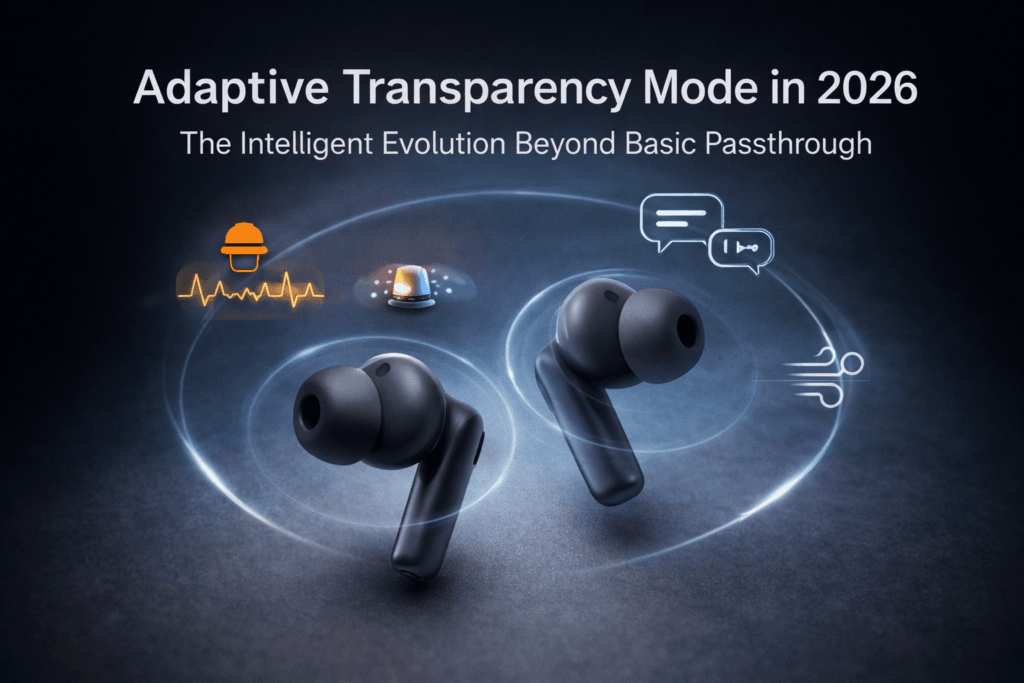
- External microphones capture ambient sound
- Algorithms classify audio events in real time
- Sudden spikes (sirens, construction noise, feedback loops) are compressed
- Speech frequencies are selectively enhanced
- Wind distortion is dynamically filtered
The listener hears an environment that feels natural — but is heavily curated.
Transparency has evolved from amplification to selective interpretation.
Why This Became Technically Possible
Three engineering advances enabled this leap:
- Low-Latency On-Device Processing
Modern audio chipsets can perform classification and gain adjustment within milliseconds. That speed prevents perceptible lag between real-world sound and perceived output. - Machine Learning-Based Sound Recognition
Instead of fixed filters, systems now rely on trained models that distinguish speech, traffic, mechanical noise, and impulsive sounds. - Dynamic Range Compression Intelligence
Older systems compressed everything equally. Adaptive transparency mode selectively compresses only harmful peaks while preserving spatial cues.
The result feels less like listening through microphones and more like enhanced natural hearing.
Transparency vs Noise Cancellation: Different Goals Now
| Function | Traditional Approach | Modern Adaptive Approach |
|---|---|---|
| Ambient Capture | Full amplification | Context-aware filtering |
| Loud Noise Handling | Minimal protection | Instant peak suppression |
| Speech Clarity | Passive passthrough | Frequency-focused enhancement |
| Wind Management | Basic filtering | Real-time adaptive correction |
| User Control | On/Off toggle | Continuous environmental adjustment |
This shift reveals something important: transparency is no longer the opposite of cancellation. It is a parallel intelligence system with its own processing stack.
In many scenarios, adaptive transparency mode requires more contextual awareness than ANC.
The Human Factor: Why It Feels More Natural
The goal is not technical perfection — it is perceptual realism.
Human hearing naturally adjusts to shifting environments. We subconsciously prioritize speech, dampen constant noise, and react instantly to sharp spikes. Traditional transparency failed because it treated all incoming sound equally.
Modern adaptive transparency mode mimics cognitive filtering.
When someone speaks nearby, vocal frequencies subtly rise. When a bus brakes loudly, the system compresses the spike without muting the scene. When wind interferes, algorithms compensate before distortion dominates.
The brain interprets this as clarity rather than processing.
That perceptual harmony is what makes today’s systems feel dramatically improved — even if users cannot articulate why.
The Safety Dimension
There’s also a practical layer to this evolution.
Urban environments are louder and more unpredictable than ever. Fully isolating oneself through aggressive noise cancellation can create situational risks. At the same time, fully open listening can overwhelm.
Adaptive transparency mode offers a middle path:
- Maintains spatial awareness
- Reduces harmful decibel spikes
- Keeps conversations intelligible
- Preserves directional cues
In effect, it augments awareness rather than simply restoring it.
For commuters, cyclists, and pedestrians, this is not cosmetic refinement. It is functional intelligence.
The Subtle Competitive Shift in Audio
Audio brands are no longer competing purely on noise cancellation strength. They are differentiating based on environmental intelligence.
How accurately does the system identify sound types?
How smoothly does it transition between environments?
How stable is the gain adjustment under rapid acoustic shifts?
These questions matter more now than raw decibel reduction numbers.
Transparency has become a signature experience layer — one that reflects the sophistication of a company’s audio algorithms.
The Direction This Is Heading
Future adaptive transparency mode systems will likely incorporate:
- Personalized hearing profiles
- Context-linked automation (home, office, street)
- Health-based sound exposure management
- Spatial audio integration within passthrough
The line between hearing assistance and consumer audio will continue to blur. What began as convenience is edging toward augmentation.
Transparency is evolving from passive listening to active environmental management.
Hearing, But Better Curated
The most interesting part of this shift is philosophical.
We are no longer choosing between silence and noise. We are choosing how the world is filtered before it reaches us.
Adaptive transparency mode represents a broader trend in consumer technology: intelligence shaping reality subtly, persistently, and in ways that feel natural rather than engineered.
It’s not louder.
It’s not quieter.
It’s smarter.
And in modern audio design, smart has become the real premium feature.
Stay Tuned with Vibetric
- Follow our Instagram @vibetric_official for deep audio and performance analysis.
- Bookmark vibetric.com for insight into evolving tech standards.
- Stay connected as we decode the engineering behind everyday experiences.
What’s your take on this?
At Vibetric, the comments go way beyond quick reactions — they’re where creators, innovators, and curious minds spark conversations that push tech’s future forward.

AI Battery Optimization Is Finally Making Earbud Battery Life Reliable in 2026
AI Battery Optimization Is Revolutionizing Earbud Battery Life in 2026 The spec sheet still says ‘30 hours.’ What it doesn’t say is
On-Device Audio Processing (2026): The Breakthrough Technology Behind Smarter Earbuds
On-Device Audio Processing (2026): The Breakthrough Technology Behind Smarter Earbuds A commuter taps play on the subway. The train roars into the