
Galaxy S26 Ultra Privacy Display: 5 Brutal Real-World Truths Nobody Tells You
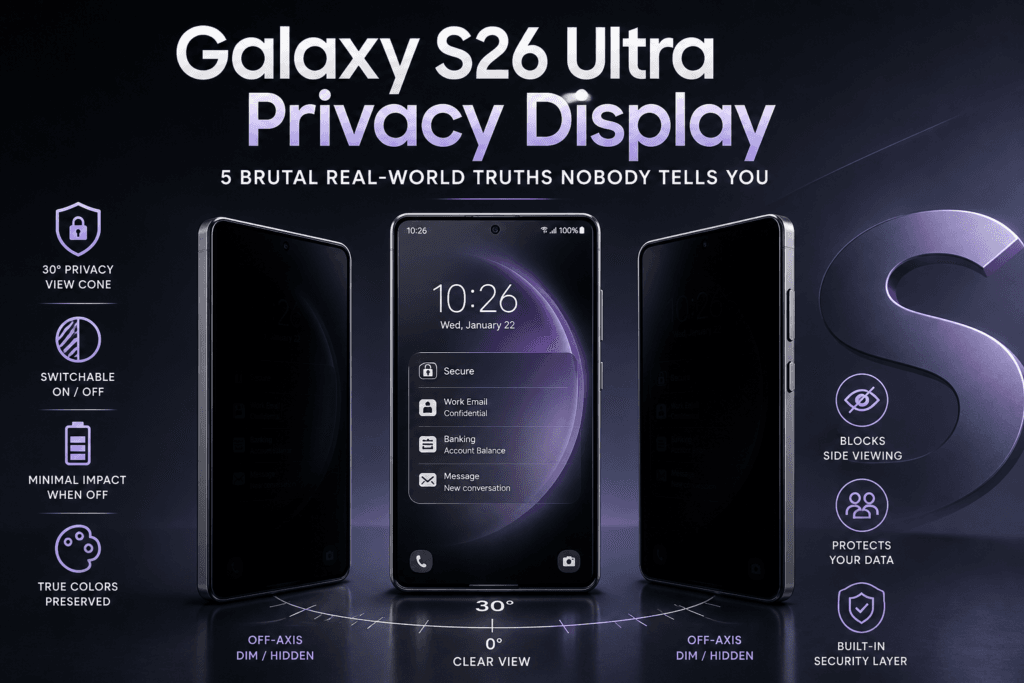
There’s a specific anxiety that comes with using a phone in public — a glance from a stranger, a colleague too close at a meeting table, a commute where the person next to you is reading your messages before you are. Samsung built its answer into the Galaxy S26 Ultra privacy display. But the real question isn’t whether the feature exists. It’s whether it actually solves anything.
The Problem It’s Quietly Solving
Modern professional life has made screen visibility a genuine security surface. Sensitive work emails, banking apps, personal conversations — the average flagship user accesses all of this on a single device, frequently in public. Traditional screen protectors with privacy filters address this crudely: permanent dimming, narrow viewing angles at all times, degraded color accuracy.
What distinguishes the Galaxy S26 Ultra privacy display approach is selectivity. The feature isn’t a physical film. It’s software and display hardware working together to restrict lateral viewing angles on command, leaving the direct-view experience — color, brightness, sharpness — largely unaffected when privacy mode is off.
This matters behaviorally. Studies on workplace data exposure consistently show that shoulder surfing is underestimated as a security risk. Most users don’t think about it until the moment it’s already happening. A switchable privacy layer changes the calculus: protection becomes contextual rather than a permanent compromise.
How the Display Actually Does It
The Galaxy S26 Ultra privacy display operates through a liquid crystal layer integrated beneath the outer glass, working in conjunction with the Dynamic AMOLED 2X panel. When activated, the liquid crystal alignment shifts to scatter light beyond roughly a 30-degree viewing cone from center. To anyone off-axis — left, right, above — the display appears dark or washed out.
This is fundamentally different from older polarizing filter approaches, which stacked a passive film over the screen and accepted permanent brightness loss. The S26 Ultra’s implementation is electrically controlled, meaning the layer switches between transparent and privacy states almost instantaneously without changing the AMOLED stack itself.
Power draw is the trade-off. Running the liquid crystal layer continuously does pull additional battery, which is why Samsung designed it to be toggled rather than left permanently enabled.
| Feature | Traditional Film Filter | Galaxy S26 Ultra Privacy Display |
|---|---|---|
| Galaxy S26 Ultra Privacy Display | Always on | Switchable |
| Peak brightness impact | Significant | Minimal when off |
| Color accuracy | Degraded | Unaffected when off |
| Activation | Physical (accessory) | Software / hardware |
| Response speed | Passive | Near-instant |
The Gap Between the Toggle and the Habit
Here’s where the marketed experience and real-world utility diverge in important ways.
Viewing angle versus ambient conditions: The 30-degree cone works precisely in controlled settings. In bright outdoor light, the physics of screen glare complicate the privacy zone. Direct sunlight can scatter enough diffuse reflection that the intended protection becomes less reliable.
Single-person assumption: The privacy display assumes one viewer at the center. Sharing content with someone next to you — showing a photo, reviewing a document together — requires toggling the feature off, which adds friction to natural social phone use.
Detection lag: The feature doesn’t automatically sense who’s looking. It depends entirely on the user remembering to activate it. That’s not a flaw in the technology — it’s an honest description of what it is: a user-controlled tool, not an ambient security system.
Where This Sits in the Industry
Samsung is not the first to attempt a switchable privacy display. HP explored the concept in laptop screens, and earlier Android devices experimented with software-level blurring. What makes the Galaxy S26 Ultra privacy display notable is the integration quality: the liquid crystal approach produces less color shift in privacy mode than prior implementations, and the form factor doesn’t require any external accessory.
The direction this points toward is significant. As dual-use devices — phones that are simultaneously personal and professional — become standard, display-level privacy controls are likely to move from premium differentiator to expected feature. Enterprise procurement, in particular, has started factoring physical data security into device evaluations alongside software MDM solutions.
Reading the Signal Correctly
The Galaxy S26 Ultra privacy display is genuinely useful in a specific set of circumstances: dense public environments, professional contexts where sensitive information is regularly accessed, and users who are disciplined enough to build the toggle into their workflow. It performs what it claims to perform, without the display degradation that earlier privacy filter technology accepted as unavoidable.
Where it falls short is in the gaps between hardware and human behavior — outdoor glare softening the viewing cone, collaborative moments requiring the feature off, and the quiet reality that a toggle nobody remembers to use is just an unused spec. Privacy technology has always faced this: the best implementation still depends on the person holding the device.
There’s something worth sitting with in that. The Galaxy S26 Ultra privacy display is, in a narrow sense, the most refined version of this idea yet built into a consumer smartphone. But refinement doesn’t close the behavioral gap. It just makes the gap easier to ignore — until the moment it isn’t.
Stay sharp with Vibetric
- Bookmark Vibetric — the best analysis lands between the spec sheets
- Follow Vibetric_Offical on Instagram for display tech breakdowns as they happen.
- Share this piece with someone who still thinks a screen protector is a privacy solution
What’s your take on this?
At Vibetric, the comments go way beyond quick reactions — they’re where creators, innovators, and curious minds spark conversations that push tech’s future forward.
Community Triage (0)