
Next-Gen Smartphones Feel Dramatically Better in 2026 — Even If They Look the Same
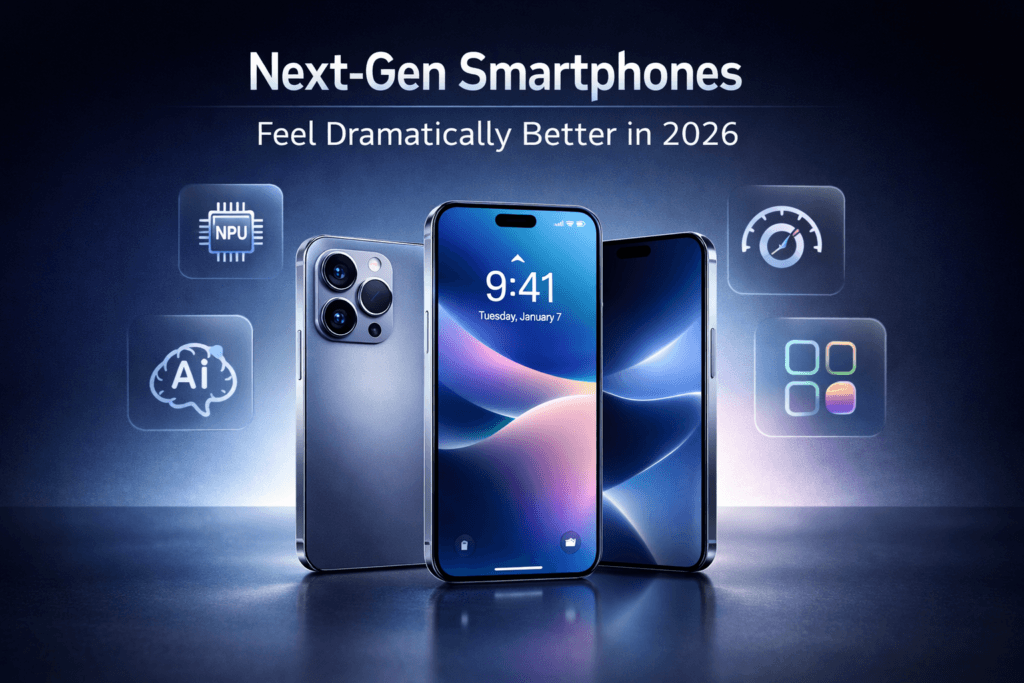
The industrial design hasn’t changed much. The camera bump is still there. The glass is still flat or slightly curved. What’s different is harder to photograph — and harder to dismiss.
The Spec Sheet Argument Is Already Over
Start with what the critics are right about. Next-gen smartphones in 2026 do not offer the kind of year-on-year hardware leap that defined the industry’s first fifteen years. Display resolution plateaued at a level human vision can’t meaningfully exceed at arm’s length. Camera sensor size in the flagship form factor has approached a physical ceiling imposed by lens optics and chassis depth. Processor clock speeds are no longer the primary variable in perceived performance.
These observations are accurate. They’re also the wrong frame for understanding why this generation of next-gen smartphones feels materially different to use. The shift isn’t in the components. It’s in how the components are orchestrated — and that orchestration has crossed a perceptible threshold in 2026.
Silicon Architecture Is Doing Work That Used to Require Software
The most consequential change in current flagship silicon is the expansion of dedicated heterogeneous processing blocks. Modern next-gen smartphone chips carry separate neural engines, image signal processors, always-on sensing cores, and secure enclaves that operate in parallel rather than sharing a single pipeline. The practical effect is that tasks previously handled sequentially — computational photography, voice processing, on-device inference — now execute simultaneously without the thermal or latency penalty that sequential processing incurred.
This matters because it dissolves the tradeoff users previously managed unconsciously. Turning on Live Translate used to impose a CPU load that affected other background processes. Running a real-time video enhancement on a call used to throttle concurrent tasks. On 2026 flagship silicon, those tradeoffs are largely gone — not because the chip is faster in the conventional sense, but because the workloads no longer compete for the same resource.
The result feels like a more capable device even to users who cannot articulate why. Responsiveness without visible effort is the subjective experience of heterogeneous silicon working correctly.
Users Are Sensing Something They Can’t Name
There is a class of product improvement that doesn’t survive a spec comparison but dominates user satisfaction surveys. Next-gen smartphones in 2026 are generating it. Return rates on current flagship devices are down across major markets. Upgrade cycle sentiment — the willingness to describe a new phone as a meaningful step up from the previous one — has recovered after two years of “same-as-before” perception.
What users are registering is system coherence. The camera opens without a frame of hesitation. The keyboard doesn’t lag on the first character after unlock. App switching preserves state with a fidelity that previous generations only approximated. None of these are features. They are the absence of friction — and the absence of friction is extraordinarily difficult to communicate before purchase but impossible to ignore after it.
This is the perceptual gap that makes next-gen smartphones hard to review fairly. A benchmark tests peak performance. A user lives in the transitions between tasks — and that is precisely where 2026 flagships have improved most.
The most honest way to describe 2026 flagship hardware isn’t faster or better. It’s more consistent. Consistency at the level these devices now operate reads, subjectively, as quality — and quality is what premium buyers are actually paying for.
| Optimization layer | Traditional approach | AI-optimized approach |
|---|---|---|
| ANC power draw | Fixed depth, fixed consumption | Depth scaled to detected ambient noise level |
| Processor clock speed | Static profile per use mode | Dynamic scaling based on predicted workload |
| Bluetooth transmit power | Constant within codec range | Adjusted per real-time signal quality model |
| Codec selection | Negotiated once at connection | Re-evaluated as call or content type shifts |
| Idle power state | Timer-based sleep threshold | Behavior-predicted micro-sleep windows |
What This Means for the Upgrade Market
The implications for upgrade cycle economics are significant and not yet fully priced in by either manufacturers or analysts. When smartphone improvement is primarily perceptual rather than featural, the people most likely to notice it are existing premium users — which is precisely the segment with the longest current upgrade cycles. The irony is that the users for whom 2026 next-gen smartphones represent the clearest step forward are the ones least likely to be in an upgrade window.
Manufacturers are responding by extending the software update window aggressively — seven years of OS support is now a competitive specification, not a differentiator. The signal this sends is deliberate: the device you buy today is being positioned as a long-term platform, not an annual iteration. That repositioning changes how the purchase is evaluated and, over time, how frequently it’s made.
The Invisible Upgrade Is Still an Upgrade
There is a version of the ‘nothing changed’ critique that will age poorly. Reviewers measuring next-gen smartphones against their own previous coverage will find limited new surface area. Users switching from a two or three-year-old device will not. The delta that’s difficult to benchmark is real — it just requires living inside the device rather than testing it from outside.
2026 flagships mark the point where smartphone hardware maturity stops being a liability and starts being a design constraint that forces genuine software and systems innovation. The phones that win this cycle won’t be the ones with the biggest number on the sensor. They’ll be the ones whose silicon, firmware, and OS have been integrated tightly enough that the experience stops feeling like a collection of features and starts feeling like a single coherent object.
Worth Following Closely
- Bookmark Vibetric — the second half of 2026 will stress-test every claim made in this piece.
- Follow Vibetric_Offical on Instagram for takes on next-gen smartphones that go past the spec sheet.
- Send this to someone still waiting for a ‘real’ upgrade — this might be the one they’ve been describing.
What’s your take on this?
At Vibetric, the comments go way beyond quick reactions — they’re where creators, innovators, and curious minds spark conversations that push tech’s future forward.
Community Triage (0)