
Ray Tracing in 2026: The Powerful Shift From Experimental to Standard Graphics
The technology spent years as a benchmark showcase. Now it’s quietly become the assumed standard — and most players haven’t fully registered the shift.
When the Ceiling Becomes the Floor
There’s a pattern in graphics technology where a capability spends years as optional, aspirational, and GPU-punishing — and then, almost without announcement, becomes the baseline. Anti-aliasing went through it. Ambient occlusion went through it. Ray tracing is going through it right now.
Current-generation hardware from all three major GPU vendors has moved ray tracing acceleration out of the “dedicated RT cores are a nice bonus” category and into the architectural foundation. The question being asked in GPU design is no longer whether to include ray tracing hardware — it’s how many BVH traversal units to provision and at what clock rate.
The Psychology of ‘Good Enough’ Realism
One underappreciated force driving ray tracing from experiment to expectation is human visual calibration. Players who’ve spent significant hours in titles running fully path-traced lighting — Metro Exodus Enhanced Edition was a watershed moment, Control another — have recalibrated what “natural” looks like in a virtual environment.
This isn’t a trivial point. Rasterized global illumination approximations work partly because players never had a sustained reference point for how light actually behaves in enclosed spaces. Once that reference exists, the approximations start reading as approximations. The industry calls this the perceptual threshold crossing — and ray tracing crossed it for a meaningful portion of the player base somewhere around 2023.
Path tracing is not ray tracing with extra steps. It’s a fundamentally different sampling strategy — Monte Carlo-driven, probabilistic, and convergence-dependent. The distinction matters because hybrid rasterization + ray tracing (what most games still use) is architecturally quite different from the full path-traced pipelines now appearing in AAA titles.
Hybrid Pipelines: The Real Story of Adoption
The common narrative frames ray tracing adoption as binary: either a game uses it or doesn’t. That’s not how the technology actually propagated. What happened instead is granular integration — developers identifying the three or four lighting interactions in their specific scene architecture where ray tracing delivers disproportionate visual return, and deploying it surgically there.
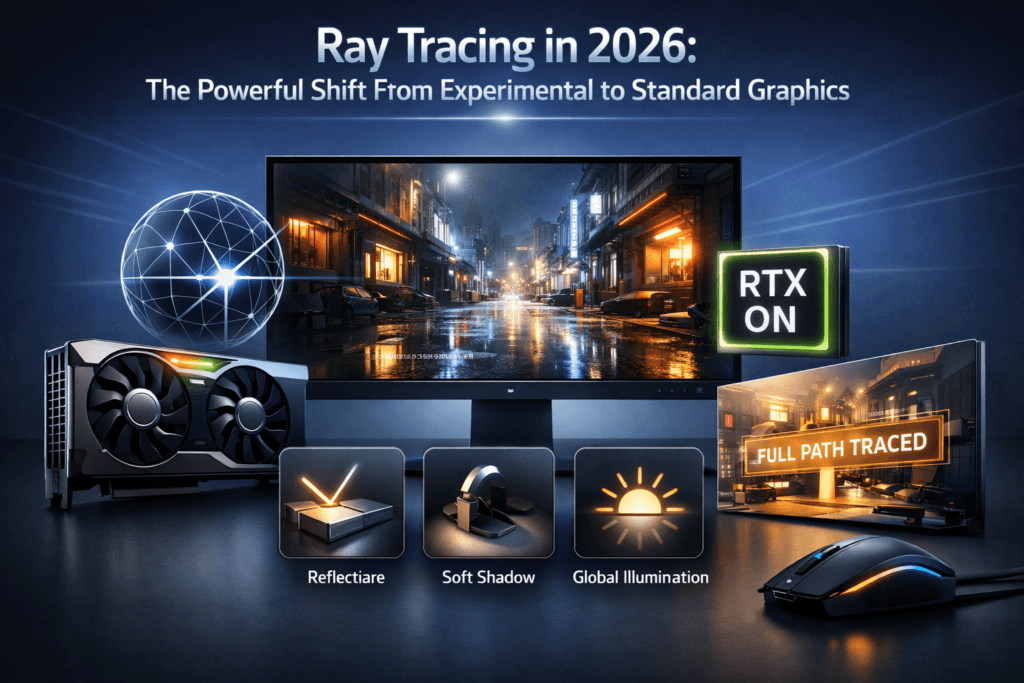
Reflections on wet surfaces. Soft shadow contact with irregular geometry. Indirect lighting in interior environments with complex occlusion. These are the insertion points. The result is that ray tracing is now present in a large share of major releases, even in titles that don’t market the feature on the box.
| Integration type | Visual payoff | Compute cost |
|---|---|---|
| Ray-traced reflections | High — especially on curved or wet surfaces | Moderate with denoising |
| Ray-traced shadows | High — contact and penumbra accuracy | Low to moderate |
| Ray-traced ambient occlusion | Medium — subtle but cumulative | Low |
| Full path tracing | Very high — eliminates major approximation artifacts | Very high (AI upscaling required) |
The Contrarian Case: Software Is Still Catching Up
It would be intellectually lazy to declare ray tracing universally mature. The hardware argument is strong — the software argument is messier. Engine-level ray tracing integration still varies dramatically by studio and pipeline. Titles built on proprietary engines without ray tracing architectured in from early development carry a retrofitting cost that some studios simply don’t absorb.
The more honest framing is that ray tracing is a settled hardware expectation with uneven software realization. Demanding it uniformly across the medium in 2025 still produces inconsistency — not because the technology can’t deliver, but because the development ecosystem hasn’t finished homogenizing around it.
Upscaling Changed the Economics
The single biggest structural enabler of ray tracing moving from ceiling to floor wasn’t a GPU architecture breakthrough — it was the maturation of AI-driven temporal upscaling. DLSS, FSR, and XeSS all operate on the same core insight: if you can render fewer native pixels with high geometric and temporal coherence, you can reallocate that headroom to ray tracing workloads without a net performance regression.
This is the economic equation that changed the adoption calculus. Studios could now add meaningful ray tracing to a scene and tell players they’d lose no frame rate if upscaling was engaged. The tradeoff became invisible at normal viewing distances — and the visual gain was not. That asymmetry is what industrialized the technology.
What Comes After the Baseline
Ray tracing didn’t win by being the best technology in controlled conditions. It won by becoming affordable at scale — architecturally, algorithmically, and economically. The studios still treating it as a premium toggle are catching up to hardware that already moved on. The interesting question now isn’t whether ray tracing is mainstream. It’s how long before full path tracing clears the same threshold.
Stay in the Loop with Vibetric
- Follow Vibetric on Instagram for concise takes on tech that’s actually moving.
- Bookmark Vibetric_Offical — the next graphics standard shift is already in the pipeline.
- Save this piece — it’ll read differently in twelve months as the path tracing debate lands.
What’s your take on this?
At Vibetric, the comments go way beyond quick reactions — they’re where creators, innovators, and curious minds spark conversations that push tech’s future forward.
Community Triage (0)