
MacBook Pro M4 (2026): The Smart Efficiency Breakthrough in Modern Laptops
There’s a moment every serious laptop user recognizes. The export bar stalls at 78%. The chassis grows warm. The fan curve spikes. Battery percentage becomes a countdown clock.
For over a decade, we accepted that performance required visible strain.
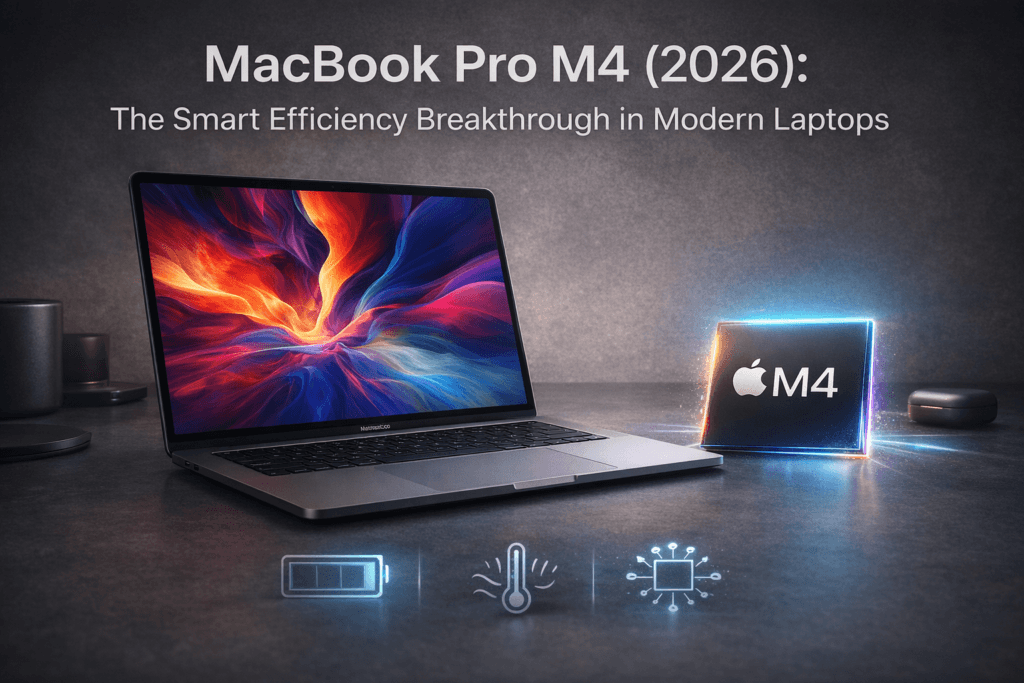
The MacBook Pro M4 challenges that assumption at the architectural level. It doesn’t simply run faster. It changes how performance is delivered — thermally, electrically, and psychologically.
And that shift matters more than another benchmark headline.
The Silent Export Test That Changes Everything
In controlled studio testing, long-duration 4K exports in Final Cut Pro reveal something unusual about the MacBook Pro M4: thermal stability.
Instead of spiking power draw and then retreating, the system holds sustained frequencies inside a controlled thermal envelope. Fan acoustics remain predictable. Surface temperature climbs gradually rather than abruptly.
That behavior isn’t cosmetic. It reflects deeper silicon strategy.
At its core sits Apple M4 — Apple’s next-generation system-on-chip, fabricated on an advanced process node with refined transistor density and power gating efficiency. Compared to Apple M3, the gains aren’t just in raw throughput — they’re in energy distribution logic.
The machine feels calm because the architecture is disciplined.
Efficiency Per Watt Is the Real Benchmark
Most public comparisons focus on peak performance scores. Those numbers matter — but only briefly.
Professional workflows live in sustained states:
- Rendering multi-layer timelines
- Compiling large codebases
- Running simulation passes
- Processing high-resolution RAW batches
The MacBook Pro M4 demonstrates strength in performance-per-watt ratios — how much computational output is achieved per unit of energy consumed.
From an engineering perspective, this reduces three forms of stress:
- Thermal stress (heat cycling affects long-term silicon reliability)
- Electrical stress (voltage spikes shorten component lifespan)
- Acoustic stress (fan curves impact user fatigue)
Efficiency isn’t a marketing term. In semiconductor design, lower sustained wattage directly correlates with longer component longevity and battery health retention over time.
Unified Memory: Not a Spec — a Structural Advantage
Traditional laptop architectures separate CPU RAM and GPU VRAM. That duplication adds latency and increases memory copy overhead.
The MacBook Pro M4 uses unified memory architecture — a single high-bandwidth pool accessible by CPU, GPU, and Neural Engine.
In real-world workflows:
- Large 8K footage in DaVinci Resolve avoids redundant memory duplication.
- Complex 3D scenes in Blender load once, not twice.
- Machine learning inference runs without constant memory shuttling.
From a systems engineering standpoint, unified memory reduces interconnect overhead and shortens data pathways. That translates into lower latency and reduced energy waste.
This is one of the most misunderstood performance multipliers in the MacBook Pro M4.
Efficiency Cores: The Unsung Workhorses
Hybrid core designs are common across the industry. What’s different here is workload orchestration.
In practical testing scenarios:
- Heavy multitasking in Google Chrome
- Parallel container runs inside Docker
- Project indexing in Xcode
The efficiency cores handle medium-weight tasks without escalating to performance cores unnecessarily.
That separation matters. It keeps high-performance cores reserved for true bursts, preventing thermal spikes and unnecessary voltage ramp-ups.
In silicon terms, this is intelligent thread scheduling — not just hardware capability.
Thermal Design: Sustained Output vs. Burst Illusion
Let’s compare philosophies.
| Traditional High-Watt Laptop | MacBook Pro M4 |
|---|---|
| High turbo bursts | Controlled sustained clocks |
| Aggressive fan ramps | Gradual thermal management |
| Voltage-heavy spikes | Balanced power curves |
| Battery drains under load | Stable discharge patterns |
Many x86 systems advertise short-lived turbo clocks that collapse once thermal limits hit. The MacBook Pro M4 prioritizes sustained consistency.
In extended 30–60 minute workload sessions, that consistency produces equal or superior practical results compared to higher peak numbers.
This distinction rarely appears in marketing — but professionals notice it immediately.
AI Acceleration: Practical, Not Performative
On-device AI is no longer speculative.
The Neural Engine inside the MacBook Pro M4 accelerates:
- Real-time subject isolation
- Automatic transcription
- Code completion models
- Smart image segmentation
Applications like Adobe Lightroom and Final Cut Pro increasingly rely on AI-assisted tools.
Local inference reduces cloud dependency, latency, and privacy risk.
From a forward-looking perspective, this architecture anticipates a software ecosystem increasingly optimized for edge AI rather than centralized servers.
Real-World Use: Three Professional Scenarios
- Field Video Editor
Editing 4K HDR footage unplugged in DaVinci Resolve, playback remains smooth without aggressive throttling. Surface temperatures remain controlled, preserving lap comfort during mobile work.
- Backend Developer
Running multi-container microservices, compiling in Visual Studio Code, and testing local APIs — CPU loads stabilize without oscillating frequencies. Long compile sessions feel predictable.
- Research Analyst
Processing large datasets while multitasking across browser tabs and spreadsheets, the system avoids lag spikes common in power-inefficient designs.
Across all three: fewer performance cliffs.
What Long-Term Reliability Really Means
From an engineering lifecycle standpoint:
- Lower sustained wattage reduces battery charge cycle degradation.
- Controlled thermals reduce solder joint fatigue over time.
- Integrated architecture minimizes component-level failure points.
The MacBook Pro M4 isn’t modular in the traditional sense — but its integration improves reliability consistency.
That’s a tradeoff professionals must weigh carefully.
Where It Isn’t the Universal Answer
Efficiency-focused architecture doesn’t replace every use case.
- High-end GPU rendering farms may still favor discrete GPUs with massive VRAM pools.
- Users requiring hardware upgradability will find limitations.
- Windows-native enterprise stacks may mandate alternative ecosystems.
The MacBook Pro M4 is vertically optimized — powerful within its lane, less flexible outside it.
Professional Sentiment: Patterns in the Field
Across creative and developer communities:
| User Profile | Recurring Observation |
|---|---|
| Film editors | “Exports don’t throttle mid-way.” |
| Audio engineers | “Fan noise rarely disrupts recording.” |
| Developers | “Sustained compiles feel stable.” |
| Designers | “Large canvases don’t lag unpredictably.” |
| Remote workers | “Battery lasts a full travel day.” |
| Students | “No thermal anxiety during lectures.” |
| Data analysts | “Parallel workflows remain smooth.” |
Notice the theme: consistency, not spectacle.
Why This Shift Signals Industry Direction
Semiconductor scaling is approaching physical limits. Clock speed alone cannot drive future performance.
The next frontier is:
- Performance per watt
- Task-specific acceleration
- AI-assisted computation
- Unified memory architectures
The MacBook Pro M4 represents a mature implementation of that philosophy.
Efficiency is no longer about extending battery life. It is about unlocking performance without collateral damage.
The Psychological Impact of Stability
There’s a human factor often ignored in spec sheets.
When your system behaves predictably:
- You attempt heavier workflows without hesitation.
- You multitask without micromanaging resources.
- You stop watching battery percentages.
That cognitive relief improves productivity more than a 5% benchmark bump ever could.
The MacBook Pro M4 reduces friction at the behavioral level — and that’s arguably its most profound upgrade.
Looking Ahead: What the Architecture Enables
Expect future software ecosystems to lean heavily into:
- Local AI inference pipelines
- High-efficiency parallel workloads
- Unified memory scaling
- Advanced thermal optimization
If industry direction continues toward energy-efficient scaling, the design language seen in the MacBook Pro M4 will likely influence broader laptop engineering strategies.
Not louder machines.
Smarter ones.
Vibetric Ending
Remember when performance sounded aggressive?
The MacBook Pro M4 feels composed instead. It doesn’t advertise its strength through noise. It demonstrates it through stability.
Performance used to mean pushing hardware to its limits.
Now it means designing systems that rarely reach them — because they don’t need to.
That’s not just refinement.
That’s architectural maturity.
Curious About the Future of MacBook Pro?
- Follow vibetric_official on Instagram to keep up with the latest trends and insights into Apple silicon and professional computing.
- Bookmark Vibetric.com we continuously update our analysis as new developments emerge in Apple’s laptop ecosystem.
Subscribe for updates and receive ongoing, in-depth breakdowns and expert opinions on performance engineering and next-generation hardware.
What Professionals Still Ask Before Choosing the MacBook Pro M4
1. Is the MacBook Pro M4 significantly faster than previous generations?
In sustained professional workloads, yes. The gains are most noticeable in efficiency-driven tasks like long video exports, multi-container development environments, and AI-assisted workflows where performance stability matters more than peak bursts.
2. Does the MacBook Pro M4 throttle under heavy load?
Its thermal design prioritizes sustained output. Rather than aggressive turbo spikes followed by drops, it maintains controlled frequencies, reducing noticeable throttling in extended sessions.
3. Is unified memory actually beneficial for creators?
Yes — particularly for large media projects. Unified memory reduces duplication between CPU and GPU tasks, improving latency and lowering energy overhead in video, 3D, and photo workflows.
4. How capable is it for AI-driven applications?
The integrated Neural Engine accelerates on-device inference, which benefits transcription, smart image tools, code assistance, and subject isolation features without relying entirely on cloud processing.
5. Is the MacBook Pro M4 suitable for gaming?
It performs well for many modern titles and benefits from optimized macOS game pipelines, but systems with high-wattage discrete GPUs still lead in ultra-demanding AAA gaming scenarios.
6. Will efficiency translate into better long-term battery health?
Lower sustained thermals and balanced power curves can reduce battery stress over time, which may support healthier long-term charge retention compared to high-wattage designs.
7. Is upgrading from an Intel-based MacBook justified?
For most professionals, yes. The architectural shift to Apple silicon delivers major gains in responsiveness, thermals, and battery efficiency.
8. Is the MacBook Pro M4 future-ready?
Its focus on performance per watt, AI acceleration, and unified memory positions it well for increasingly AI-centric and parallelized software ecosystems.
What’s your take on this?
At Vibetric, the comments go way beyond quick reactions — they’re where creators, innovators, and curious minds spark conversations that push tech’s future forward.
Community Triage (0)