
Frame Stability in 2026: The Hidden Metric Redefining Gaming Performance
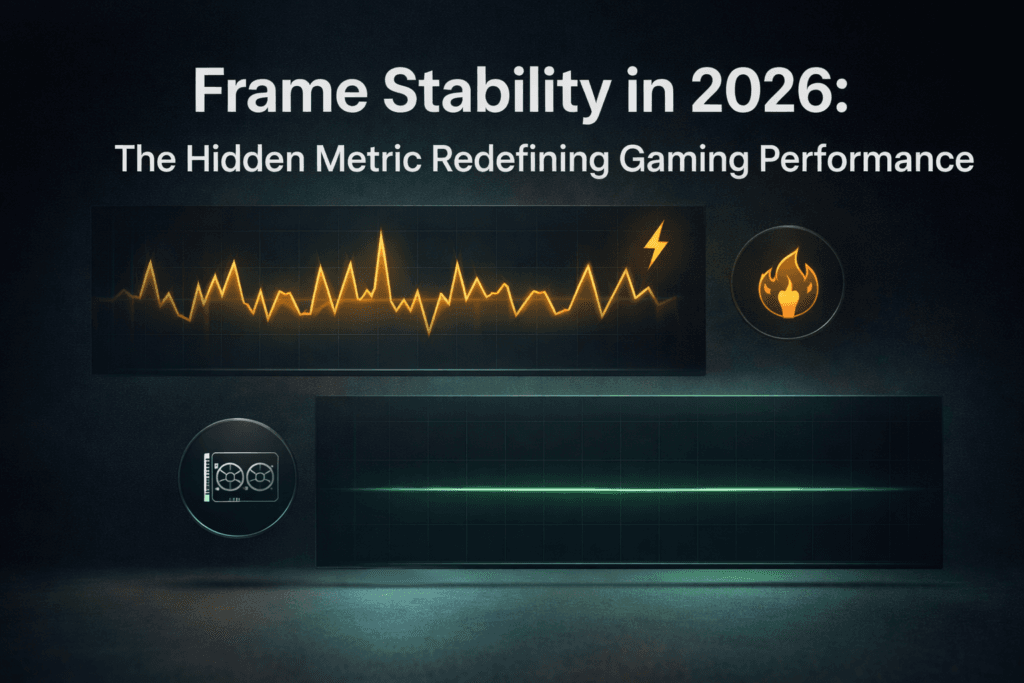
For years, gaming conversations revolved around one number: frames per second. Higher meant better. 60 was smooth. 120 was elite. 240 was competitive.
That metric still has relevance.
But it no longer tells the full story.
In modern gaming, frame stability often matters more than peak frame rate. A system that holds a consistent 90 FPS can feel smoother than one that spikes between 140 and 60. The experience isn’t defined by maximum output — it’s defined by consistency.
And consistency is harder to engineer than raw speed.
Why the Human Eye Prefers Predictability
The visual system adapts quickly to rhythm. When motion cadence remains steady, gameplay feels fluid and natural. When cadence fluctuates, even if averages are high, perception registers disruption.
Frame stability governs that rhythm.
Micro-stutters, uneven frame pacing, and sudden drops create tension in fast-paced scenes. Competitive players feel it immediately. Casual players may not articulate the cause, but they sense friction.
The illusion of smooth motion depends less on headline FPS and more on how evenly frames are delivered over time.
A flat line beats a jagged one.
The Engineering Behind Stable Frames
Maintaining frame stability requires coordination across multiple hardware layers:
- CPU scheduling efficiency
- GPU workload balancing
- Memory bandwidth consistency
- Thermal regulation
- Driver-level optimization
Companies like NVIDIA and AMD increasingly emphasize frame pacing improvements alongside raw rendering power. Modern GPUs incorporate smarter scheduling systems that anticipate workload spikes rather than reacting after performance drops occur.
The competitive focus is gradually shifting:
| Old Performance Narrative | Stability-Centered Approach |
|---|---|
| Maximum FPS achieved | Minimum FPS maintained |
| Short benchmark bursts | Sustained frame consistency |
| Resolution-first scaling | Balanced workload management |
| Peak GPU utilization | Controlled thermal behavior |
The goal is not to eliminate variation entirely — that’s unrealistic — but to minimize perceptible volatility.
Thermal Reality and the Drop-Off Effect
One of the biggest threats to frame stability is heat.
A GPU may achieve impressive frame rates during the first minutes of gameplay. As temperatures rise, thermal throttling reduces clock speeds. Performance drops. Frame timing becomes erratic.
This drop-off effect highlights a key truth: performance claims measured in brief benchmarks don’t reflect sustained play.
Efficient architectures — such as those developed by Sony for consoles and optimized silicon platforms from Microsoft ecosystem partners — increasingly prioritize balanced thermal envelopes to maintain consistent output.
Stable thermals enable stable frames.
AI Is Quietly Influencing Consistency
Modern rendering pipelines are also leveraging AI-assisted techniques to preserve frame stability.
Upscaling technologies reduce native resolution workload, allowing GPUs to maintain consistent output rather than oscillating under strain. Frame interpolation systems can smooth perceived motion during dips, though they introduce their own trade-offs in latency.
This hybrid approach shifts the objective from chasing the highest possible FPS to sustaining an experience that feels uninterrupted.
Perceived smoothness is becoming an algorithmic target.
Competitive Gaming Already Understood This
Esports players recognized early that frame stability outweighs occasional peaks.
A locked 144 FPS with minimal variance is preferable to a fluctuating 200 FPS that periodically dips. Reaction timing, muscle memory, and visual tracking depend on predictable cadence.
Frame stability reduces cognitive noise.
When the display pipeline behaves consistently, players can focus entirely on strategy and input precision.
In high-level competition, predictability is power.
The Marketing Mismatch
Despite these realities, marketing still favors bigger numbers. It’s easier to advertise 240 FPS than to explain frame pacing variance.
But consumers are becoming more informed. Reviewers increasingly analyze 1% lows, frame time graphs, and sustained performance curves rather than headline averages.
The narrative is evolving — slowly — toward holistic smoothness.
Frame stability doesn’t create flashy charts. It creates dependable experiences.
And over time, dependable wins.
The Display Factor
Stable frames matter only if the display can represent them accurately.
High-refresh-rate panels from companies like Samsung and adaptive sync technologies help reduce tearing and stutter. Variable refresh rate (VRR) alignment between GPU and monitor further enhances stability by synchronizing output cadence.
The ecosystem must work together.
GPU consistency, display responsiveness, and driver optimization collectively determine whether gameplay feels fluid or fragmented.
Where the Conversation Is Heading
As hardware performance ceilings rise, the differentiation frontier shifts toward refinement. Frame stability represents that refinement.
Future advancements will likely emphasize intelligent workload prediction, improved thermal materials, and smarter rendering techniques designed to avoid sudden drops rather than simply maximizing output.
Because once a game consistently feels smooth, higher numbers lose emotional impact.
Peak frame rates impress for seconds.
Frame stability defines the entire session.
Stay Level with Vibetric
- Follow our Instagram @vibetric_official for deeper analysis on frame stability and modern gaming performance.
- Bookmark vibetric.com to track how consistency is reshaping hardware priorities.
- Return for precision-driven insight into the engineering behind immersive play.
What’s your take on this?
At Vibetric, the comments go way beyond quick reactions — they’re where creators, innovators, and curious minds spark conversations that push tech’s future forward.