
PS5 Pro vs PS5: Powerful Upgrade or Overpriced Refresh?
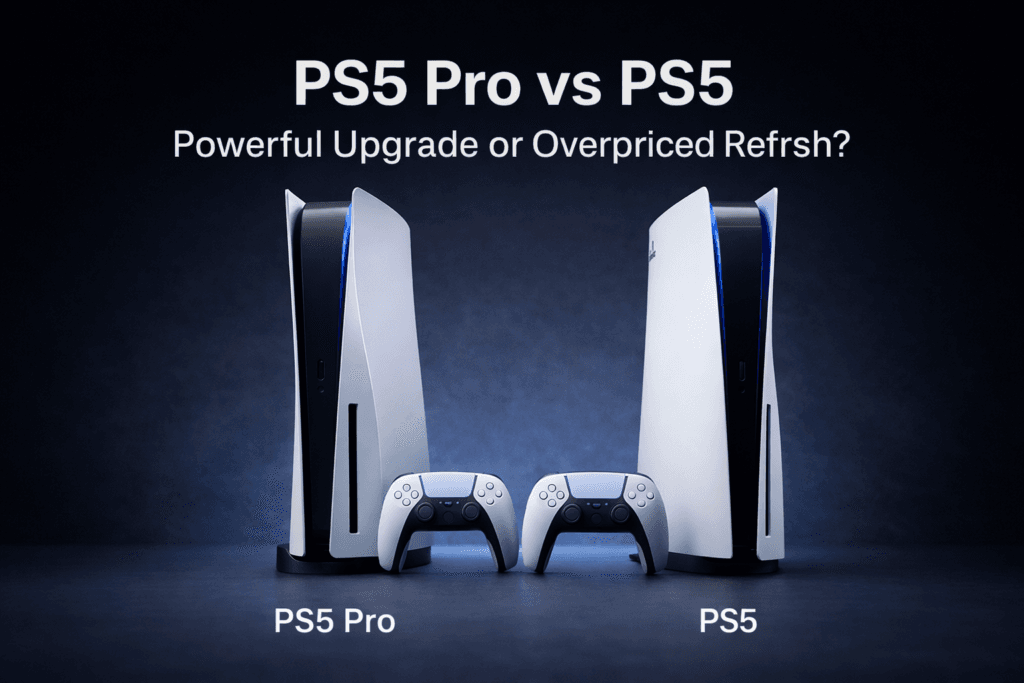
The dilemma isn’t whether the new console is better. It is whether it is better enough.
If you already own a PlayStation 5, the jump to Sony’s mid-cycle refresh feels like a luxury decision rather than a necessity. Yet if you’re buying fresh, the PS5 Pro vs PS5 conversation becomes more strategic. Performance promises, AI upscaling claims, ray-tracing upgrades — all sound compelling.
But real value lives in the details most spec sheets don’t explain.
When 60 FPS Stops Feeling Enough
You notice it in demanding titles first. Fast camera pans. Dense foliage. Ray-traced reflections during combat. The standard PlayStation 5 holds strong, but occasionally trades resolution for stability.
The PlayStation 5 Pro is designed precisely for those moments.
The tension in the PS5 Pro vs PS5 debate isn’t about compatibility — both run the same games. It’s about headroom. About how often the console has to compromise to maintain performance.
And that difference only becomes obvious when you push the hardware.
The Spec Gap That Actually Matters
Below is a side-by-side technical comparison of PS5 Pro vs PS5, focusing only on differences that meaningfully affect gameplay.
| Feature | PS5 | PS5 Pro |
|---|---|---|
| GPU Architecture | RDNA 2-based custom | Enhanced RDNA 2 variant |
| GPU Compute Units | 36 CUs | 60 CUs |
| Ray Tracing | Hardware-accelerated | Improved RT throughput |
| Upscaling | Checkerboard + dynamic | PSSR (AI-driven upscaling) |
| Internal Storage | 1TB SSD | 2TB SSD |
| Wi-Fi Standard | Wi-Fi 6 | Wi-Fi 7 |
| 4K Output | Yes | Yes (higher stability) |
| 120Hz Support | Yes | Yes (more consistent) |
| Disc Drive | Available variant | External add-on option |
From an engineering standpoint, the leap is concentrated in three areas:
- GPU compute increase
- AI-based upscaling (PSSR)
- Higher ray-tracing bandwidth
Everything else is incremental.
That clarity reframes the PS5 Pro vs PS5 discussion — this is a graphics pipeline upgrade, not a generational reset.
Why AI Upscaling Changes the Equation
Sony’s PlayStation Spectral Super Resolution (PSSR) is the most consequential difference. Instead of rendering every frame at native 4K, the system reconstructs high-resolution imagery using machine learning models trained on real game data.
What this means in practice:
- Higher internal performance headroom
- Fewer frame drops in quality modes
- Sharper image reconstruction versus older checkerboard techniques
The standard PS5 relies more heavily on dynamic resolution scaling. The Pro relies on smarter reconstruction.
That distinction shapes long-term value in the PS5 Pro vs PS5 comparison — because future titles will likely lean harder on AI reconstruction to balance fidelity and performance.
Where the Upgrade Feels Real
The difference becomes noticeable under specific conditions:
- 4K OLED or Mini-LED displays
- 120Hz panels with VRR enabled
- Games using heavy ray tracing or large open worlds
- Performance mode players who hate dips below 60 FPS
If you’re gaming on a 1080p display or 60Hz panel, the visual gap narrows dramatically. That’s why many debates around PS5 Pro vs PS5 feel contradictory — users are experiencing different bottlenecks.
The console only shines if your display chain can expose the gains.
Engineering Logic: Why Mid-Gen Refreshes Exist
Mid-cycle hardware upgrades serve one purpose: extend the lifecycle without fragmenting the user base.
The Pro model does not create exclusive titles. It enhances existing ones. That design avoids ecosystem division but introduces psychological friction — the feeling of optional superiority.
Sony is optimizing for:
- Extended generation longevity
- Higher average selling price
- Better performance baseline for late-cycle AAA titles
The PS5 Pro vs PS5 decision is therefore less about today’s library and more about the final three years of the generation.
Real-World Use Cases
Consider four common player profiles:
- Competitive Multiplayer Player
Frame consistency matters more than texture density. The Pro’s stronger GPU improves stability during chaotic scenes. - Single-Player Cinematic Enthusiast
Ray tracing and sharper reconstruction matter. The Pro delivers visibly cleaner reflections and lighting in supported titles. - Casual Weekend Gamer
The base PS5 already delivers stable 60 FPS in most titles. Upgrade impact may feel minimal. - Storage-Heavy Digital Collector
The Pro’s 2TB SSD reduces expansion pressure immediately.
Quick Reality Snapshot
| Player Type | Noticeable Upgrade? | Worth It? |
|---|---|---|
| 1080p TV Owner | Minimal | Likely No |
| 4K 120Hz OLED User | Clear | Likely Yes |
| Competitive FPS Player | Moderate | Depends |
| Story-Driven Gamer | Strong in RT titles | Often Yes |
Context drives value. Not marketing.
The Psychological Trap in “Pro” Branding
Here’s the hidden layer of the PS5 Pro vs PS5 debate: branding implies necessity.
“Pro” suggests incomplete ownership. It subtly reframes the base PS5 as standard rather than premium. Yet technically, the original system remains highly capable and far from obsolete.
Mid-generation upgrades historically create three groups:
- Early adopters chasing peak fidelity
- New buyers choosing the stronger SKU
- Existing owners feeling performance anxiety
The anxiety, more than performance need, drives many upgrades.
Where the Base PS5 Still Wins
The standard PS5 offers:
- Identical game compatibility
- Same CPU architecture
- Same DualSense experience
- Comparable load times
In CPU-bound scenarios, differences shrink further because both consoles use similar Zen 2 foundations.
In other words, the PS5 Pro vs PS5 battle is GPU-centric. If a game is CPU-limited, gains may be modest.
Edge Cases Most People Ignore
There are scenarios where upgrading makes less sense than assumed:
- You primarily play indie or stylized games
- You sit far from your TV
- Your internet connection doesn’t benefit from Wi-Fi 7
- You plan to upgrade displays in several years anyway
Technology timing matters. Buying performance without the environment to reveal it reduces perceived return.
Reddit Reality Check
Across gaming forums, opinions are polarized. Here’s a synthesis of recurring user themes:
| Community Sentiment | Frequency in Discussions |
|---|---|
| “Worth it for 4K TVs” | Very common |
| “Too expensive for minor gains” | Common |
| “Future-proofing makes sense” | Moderate |
| “Base PS5 already great” | Very common |
| “Storage alone is tempting” | Moderate |
| “Ray tracing finally stable” | Growing |
The recurring conclusion: the Pro feels premium but optional.
That nuance dominates the PS5 Pro vs PS5 discourse online.
Future Trajectory: What Happens in Late Generation?
Late-cycle AAA titles tend to push hardware ceilings. As engines evolve, developers optimize around the stronger SKU where available.
Expect:
- Higher reliance on AI upscaling
- Expanded ray tracing presets
- More consistent 60 FPS targets on Pro
- Base PS5 using more dynamic scaling
This does not make the original PS5 irrelevant. It simply means performance divergence will gradually widen.
The longer you plan to stay in this generation, the more strategic the PS5 Pro vs PS5 decision becomes.
Who Should Upgrade — and Who Shouldn’t
Everyday Players
If gaming is occasional entertainment, the base PS5 remains sufficient.
Competitive & Performance-Focused Gamers
If frame stability affects enjoyment, Pro offers measurable improvement.
Visual Fidelity Enthusiasts
If lighting, reflections, and texture clarity matter deeply, the upgrade aligns with your priorities.
Future-Proof Buyers
If you intend to skip the next generation’s early cycle, Pro may extend satisfaction longer.
When Skipping Is the Smarter Move
If your current PS5 already delivers what you need, upgrading may produce diminishing emotional returns.
Performance upgrades feel exciting for weeks. Long-term satisfaction depends on visible gains during play — not during spec comparisons.
That’s the subtle truth in the PS5 Pro vs PS5 discussion: perception must match environment.
Vibetric Ending
Picture the glow of your TV during a fast-paced battle. If you crave sharper reflections, smoother performance, and technical headroom for future releases, the Pro speaks directly to that desire.
If your current setup already feels fluid and immersive, the base PS5 remains an exceptional machine.
The real decision isn’t between two consoles. It’s between two expectations.
Choose based on what you actually see — not what the box promises.
Which One Is Right for You: PS5 Pro or PS5?
- Follow vibetric_official on Instagram to keep up with the latest trends and insights into gaming technology.
- Bookmark Vibetric.com we continuously update our analysis as new developments emerge in console hardware.
Subscribe for updates and receive ongoing, in-depth breakdowns and expert opinions on gaming systems and performance tech.
What Players Still Want to Know Before Choosing
1. Is the PS5 Pro significantly more powerful than the standard PS5?
Yes, primarily on the GPU side. The Pro delivers higher graphics throughput and improved ray tracing, but the CPU architecture remains similar — meaning gains are mostly visual and frame stability–related.
2. Will older PS5 games automatically look better on the Pro?
Many titles benefit from enhanced resolution stability or frame consistency, but the biggest improvements appear in games patched to leverage PSSR and higher GPU bandwidth.
3. Does the PS5 Pro eliminate performance modes?
Not entirely. Developers may still offer performance and quality presets, but the Pro narrows the gap between them, often delivering higher resolution at smoother frame rates.
4. Is the upgrade noticeable without a 4K TV?
In most cases, no. The visual advantage becomes clear on high-resolution displays, especially those supporting 120Hz and VRR.
5. Are load times faster on PS5 Pro?
Load times are very similar. Both consoles rely on high-speed SSD architecture, so gameplay fluidity improvements come more from graphics power than storage speed.
6. Does the PS5 Pro consume more power or run hotter?
It has higher GPU capability, but thermal design improvements aim to manage efficiency. Under load, power draw may increase slightly compared to the base model.
7. Is the storage difference a major factor?
For digital libraries, yes. The Pro’s 2TB SSD reduces the need for immediate expansion, especially with modern game file sizes increasing steadily.
8. If I don’t care about ray tracing, is the upgrade worth it?
Probably not. The biggest gains in the PS5 Pro vs PS5 comparison appear in visually intensive titles using ray tracing and high-resolution rendering.
9. Will upcoming games prioritize PS5 Pro performance?
Late-generation titles may optimize more aggressively for the Pro’s GPU headroom, though full compatibility across both systems will remain.
10. Is it smarter to upgrade now or wait for the next generation?
If you’re satisfied with current performance, waiting could be reasonable. The Pro is a refinement for enthusiasts, not a mandatory step for every player.
What’s your take on this?
At Vibetric, the comments go way beyond quick reactions — they’re where creators, innovators, and curious minds spark conversations that push tech’s future forward.
Community Triage (0)