
Compact Earbuds Technology 2026 — The Powerful Shift Toward Smaller, Smarter Audio
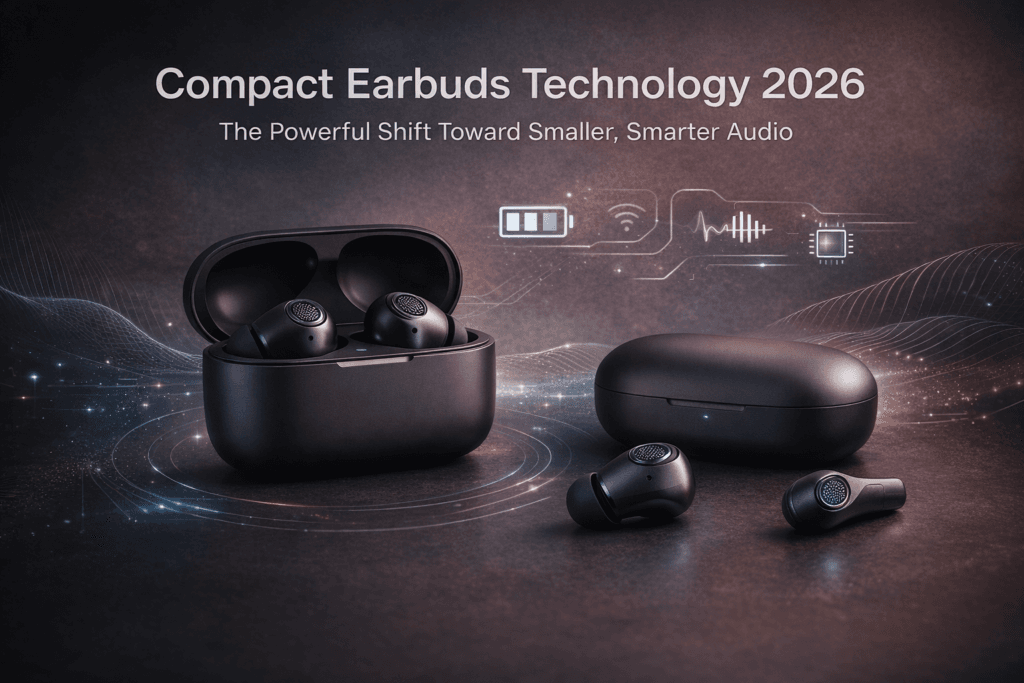
Minimalism in audio design used to mean compromise. Smaller shells often translated to weaker drivers, shorter battery life, and limited noise control. In 2026, that trade-off is disappearing. The most refined earbuds are shrinking in size while expanding in capability — not because physics changed, but because engineering priorities did. Compact earbuds technology 2026 is less about miniaturization alone and more about architectural intelligence.
The shift is subtle but important: manufacturers are no longer stacking components. They are integrating them.
Power Efficiency Is Replacing Battery Bulk
For years, performance gains required larger housings to accommodate bigger batteries. That approach created diminishing returns. Thermal constraints increased, weight rose, and comfort declined. Today’s designs instead focus on reducing energy demand at the source.
Modern system-on-chip platforms combine Bluetooth processing, digital signal processing, adaptive noise cancellation, and AI audio tuning into unified silicon. Fewer discrete components mean lower leakage, reduced heat, and tighter internal layouts. This integration is the backbone of compact earbuds technology 2026.
Efficiency gains are happening in three quiet ways:
- Smarter power scaling adjusts processing intensity in real time
- Updated wireless protocols reduce constant transmission drain
- Background tasks deactivate when unnecessary
Instead of increasing battery size, engineers are lowering baseline consumption.
The Acoustic Engineering Paradox
Driver size once dictated output authority. Larger diaphragms moved more air, delivering stronger low-frequency presence. While physics still governs sound reproduction, materials science has narrowed the gap.
High-rigidity composite diaphragms and optimized magnetic assemblies allow smaller drivers to maintain structural stability at higher excursions. Acoustic chamber modeling has also improved dramatically. Internal airflow and resonance are now digitally simulated before manufacturing, minimizing inefficiencies.
This is why compact earbuds technology 2026 no longer feels sonically constrained. Precision modeling replaces brute force. Instead of relying solely on hardware scale, tuning and AI calibration compensate for physical limitations.
Why Smaller Shells Improve Real-World Performance
Reduced size does more than enhance aesthetics. A lighter earbud creates a more stable seal, especially during movement. That stability improves passive isolation, which in turn reduces the workload on active noise cancellation systems.
The engineering loop looks like this:
Better fit → Stronger passive isolation → Lower ANC intensity required → Reduced power draw.
In this sense, comfort directly influences performance efficiency. Compact earbuds technology 2026 treats ergonomics as a technical variable, not just a design preference.
What Has Actually Changed Internally?
| Innovation Shift | Engineering Impact | User-Level Result |
|---|---|---|
| Integrated audio SoC platforms | Fewer internal modules | Smaller, lighter housings |
| Adaptive noise control algorithms | Variable processing load | Stable battery life |
| AI-based sound calibration | Fit-aware tuning | Consistent tonal balance |
| Low-power wireless codecs | Reduced transmission strain | Reduced transmission strain |
| Thermal optimization layouts | Lower heat density | Sustained performance |
The table reveals a consistent theme: integration over expansion. Every meaningful advancement in compact earbuds technology 2026 centers on efficiency, not excess.
The Consumer Perception Gap
Many buyers still equate physical size with capability. Larger devices appear more powerful, more serious, more premium. Yet in audio engineering, wasted space often signals inefficiency rather than strength.
Smaller earbuds today carry advanced processors capable of real-time environmental analysis, adaptive equalization, and spatial rendering. None of that requires visible bulk. The real power lies in computation density and software refinement.
This perception gap creates an interesting dynamic. Devices look simpler, yet internally they are more complex than ever. Compact earbuds technology 2026 is redefining what “premium” looks like — subtle, not oversized.
A Contrarian Take: Mass Adoption Isn’t the Goal
A common assumption is that foldables must replace slab phones to succeed. That’s a false benchmark. The more realistic outcome—and arguably the healthier one—is coexistence.
Foldables don’t need universal adoption. They need sustainable, satisfied users who choose them deliberately. By that measure, 2026 looks far more promising than any prior year. The category is settling into its role instead of chasing dominance.
The contrarian truth is that foldables become practical precisely when they stop trying to be everything.
Where Limits Still Exist
Despite rapid progress, constraints remain. Smaller acoustic chambers can slightly limit maximum loudness headroom. Ultra-compact batteries depend heavily on intelligent power management. Physical durability also becomes more challenging as structures thin.
However, these compromises are increasingly marginal. For most listeners, the improvements in comfort, stability, and consistent output outweigh the rare edge-case limitations. Engineering has reached a point where size reduction no longer signals feature reduction.
Refinement Over Expansion
The evolution of compact earbuds technology 2026 reflects a broader pattern in consumer electronics. Growth no longer comes from adding visible hardware. It comes from tightening integration, reducing inefficiencies, and optimizing every millimeter.
Smaller earbuds are not minimal versions of larger predecessors. They are more advanced systems condensed through smarter design. As wireless standards mature and AI audio processing deepens, future improvements will likely remain invisible — felt in comfort and consistency rather than seen in size.
Miniaturization, once a risk, has become a marker of engineering maturity.
Stay Connected with Vibetric
- Follow our Instagram @vibetric_official for sharp analysis of next-gen audio innovation.
- Bookmark vibetric.com for focused breakdowns of evolving hardware trends.
- Stay updated as compact design reshapes performance standards.
What’s your take on this?
At Vibetric, the comments go way beyond quick reactions — they’re where creators, innovators, and curious minds spark conversations that push tech’s future forward.