
Motion Clarity Gaming Monitors: Why 2026 Displays Prioritize Speed Over Resolution
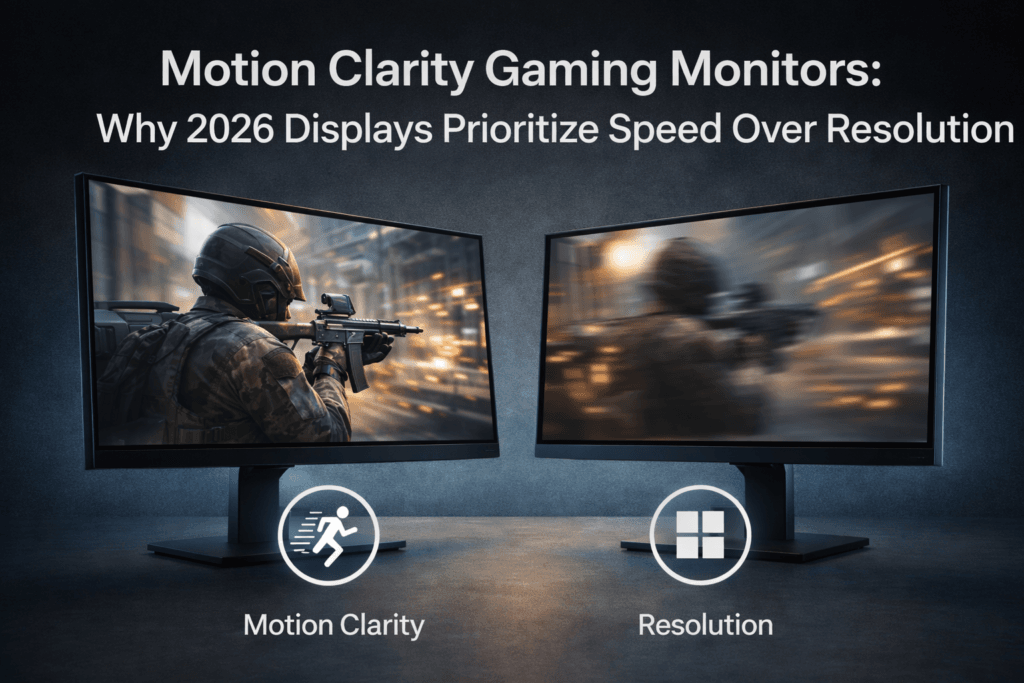
For years, gaming monitor marketing revolved around one number: resolution. Full HD gave way to Quad HD, which quickly escalated into 4K panels promising sharper textures and denser pixel grids. In 2026, that race has slowed—not because resolution stopped improving, but because it stopped being the primary bottleneck in gameplay. Instead, manufacturers are shifting attention toward something far more impactful in competitive and fast-paced titles: motion clarity. The rise of motion clarity gaming monitors signals a performance conversation moving beyond static image sharpness toward how clearly players see action while it’s happening.
Resolution Plateau vs Motion Bottleneck
Modern GPUs can already drive high-resolution panels effectively in many titles, and pixel density at typical viewing distances has reached a point where incremental sharpness gains are less noticeable. Motion, however, remains an active challenge. Even a 4K display can look blurred when objects move quickly across the screen due to sample-and-hold display behavior and pixel response limitations.
This is why motion clarity gaming monitors are prioritizing refresh rate optimization, response time refinement, and advanced backlight control rather than simply adding more pixels. When a player tracks a moving target, the clarity of that motion has a greater impact on reaction accuracy than the static sharpness of a paused frame.
The Science Behind Motion Perception
Human visual perception processes moving objects differently from static images. Blur during motion occurs not only because of slow pixel transitions but also because most displays hold each frame for the entire refresh interval. The longer a frame remains on screen, the more perceived blur accumulates as the eye tracks moving content.
To address this, manufacturers are refining several technical areas simultaneously:
- Higher refresh rates to reduce frame persistence
- Improved pixel response consistency across transitions
- Advanced strobing or backlight modulation systems
- Smarter overdrive tuning to minimize ghosting
These improvements collectively define the modern motion clarity gaming monitors category. Instead of advertising only resolution, brands now emphasize motion handling metrics and real-world tracking performance.
Why High Resolution Alone Doesn’t Improve Competitive Play
In competitive gaming, clarity during motion determines whether players can accurately follow fast-moving objects or opponents. A sharper static image does little to help if motion blur obscures fine details mid-action. Increasing resolution without improving motion handling can even reduce performance headroom, limiting frame rates that contribute to smoother motion.
That trade-off explains why many 2026 gaming displays are pairing optimized resolutions with extremely high refresh rates. The focus has shifted from “more pixels” to “clearer frames,” aligning monitor capabilities with the actual demands of esports and fast-paced gameplay.
Motion Clarity vs Resolution: Where Each Matters Most
| Scenario | Resolution Priority | Motion Clarity Priority |
|---|---|---|
| Competitive FPS titles | Moderate | Very High |
| Cinematic single-player games | High | Moderate |
| Esports training | Moderate | Extremely High |
| Content creation & editing | Very High | Moderate |
| Fast racing or sports games | Moderate | High |
This comparison shows why motion clarity gaming monitors are gaining traction. In dynamic gameplay, smoother and clearer motion contributes more directly to precision than incremental pixel density increases.
Panel Technology Is Evolving for Consistency
Beyond refresh rates, consistency across pixel transitions is becoming critical. Earlier high-refresh panels sometimes suffered from uneven response times, leading to overshoot artifacts or inverse ghosting. Modern engineering focuses on refining voltage control and response curve tuning to maintain uniform performance across brightness levels.
Additionally, newer display technologies are reducing latency between input and visual output, tightening synchronization between GPU frame delivery and panel refresh cycles. These changes ensure that motion clarity gaming monitors not only refresh quickly but also maintain stable, artifact-free motion rendering.
The Industry Shift Toward Real-World Metrics
Another subtle change in 2026 is how manufacturers measure and communicate performance. Instead of relying solely on theoretical response time figures, brands are increasingly referencing real-world motion performance testing, including blur reduction effectiveness and consistency across refresh ranges. This signals a broader understanding that gaming performance depends on multiple synchronized variables rather than isolated specifications.
As a result, buyers are beginning to evaluate monitors based on how they perform in actual gameplay scenarios rather than on spec-sheet numbers alone. The emphasis on motion clarity reflects this more practical performance mindset.
The Contrarian View: Resolution Still Has Its Place
While motion clarity is gaining prominence, resolution is not irrelevant. High-resolution panels remain essential for immersive single-player experiences, creative workflows, and detailed open-world environments. The shift is not about abandoning resolution but about recognizing that pixel count alone no longer defines gaming performance.
In fact, the most advanced displays combine balanced resolutions with high refresh rates and advanced motion optimization. The key change is prioritization: motion clarity is now seen as a core gameplay variable rather than a secondary enhancement.
Closing Insight: Performance Is Measured in Motion
The focus on motion clarity gaming monitors in 2026 reflects a deeper understanding of how players actually interact with their screens. Gaming is dynamic, reactive, and continuous—qualities that static resolution metrics cannot fully capture. As panel technologies mature, the next phase of display innovation will be defined less by pixel density escalation and more by how cleanly and consistently movement is rendered across refresh cycles. In competitive environments especially, clearer motion translates directly into faster recognition and improved precision. Resolution once defined visual progress; motion clarity is redefining performance itself.
Stay Sharp with Vibetric
- Follow our Instagram @vibetric_official for deeper gaming hardware analysis.
- Bookmark vibetric.com to track evolving display performance standards.
- Stay connected for upcoming insights on next-generation monitor engineering.
What’s your take on this?
At Vibetric, the comments go way beyond quick reactions — they’re where creators, innovators, and curious minds spark conversations that push tech’s future forward.
Community Triage (0)