
Software-Driven Smartphone Updates 2026 — The Powerful Shift Changing Hardware
Five years ago, buying a smartphone meant weighing camera megapixels, chip benchmarks, and charging speeds. In 2026, that decision feels oddly different. People aren’t asking how fast a phone is on day one—they’re asking how long it will stay useful, adaptable, and secure. The quiet shift isn’t about glass or silicon. It’s about software roadmaps quietly dictating what hardware even makes sense to ship. And once you notice it, you can’t unsee it.
When Phones Started Shipping With a Future Attached
Stand in any café and you’ll see phones that look nearly identical—flat slabs, edge-to-edge displays, muted camera bumps. The real differentiation now lives somewhere invisible. Updates roll in overnight, changing battery behavior, camera processing, privacy controls, even the way the phone feels in your hand weeks after purchase.
This is the lived reality behind software-driven smartphone updates 2026. Devices no longer arrive as finished products. They arrive as platforms with multi-year intentions baked in. Hardware decisions—RAM ceilings, neural accelerators, storage controllers—are now shaped by what the software team plans to deliver two or three OS versions from now, not just what ships at launch.
Everyone Sees “Longer Updates,” but the Real Shift Is Hardware Dependency
Most conversations stop at update promises: seven years of OS support, monthly security patches, extended AI features. That’s the visible layer. The deeper shift is more structural.
Modern updates are heavier, more context-aware, and increasingly local. On-device AI, real-time language processing, adaptive UI layers, and camera pipelines all rely on sustained hardware headroom. Without it, updates stall—or worse, degrade the experience.
That’s why software-driven smartphone updates 2026 are forcing manufacturers to over-engineer components that once sat comfortably at “good enough.”
The Engineering Tradeoffs Software Teams Are Forcing
Memory Isn’t About Multitasking Anymore
RAM used to be a spec-sheet flex. Now it’s a software survival requirement. Modern OS updates increasingly assume:
- Persistent background models
- On-device inference without cloud fallback
- Real-time context caching
Phones that ship with tight memory budgets age faster—not because the chip slows down, but because future updates are quietly optimized for more breathing room.
Storage Controllers Matter More Than Raw Capacity
Update size inflation is real, but the bigger issue is I/O behavior. Seamless updates, A/B partitions, rollback protection, and encrypted user spaces stress storage subsystems continuously. Hardware choices around controller quality and thermal stability directly affect update reliability over years.
Neural Silicon Has Become Mandatory Infrastructure
In 2026, AI features aren’t bolt-ons. They’re core OS behaviors. Live transcription, camera scene understanding, accessibility enhancements—these ship as updates, not apps. That forces hardware teams to include neural blocks with long-term software programmability, not fixed-function accelerators that age out after two years.
software-driven smartphone updates 2026 have effectively turned neural hardware into the new CPU core—silent, assumed, and non-negotiable.
Micro Snapshot: Hardware Choices Shaped by Update Strategy
| Hardware Area | Old Decision Logic | 2026 Reality |
|---|---|---|
| RAM | “Enough for launch apps” | Sized for future OS behavior |
| Neural Engine | Camera-only acceleration | System-wide AI dependency |
| Storage | Capacity marketing | Update resilience & speed |
| Thermals | Peak performance bursts | Sustained update workloads |
The Market Behavior Nobody Advertises
Manufacturers rarely say this out loud, but update commitments are now gating factors for product tiers.
Mid-range phones are no longer cut down just on cameras or materials. They’re limited on how far into the future the software team feels confident optimizing for them. If a device can’t handle anticipated OS features three years out, it quietly gets a shorter update runway.
This is why software-driven smartphone updates 2026 are reshaping product stacks from the inside. Hardware roadmaps are increasingly aligned with internal software confidence, not just cost targets.
Real-World Scenarios Where This Shows Up
Scenario 1: The “Slower” Phone That Ages Better
Two phones launch with similar benchmarks. After two years, one feels smoother—not because it’s faster, but because updates were tuned for its hardware envelope. The other struggles with UI latency after major OS revisions. Same era. Different update-first design philosophy.
Scenario 2: Camera Quality That Improves Post-Purchase
Computational photography updates increasingly outperform hardware gains. Phones built with future imaging pipelines in mind see measurable photo improvements via updates. Those without sufficient ISP or neural headroom plateau early.
Scenario 3: Battery Life That Changes Without a New Battery
Adaptive charging curves, usage prediction, and thermal-aware scheduling now arrive as updates. Devices designed around these systems see battery longevity improve over time. Others just age.
Scenario 4: Security as a Hardware Feature
Modern privacy updates depend on secure enclaves, memory isolation, and cryptographic accelerators. Without them, “supported” phones still feel less trustworthy over time.
Why Update-Centric Design Is Now the Safer Bet
There’s a subtle inversion happening. Hardware used to define software limits. Now software ambition defines hardware minimums.
This explains why software-driven smartphone updates 2026 correlate strongly with:
- Higher baseline specs across generations
- Slower year-over-year hardware leaps
- Longer usable lifespans without visible stagnation
From an engineering standpoint, this is less wasteful. From a consumer standpoint, it’s less flashy—but more honest.
The Human Impact Nobody Frames Correctly
What users experience isn’t “more updates.” It’s reduced anxiety.
- Less fear of buying the “wrong” phone
- Fewer moments where a new OS makes a device feel obsolete
- More trust that the phone will adapt rather than degrade
For creators, this means tools improving mid-cycle. For everyday users, it means stability. For professionals, it means fewer forced upgrade decisions driven by software compatibility rather than need.
software-driven smartphone updates 2026 quietly turn phones into longer-term companions instead of disposable gadgets.
A Practical Framework for Buyers in 2026
Everyday Users
Prioritize update commitment over peak specs. Smoothness over time beats raw speed on day one.
Creators & Professionals
Look for devices explicitly marketed around on-device AI, imaging pipelines, and sustained performance. These signal update-first hardware planning.
Gamers & Enthusiasts
Thermal design and memory bandwidth matter more than top benchmark numbers. Future game engines will lean into OS-level optimizations.
Future-Proof Buyers
Ignore generational hype cycles. Focus on how confidently a manufacturer discusses updates beyond the next OS version.
Pros & Cons Snapshot
| Update-Centric Phones | Tradeoffs |
|---|---|
| Longer relevance | Less dramatic annual jumps |
| Improving features | Higher upfront cost |
| Better security | Specs feel “overkill” early |
| Lower replacement anxiety | Slower visible innovation |
Where This Logic Breaks Down
Not every user benefits equally. If you upgrade yearly, update longevity matters less. If you live in regions with limited OS rollout consistency, promised updates may arrive late. And some niche users still prioritize hardware specialization over long-term software evolution.
In those cases, software-driven smartphone updates 2026 are a nice-to-have—not a deciding factor.
What Real Users Are Actually Saying
| Common Sentiment | Underlying Reality |
|---|---|
| “My phone feels new again” | Post-launch optimization |
| “This update ruined battery life” | Hardware headroom mismatch |
| “Why didn’t this ship earlier?” | Features matured via updates |
| “I’m keeping this another year” | Update trust established |
| “Specs didn’t matter as much” | Software closed the gap |
| “Security feels tighter now” | Hardware-enabled privacy |
The pattern is consistent: satisfaction tracks update quality more than launch specs.
The Next Two Years: What Changes, What Doesn’t
Expect update cycles to grow more modular. Not every feature will land on every device—even within the same OS version. Hardware-aware update branching is becoming normal.
What won’t change is the direction. software-driven smartphone updates 2026 are not a trend. They’re the structural reality of a mature smartphone market.
Innovation now happens quietly, incrementally, and continuously—exactly where software thrives.
Why Phones No Longer Peak on Day One
That café scene makes more sense now. People aren’t holding identical phones. They’re holding different futures. Some devices are still growing. Others are slowly being left behind.
In 2026, the smartest smartphone decision isn’t about what the hardware can do today—but what the software will dare to attempt tomorrow.
Vibetric Ending
Great hardware used to impress. Great software now earns trust. And in a market that finally values longevity, that trust is the most powerful spec of all.
Curious About the Science Behind Software-Centric Smartphones?
- Follow vibetric_official on Instagram to keep up with the latest trends and insights into smartphone technology.
- Bookmark Vibetric.com we continuously update our analysis as new developments emerge in mobile software and hardware convergence.
- Subscribe for ongoing, in-depth breakdowns and expert perspectives on where smartphones are really headed.
The Questions People Ask Once Specs Stop Mattering
It means smartphones are now engineered with future operating system behavior in mind, not just launch-day features. Hardware decisions—like RAM capacity, neural accelerators, and storage architecture—are made based on what the software team plans to deliver years later. The phone is treated as an evolving platform, not a finished product.
No. Update duration only matters if the hardware can sustain future workloads. Some phones receive updates but feel slower over time because they lack memory headroom or thermal capacity. The best experiences come from devices where software ambition and hardware limits were aligned from day one.
Battery regressions usually signal a mismatch between new software behavior and existing hardware constraints. Features like background intelligence, adaptive UI layers, or AI-driven services increase sustained workloads. Phones designed with these updates in mind often recover or even improve battery life over time.
They serve different roles, but insufficient RAM tends to age a phone faster than a slightly weaker CPU. Modern updates rely on persistent background processes, cached models, and real-time context handling. Without enough memory, even powerful processors feel constrained after a few OS generations.
A major one. In 2026, AI isn’t limited to cameras or voice assistants—it’s embedded in system behavior, accessibility, privacy, and UI responsiveness. Phones without flexible neural hardware often stop receiving the most meaningful features, even if they still get basic OS updates.
If you plan to keep your phone more than two years, yes. Update clarity signals how confident a manufacturer is in the hardware’s future viability. Vague promises often mean limited internal optimization plans beyond the near term.
Because specs don’t reveal how deeply software is optimized for that hardware. Update-first phones are tuned continuously across OS versions, while others rely on generic compatibility. Over time, that difference shows up as smoother UI, better battery behavior, and fewer feature gaps.
For many users, absolutely. When phones improve post-purchase instead of stagnating, upgrade pressure drops. This is especially noticeable for productivity users and creators, where new features arrive through software rather than requiring new hardware.
In practice, yes. Longer usable lifespans reduce replacement cycles and electronic waste. While manufacturing impact still matters, software-driven longevity is one of the few changes that meaningfully slows smartphone turnover.
Look beyond headline numbers. Signals like generous RAM, modern neural processing blocks, strong thermal design, and explicit multi-year update strategies matter more than peak benchmarks. These are the foundations that make long-term software evolution possible.
What’s your take on this?
At Vibetric, the comments go way beyond quick reactions — they’re where creators, innovators, and curious minds spark conversations that push tech’s future forward.
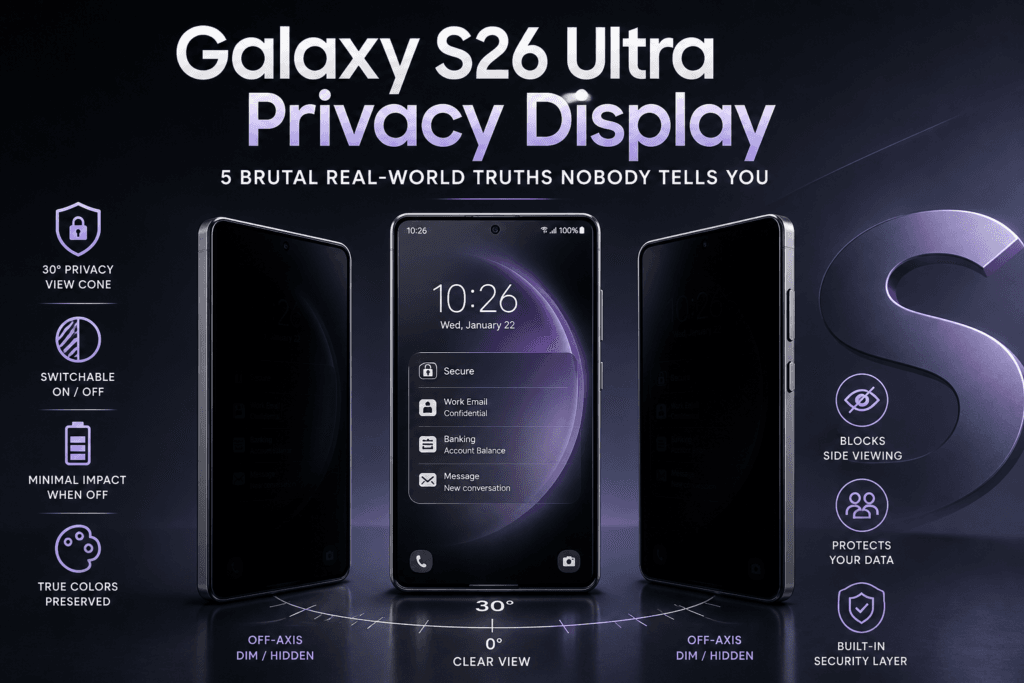
Galaxy S26 Ultra Privacy Display: 5 Brutal Real-World Truths Nobody Tells You
Galaxy S26 Ultra Privacy Display: 5 Brutal Real-World Truths Nobody Tells You There’s a specific anxiety that comes with using a phone