
Windows AI PCs 2026 — The Powerful Shift Toward Intelligent Computing
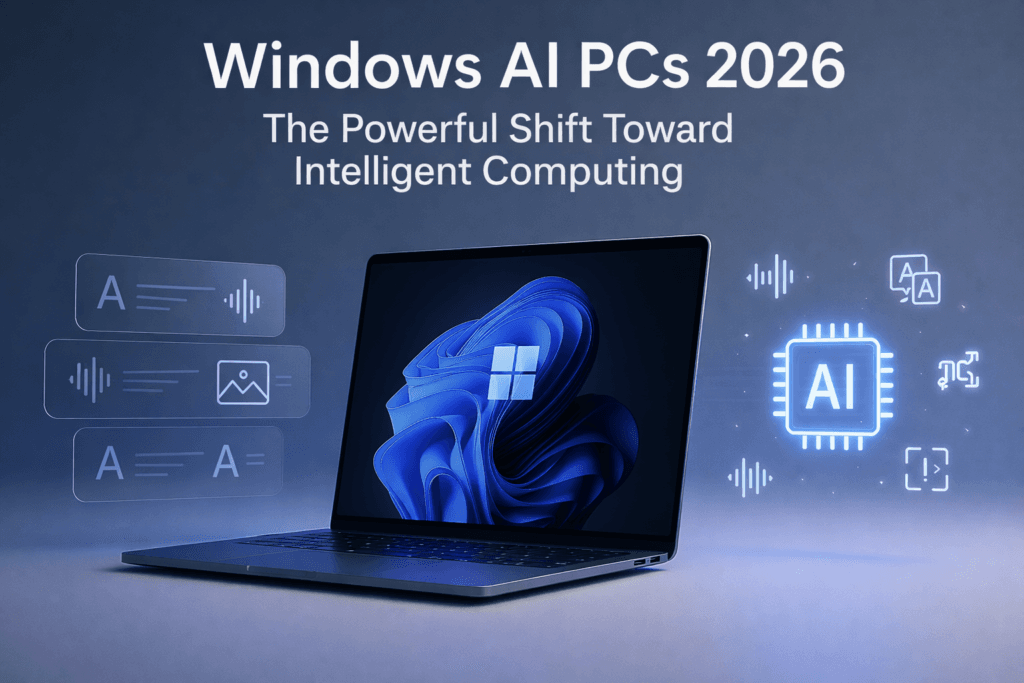
For years, PC upgrades were measured through familiar metrics—faster processors, better graphics, and longer battery life. In 2026, the conversation has shifted toward intelligence embedded directly into hardware. Manufacturers are positioning Windows AI PCs 2026 as a new computing category powered by integrated neural processing units (NPUs) capable of running AI tasks locally. The promise is simple: computers that assist, predict, and automate workflows in real time. The real question is whether this shift represents a genuine productivity leap or primarily a strategic marketing reset for the PC industry.
The Architectural Shift Behind the AI PC Label
Unlike traditional systems that relied mainly on CPUs and GPUs, modern AI-focused laptops integrate dedicated NPUs designed specifically for machine-learning workloads such as transcription, summarization, background image processing, and predictive system optimization. Running these tasks locally reduces latency and improves privacy, since sensitive data does not always need to be sent to cloud servers.
This structural difference is why Windows AI PCs 2026 are not simply faster versions of previous laptops. They are built around a new computing workflow where small AI models operate continuously in the background, enhancing applications in subtle but persistent ways.
What Actually Feels Different in Daily Use
The everyday impact of Windows AI PCs 2026 is less dramatic than marketing presentations might suggest. Instead of one visible breakthrough feature, users experience incremental workflow improvements: automatic meeting transcription, real-time translation, predictive file search, intelligent camera framing, and context-aware productivity suggestions. Each feature individually feels modest, but together they reduce friction across daily tasks.
Because many AI functions run locally, response times are nearly instantaneous compared to cloud-based processing, particularly in voice recognition and real-time editing scenarios. Over extended usage, these small efficiency gains accumulate into measurable productivity improvements.
Traditional PCs vs AI PCs: The Functional Difference
| Capability Area | Traditional Windows PCs | Windows AI PCs 2026 |
|---|---|---|
| AI workload processing | Primarily cloud-dependent | Local NPU acceleration |
| Real-time assistance features | Limited or slower | Instant on-device processing |
| Privacy handling | More data sent to cloud services | More tasks processed locally |
| Power efficiency for AI tasks | Higher power usage | Optimized low-power inference |
| Future software compatibility | Standard performance scaling | Designed for AI-accelerated apps |
This distinction shows why Windows AI PCs 2026 are being treated as a platform transition rather than a normal hardware refresh.
Why Some Users Still Feel Underwhelmed
Despite the technical changes, early consumer reactions are sometimes mixed. The reason is behavioral rather than technological. AI improvements tend to optimize workflows quietly instead of transforming interfaces dramatically. Users may not immediately recognize the value because the benefits appear as time savings, automation, and reduced manual steps rather than visually obvious upgrades.
Historically, similar transitions—such as the move to SSD storage—initially felt incremental before becoming essential. AI-accelerated computing is likely following the same trajectory, where long-term productivity gains matter more than first-impression excitement.
The Industry Incentive Driving the AI PC Push
The strong marketing momentum around Windows AI PCs 2026 also reflects industry economics. After years of incremental laptop improvements, manufacturers needed a new innovation narrative capable of encouraging upgrade cycles. Dedicated AI silicon provides a meaningful technological foundation for that narrative while giving software developers a new hardware capability to target.
Operating systems and productivity platforms are already integrating AI-accelerated features designed specifically for NPU-enabled devices. As more applications rely on local inference, systems without AI acceleration may gradually feel slower or less responsive in comparison.
A Contrarian Perspective: Hardware Alone Isn’t Enough
While AI-enabled chips are essential, the real transformation depends on software ecosystems catching up. A laptop equipped with advanced AI hardware delivers limited value if applications do not actively use those capabilities. Early platform transitions often show this gap, where hardware potential exists before software fully exploits it.
The long-term success of Windows AI PCs 2026 will depend less on processor specifications and more on how seamlessly operating systems and third-party applications integrate AI features into everyday workflows without requiring manual activation.
The Emerging Behavior Shift Toward Proactive Computing
As local AI models become more capable, PCs are gradually moving from reactive tools to proactive assistants—suggesting workflow shortcuts, summarizing long documents automatically, and organizing digital content based on usage patterns. These changes may redefine productivity expectations over the next few years, making AI assistance feel less like an optional feature and more like a default computing behavior.
Once users become accustomed to systems that anticipate tasks and automate repetitive steps, returning to traditional computing environments may feel noticeably slower and less efficient.
A Transition That Will Mature Over Time
The rise of Windows AI PCs 2026 represents both a genuine infrastructure upgrade and a strategically marketed transition designed to accelerate adoption. The immediate experience may feel evolutionary rather than revolutionary, but the underlying architectural changes—local AI processing, dedicated NPUs, and AI-optimized operating systems—lay the groundwork for the next phase of personal computing. As software ecosystems increasingly rely on real-time on-device intelligence, the distinction between “AI PCs” and standard PCs will gradually disappear, replaced by an expectation that intelligent assistance is simply part of modern computing itself.
Stay Ahead with Vibetric
- Follow our Instagram @vibetric_official for next-generation computing intelligence insights.
- Bookmark vibetric.com to track emerging AI hardware ecosystem shifts.
- Stay connected for ongoing analysis of technologies shaping the 2026 PC landscape.
What’s your take on this?
At Vibetric, the comments go way beyond quick reactions — they’re where creators, innovators, and curious minds spark conversations that push tech’s future forward.