
CES 2026 Smartphone Trends — Important Changes You Can’t Ignore
CES has never been the primary stage for flagship smartphones, but the early 2026 launches shown this year were unusually revealing. Not because of dramatic breakthroughs—but because of what they didn’t try to do. There were no radical form-factor gambles, no spec arms races designed to dominate headlines. Instead, CES 2026 smartphones quietly signaled a broader reset in priorities.
What these first devices reveal about CES 2026 smartphone trends is an industry shifting from spectacle to stability, from differentiation through hardware to advantage through behavior-aware design.
Experience Tuning Is Replacing Feature Expansion
One of the clearest patterns across CES 2026 smartphone announcements was restraint. Rather than adding more camera modes, sensors, or interaction layers, manufacturers focused on experience tuning—how existing capabilities behave across real-world usage.
Battery systems are optimized around usage rhythm, not maximum capacity. Displays adjust color behavior and brightness curves based on ambient conditions and eye fatigue, not just peak nit values. Performance scaling is increasingly intent-driven, prioritizing sustained smoothness over benchmark spikes.
These choices don’t look dramatic on spec sheets, but they define CES 2026 smartphone trends more accurately than any single feature. Phones are being designed to feel consistent across a full day, not impressive for five minutes.
The Software-Hardware Boundary Is Fading
Another signal emerging from early 2026 launches is how indistinct the line between hardware and software has become. Many of the most meaningful improvements weren’t tied to new components, but to tighter system-level integration.
Camera performance improvements, for example, leaned heavily on adaptive processing rather than new sensors. Thermal behavior was managed through predictive workload distribution instead of brute-force cooling. Even UI responsiveness benefited from background intelligence rather than raw silicon gains.
In CES 2026 smartphone trends, hardware is increasingly the enabler—not the headline. The value comes from how systems coordinate, not what any single part claims to do alone.
Design Maturity Over Visual Reinvention
Visually, smartphones at CES 2026 looked… familiar. That’s not a failure of creativity—it’s a sign of maturity. Industrial design has converged on forms that balance ergonomics, durability, and manufacturing efficiency.
What changed instead were subtler choices: material finishes optimized for longevity, simplified camera layouts to improve structural integrity, and reduced part complexity to aid repair and sustainability. These decisions rarely headline launch events, but they reflect where confidence now lives.
CES 2026 smartphone trends suggest that brands no longer feel pressure to reinvent form every year. They’re refining what works—and signaling that reliability now matters more than novelty.
AI Shows Up as Behavior, Not Branding
Artificial intelligence was everywhere, but rarely branded loudly. Instead of “AI features,” smartphones demonstrated AI-driven behavior adjustments: smarter background task management, context-aware notification filtering, adaptive power usage, and camera systems that respond to shooting intent rather than preset modes.
This is a meaningful evolution. AI in early 2026 smartphones is less about capability expansion and more about decision-making quality. Phones intervene less often, but more accurately. They surface information selectively and stay out of the way when they’re not needed.
That subtlety defines CES 2026 smartphone trends more than any named AI engine. Good intelligence is becoming invisible by design.
The Contrarian Insight: Fewer Reasons to Upgrade—On Purpose
A surprising implication of these launches is that smartphones are becoming less urgent to upgrade—and that appears intentional. Extended software support, steadier performance over time, and fewer experimental features reduce churn but increase trust.
Manufacturers seem to recognize that long-term satisfaction now outweighs short-term excitement. Instead of forcing annual upgrades, they’re building devices meant to age gracefully. This strategy aligns with sustainability goals, regulatory pressure, and changing consumer sentiment.
The contrarian truth is that CES 2026 smartphone trends point toward slower cycles, not faster ones—and a healthier ecosystem because of it.
A Snapshot of What the Early Launches Indicate
| Area | Past Focus | CES 2026 Signal |
|---|---|---|
| Performance | Peak benchmarks | Sustained smoothness |
| Design | Visual reinvention | Structural refinement |
| AI | Named features | Behavioral tuning |
| Upgrades | Annual urgency | Longevity & trust |
This snapshot captures the quiet recalibration happening across the category.
What This Means for Buyers in 2026
For buyers, the takeaway is clarity. Choosing a smartphone in 2026 will matter less about chasing the “most advanced” model and more about how well a device aligns with daily patterns. Battery consistency, thermal stability, camera reliability, and software longevity outweigh experimental extras.
CES 2026 smartphone trends suggest that the best phones this year won’t try to impress you constantly—they’ll stop giving you reasons to think about them at all.
Where Smartphone Innovation Is Actually Heading
The first launches of 2026 hint at a broader future: smartphones evolving into quietly dependable systems rather than feature showcases. Innovation is shifting inward—toward calibration, judgment, and restraint.
That may feel less exciting on launch day, but it’s exactly what the category needs. When phones fade into the background and simply support life without friction, progress has done its job.
Signals Worth Tracking
- Follow our Instagram @vibetric_official for grounded reads on CES 2026 smartphone trends.
- Bookmark vibetric.com to track which early 2026 launches hold up over time.
- Stay informed as smartphone innovation shifts from spectacle to substance.
What’s your take on this?
At Vibetric, the comments go way beyond quick reactions — they’re where creators, innovators, and curious minds spark conversations that push tech’s future forward.
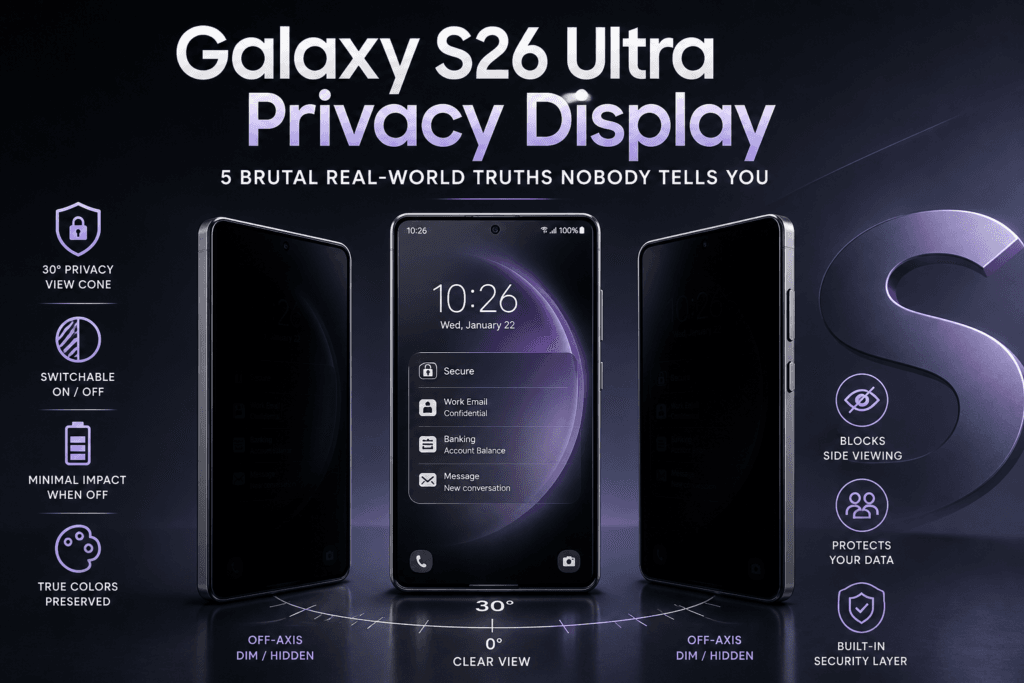
Galaxy S26 Ultra Privacy Display: 5 Brutal Real-World Truths Nobody Tells You
Galaxy S26 Ultra Privacy Display: 5 Brutal Real-World Truths Nobody Tells You There’s a specific anxiety that comes with using a phone