
AirPods Pro 3 vs Sony WF-1000XM6 — Critical Comparison
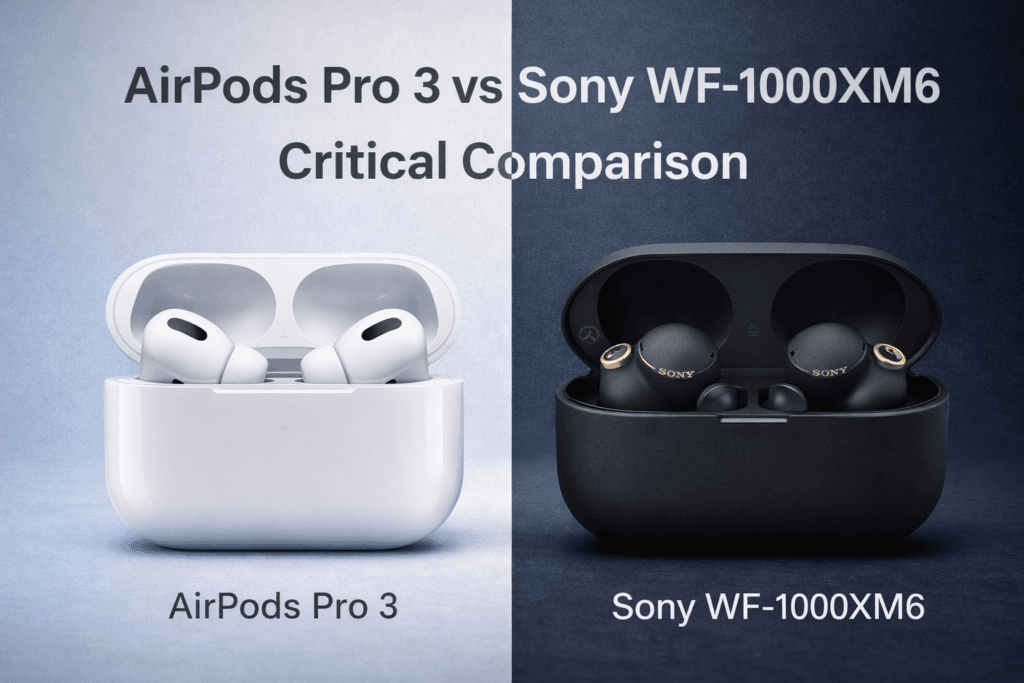
People don’t buy premium earbuds because they lack volume or bass. They buy them because something in their daily flow feels slightly off—calls that fatigue them, noise cancellation that works until it suddenly doesn’t, earbuds that sound impressive but disappear emotionally after a week. The premium tier promises resolution, control, and calm. What it actually delivers depends on the philosophy behind the product.
That’s where the AirPods Pro 3 vs Sony WF-1000XM6 conversation becomes interesting. On paper, both aim at the same user: someone who wants the best wireless audio experience money can buy. In reality, they solve very different problems—and reward very different listening behaviors.
Why these two earbuds aren’t trying to win the same listener
Apple and Sony arrive at premium audio from opposite directions.
Apple treats earbuds as an extension of the operating system. The product is not just sound—it’s spatial awareness, context switching, microphone intelligence, and seamless handoff across devices. The AirPods Pro line has never chased raw sonic fireworks. It chases effortlessness.
Sony, on the other hand, treats earbuds as miniature reference tools. The WF-1000XM series is engineered from the driver outward: acoustic chamber design, digital signal processing, codec support, and user-adjustable sound profiles. Sony assumes you want control—and will use it.
Understanding AirPods Pro 3 vs Sony WF-1000XM6 starts with that divergence.
What most comparisons miss about “better sound”
When reviewers talk about sound quality, they usually collapse it into bass, clarity, and loudness. That’s a surface-level read.
What actually separates premium earbuds is how they handle dynamic transitions:
- Quiet to loud passages
- Busy mixes vs sparse vocals
- Movement through different noise environments
- Long listening sessions without fatigue
Sony traditionally optimizes for fidelity under scrutiny. Apple optimizes for comfort under chaos. Neither approach is objectively superior—but they feel radically different in daily life.
The technical heart of the difference
Apple’s invisible engineering bet
With AirPods Pro 3, Apple’s engineering priorities continue to revolve around:
- Custom silicon for real-time audio processing
- Tight coupling between microphones, accelerometers, and OS-level awareness
- Adaptive systems that make decisions without user input
Instead of exposing EQ curves or codec switches, Apple pushes computation upstream. The goal is not “perfect sound” in isolation—it’s consistent sound across calls, music, spatial audio, and transparency modes.
This makes the AirPods Pro 3 feel less impressive in quick demos and more impressive after weeks of use.
Sony’s audible engineering muscle
Sony’s WF-1000XM6 lineage is about measurable gains:
- Larger, more rigid dynamic drivers
- High-performance DAC and amplifier stages
- Support for high-bitrate codecs like LDAC
- Aggressive but tunable noise cancellation algorithms
Sony expects the user to care. You’re invited to tweak, adjust, and experiment. When dialed in, the payoff is obvious: deeper low-end texture, more air around instruments, and greater separation in complex mixes.
This is why audiophile-leaning listeners keep gravitating toward Sony.
Side-by-side reality check
| Dimension | AirPods Pro 3 | Sony WF-1000XM6 |
|---|---|---|
| Core philosophy | System-level intelligence | Sound-first engineering |
| Default tuning | Balanced, fatigue-free | Rich, detailed, customizable |
| Noise cancellation style | Adaptive, context-aware | Maximum attenuation focus |
| Codec strategy | Apple ecosystem optimized | High-bitrate, cross-platform |
| User control | Minimal by design | Extensive via app |
| Long-session comfort | Excellent | Very good, slightly heavier |
This table captures why AirPods Pro 3 vs Sony WF-1000XM6 isn’t a simple winner-loser debate.
Where noise cancellation actually feels different
Both earbuds cancel noise extremely well—but in different ways.
AirPods Pro 3 tends to reduce the presence of noise. Conversations, traffic, and office hum fade into something psychologically ignorable. Transparency mode remains a standout, feeling less like audio passthrough and more like augmented hearing.
Sony’s WF-1000XM6 aims for silence. Low-frequency rumble and steady noise sources are aggressively suppressed. On planes or trains, Sony often feels stronger. In mixed environments, it can feel slightly more artificial.
The difference isn’t strength—it’s intent.
Real-world scenarios that reveal the gap
Commuting through a city
- AirPods Pro 3 adapt smoothly as environments change.
- Sony requires a bit more manual context switching, but delivers heavier isolation when locked in.
Long workdays with calls and music
- Apple’s microphone processing and auto-switching reduce friction.
- Sony sounds better for music breaks but feels more “device-like.”
Critical listening at home
- Sony’s tuning flexibility and resolution shine.
- AirPods Pro 3 sound clean but emotionally flatter in direct A/B sessions.
This is why many users praise both—and still pick one decisively.
The hidden cost of “control”
Sony’s strength is also its friction point. The WF-1000XM6 rewards effort, but demands attention:
- App updates
- Profile switching
- Codec considerations depending on device
- Battery trade-offs when using higher-quality modes
Apple removes those decisions entirely. The AirPods Pro 3 assume you’d rather not think about audio.
That assumption either delights you—or frustrates you.
What data trends quietly suggest
Across premium wireless audio, three trends are clear:
- Adaptive processing is replacing static tuning
- Microphone quality matters as much as drivers
- Ecosystem integration now influences perceived sound quality
Apple is betting heavily on trends one and three. Sony is doubling down on trend two and raw acoustic performance.
Neither company is behind. They’re just betting on different futures.
How this choice affects daily life
Sound isn’t just entertainment—it shapes stress, focus, and fatigue.
Users who prioritize:
- seamless device switching
- natural transparency
- zero setup friction
tend to report less cognitive load with AirPods Pro 3.
Users who prioritize:
- musical immersion
- sonic texture
- customization
often describe the WF-1000XM6 as more emotionally rewarding.
This is the human layer most spec sheets miss.
Which one fits you better?
| Listener Type | Better Match | Why |
|---|---|---|
| Everyday multitasker | AirPods Pro 3 | Effortless, adaptive |
| Apple ecosystem user | AirPods Pro 3 | Deep OS integration |
| Music-first listener | Sony WF-1000XM6 | Richer tuning |
| Android user | Sony WF-1000XM6 | Codec & app freedom |
| Frequent traveler | Sony WF-1000XM6 | Strong isolation |
| Long-call professional | AirPods Pro 3 | Mic & comfort balance |
This framing matters more than raw specs in the AirPods Pro 3 vs Sony WF-1000XM6 debate.
When the “loser” actually wins
There are scenarios where each choice flips.
If you listen mostly to podcasts and calls, Sony’s strengths barely register. If you sit down for albums and lossless files, Apple’s restraint feels limiting. The wrong pick isn’t bad—it’s just misaligned.
That’s the uncomfortable truth of premium audio.
What Reddit and long-term users tend to report
| User sentiment | AirPods Pro 3 | Sony WF-1000XM6 |
|---|---|---|
| “I forget I’m wearing them” | Very common | Less common |
| “Best sound I’ve heard wirelessly” | Occasional | Frequent |
| App frustration | Rare | Sometimes |
| Battery anxiety | Moderate | Slightly higher |
| Ecosystem lock-in concern | Noted | Minimal |
| Upgrade justification | Convenience-driven | Sound-driven |
These aren’t lab results. They’re lived patterns.
Where premium wireless sound is heading next
Expect future earbuds to blur this divide:
- Apple will continue pushing computational audio and spatial realism.
- Sony will likely automate more of its tuning intelligence.
The long-term winner won’t be the brand with better specs—but the one that reduces friction without flattening emotional engagement.
The moment that makes the decision obvious
Picture this: late evening, city noise outside, one last track before sleep.
- If you want the music to wrap around you—Sony wins.
- If you want the world to quiet down without effort—Apple wins.
That’s the core of AirPods Pro 3 vs Sony WF-1000XM6. Two different answers to the same modern problem.
Vibetric Ending
Premium audio isn’t about chasing “the best.” It’s about choosing the system that disappears in the right way.
Which One Fits Your Listening Life Better?
- Follow vibetric_official on Instagram for ongoing breakdowns of premium audio and emerging tech trends.
- Bookmark Vibetric.com we update our analysis as wireless audio evolves.
Subscribe for deeper, experience-driven comparisons that go beyond specs.
The Questions Serious Buyers Actually Ask
1. Is AirPods Pro 3 sound quality worse than Sony WF-1000XM6?
Not worse, but intentionally restrained. Apple prioritizes tonal balance and long-session comfort, while Sony leans into detail retrieval, bass texture, and spatial separation that stand out in focused listening.
2. Which earbuds deliver better noise cancellation overall?
Sony’s WF-1000XM6 typically suppresses low-frequency noise more aggressively, especially during travel. AirPods Pro 3 counter with smarter, context-aware cancellation that feels more natural as environments change.
3. Do Sony WF-1000XM6 earbuds work well with iPhones?
They work reliably for playback and calls, but you lose Apple-specific advantages like seamless device switching, spatial audio integration, and deeper system-level optimizations.
4. Are AirPods Pro 3 worth buying outside the Apple ecosystem?
Their value drops noticeably on Android or Windows, where many of Apple’s signature conveniences disappear. In those cases, Sony offers a more flexible and feature-complete experience.
5. Which is better for long listening sessions or workdays?
AirPods Pro 3 generally cause less listening fatigue thanks to lighter tuning, comfort-focused ergonomics, and excellent microphone processing during calls and meetings.
6. Does high-bitrate codec support actually matter in daily use?
It matters most for music-first listeners using high-quality sources in quiet environments. For commuting, calls, and streaming, tuning and noise control matter more than codec specs.
7. Which earbuds are more future-proof?
Apple’s strength lies in software evolution and ecosystem updates, while Sony’s future-proofing comes from strong acoustic hardware that remains competitive even as standards change.
8. Are these earbuds overkill for casual listeners?
Yes, from a purely functional standpoint—but premium earbuds are about reducing friction and improving comfort, not just hitting minimum requirements.
9. Which option is better for audiophiles or critical listeners?
Sony WF-1000XM6 aligns better with audiophile expectations due to its tuning flexibility, driver performance, and emphasis on musical detail over automation.
10. Can either fully replace wired headphones?
Not entirely. Sony comes closer in controlled environments, but both still trade some resolution and dynamics for convenience and portability.
What’s your take on this?
At Vibetric, the comments go way beyond quick reactions — they’re where creators, innovators, and curious minds spark conversations that push tech’s future forward.
Community Triage (0)