
OLED Gaming Monitor Burn-In in 2026 — Why the Risk Finally Fades
Every time a new OLED gaming monitor launches, the same thought quietly follows it home: How long before the image stays forever?
Even as refresh rates climbed past 240 Hz and response times collapsed into fractions of milliseconds, concerns around OLED gaming monitor burn-in remained the unspoken tax on visual perfection. Gamers loved OLED’s infinite contrast and motion clarity, but many still hedged, lowered brightness, hid UI elements, or stuck with LCD alternatives out of habit and fear.
The new wave of next-generation panels doesn’t just promise better specs. It challenges the one objection that mattered most. And for the first time, the answer isn’t marketing spin—it’s engineering and usage logic.
When the Display Stops Feeling Fragile
Sit in front of a modern OLED gaming monitor today and the experience feels subtly different—not just visually, but psychologically. The brightness ramps smoothly without subconscious hesitation. Static UI elements no longer trigger knee-jerk caution. You stop thinking about protecting the panel and start using it like a normal display again.
That shift matters more than any spec bump. Because burn-in was never just a technical flaw—it was a trust problem. And trust isn’t restored with numbers. It’s restored with behavior.
The Pain Point No One Wanted to Admit
For years, OLED gaming monitor burn-in was talked about in hushed terms among enthusiasts:
- “I love it, but I worry about long sessions with HUDs.”
- “It looks perfect, but I keep an LCD around.”
- “Should I really play 8 hours straight?”
These aren’t hyperbolic online quips. They reflect actual decision paralysis. Gamers learned the hard way that static elements—minimaps, health bars, scoreboards, toolbars—stress OLED pixels unevenly. The result wasn’t instantaneous failure, but a creeping sense of fragility that influenced purchasing decisions for an entire generation of display buyers.
New panels reject that mindset by redefining the risk profile.
Everyone Blamed OLED Pixels—The Real Problem Was Usage Reality
Burn-in has always been framed as an OLED weakness. That’s only partially true.
The deeper issue was a mismatch between TV-first OLED design and desktop gaming behavior.
OLED pixels age based on cumulative luminance and time. Early panels assumed:
- Dynamic, full-screen content
- Constant image variation
- Limited static UI exposure
Gaming monitors live in the opposite world:
- Persistent HUDs
- Taskbars and widgets
- Crosshairs, overlays, and static icons
So it wasn’t that OLED pixels were weak—just that the usage profile diverged dramatically from what earlier OLED ecosystems expected.
The Quiet Redesign That Actually Changed the Outcome
The current generation of OLED gaming monitor panels introduces a layered defense system rather than a single fix. No silver bullet—just smart trade-offs and predictive adaptation.
What changed under the hood:
- Refined pixel materials with slower differential aging
- Sub-pixel layout adjustments that distribute stress more evenly
- Real-time usage tracking, not static timers
- Localized compensation, instead of full-panel resets
- Algorithmic brightness modulation tied to usage patterns
These aren’t flashy features you’d see in a headline spec sheet. But together they attack burn-in at its actual cause: uneven wear, not brightness itself.
Why Burn-In Protection Is Now Predictive, Not Reactive
Earlier OLED gaming monitor burn-in prevention relied on blunt tools:
- Periodic pixel refresh cycles
- Global dimming after inactivity
- Full-screen compensation that interrupted use
Modern panels behave more like adaptive systems. They track:
- Which screen regions remain static
- How often brightness peaks occur in the same areas
- Temporal patterns across gaming, productivity, and idle time
Instead of reacting after damage accumulates, the panel subtly redistributes pixel load before degradation becomes visible.
This is the most important shift—and the least advertised one.
A Simple Model of Why Burn-In Finally Slowed Down
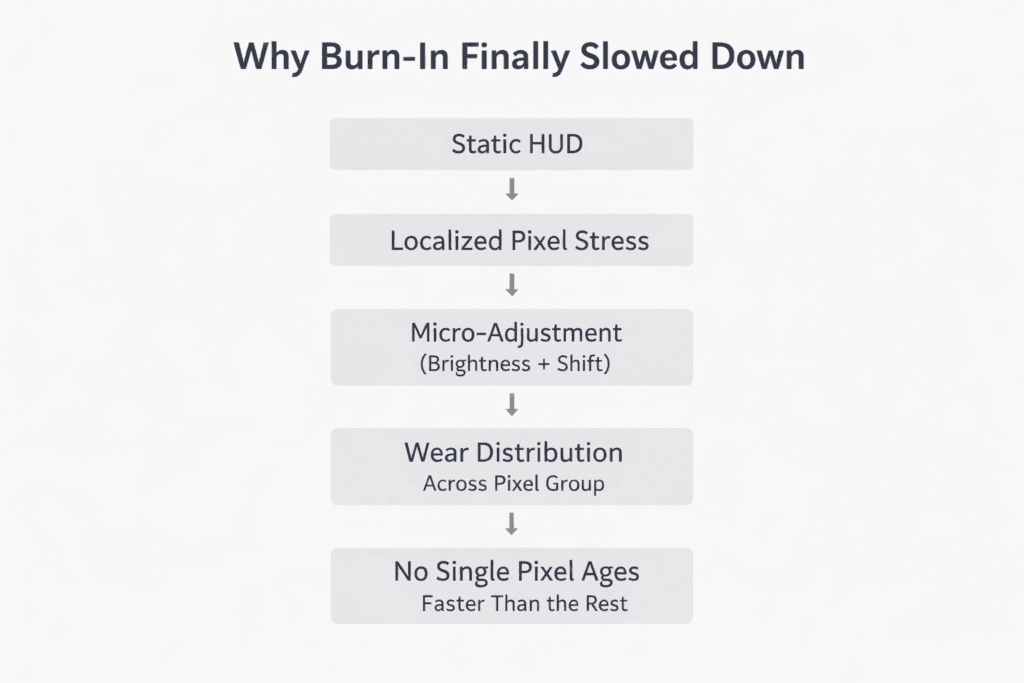
Older panels stopped at step two. New ones complete the loop.
When Brightness Isn’t the Enemy
A persistent misconception is that brightness equals burn-in risk. That’s only half the equation. The real risk emerges when brightness combines with static content.
OLED pixels handle high brightness well—if they are traversed evenly over time. The problem arises when the same pixels sit at high luminance for long durations with no variation.
Next-gen OLED monitors address this by:
- Smoothing sustained brightness peaks
- Redistributing static image load over time
- Allowing high brightness in motion-intensive scenes
The result? You get both luminosity and longevity.
Why QD-OLED and MLA-OLED Matter
Not all OLED gaming monitors approach burn-in mitigation the same way—and that diversity now benefits buyers.
QD-OLED panels:
- Minimize reliance on absorption filters
- Deliver higher brightness for the same stress
- Maintain color accuracy at HDR levels
MLA-enhanced WOLED panels:
- Use micro-lens arrays to extract more light
- Achieve required brightness with lower electrical load
- Slow organic material fatigue
Neither format eliminates burn-in completely. But both make the risk horizon longer than most upgrade cycles.
The Shift in How Manufacturers Communicate
Another quiet but impactful change is how OEMs talk about OLED gaming monitors. Instead of generic “perfect for everything” slogans, messaging now emphasizes actual use cases:
- Extended gaming sessions
- Competitive play with persistent HUDs
- Mixed workflows with productivity software
This honesty allowed engineers to optimize for real behavior instead of hypotheticals. That shift inside the industry matters just as much as the underlying technology.
What Real Users Are Noticing First
Across enthusiast forums and early owner feedback, the conversation tone is changing from caution to confidence.
| Observation | What It Signals |
|---|---|
| Fewer brightness drops during long sessions | Smarter local adaptation |
| HUDs feel “less risky” | Confidence in redistribution |
| Compensation cycles are invisible | Less intrusive protection |
| No retention after months of use | Wear leveling is effective |
| Higher sustained HDR performance | Lower per-pixel stress |
The absence of complaints is, in itself, a data point.
Burn-In Didn’t Vanish—The Risk Window Moved
This is the crucial nuance.
OLED gaming monitor burn-in is no longer a short-term fear. It’s now a long-horizon variable—measured in years of heavy use, not months of caution.
That doesn’t mean:
- Static productivity at max brightness is free
- Leaving the same UI on 24/7 is harmless
It means normal gaming behavior no longer triggers alarm bells.
Freeing Gamers From Compromise
For years, LCD held a single unassailable advantage: durability under static content. But as OLED gaming monitor burn-in mitigation improves:
- Mini-LED complexity looks less elegant
- IPS glow feels harder to ignore
- Motion clarity advantages widen further
The trade-off equation has shifted. OLED is no longer the “risky luxury” option—it’s becoming the premium default.
Who Benefits Most
Everyday Gamers
Play without fear of ghosted relics on your screen.
Competitive Players
Static overlays and training tools now coexist peacefully with OLED panels.
Creators Who Game
Mixed workflows finally make sense on one display.
Future-Proof Buyers
Panel longevity now aligns with upgrade cycles, reducing total cost of ownership.
When the Advice Still Doesn’t Apply
There are still edge cases where caution matters:
- Dashboards running 10+ hours daily
- Sticky widgets on max brightness
- Professional static UI rigs
OLED gaming monitors are resilient now—but they’re still bound by physical limits.
The Broader Impact on Display Technology
OLED gaming monitor burn-in mitigation isn’t just an isolated improvement. It signals a broader shift:
- Displays are becoming more usage-aware, not just spec-aware
- Longevity engineering now accounts for real human behavior
- Future screens will calibrate toward context, not content
This reflects a deeper maturity in the industry—from shiny specs to smart performance.
What This Means for the Next Two Years
Expect burn-in to move from headline fear to footnote:
- Warranties become more confident
- Mid-range adoption accelerates
- Mixed usage becomes standard, not niche
OLED gaming monitors aren’t perfect. They’ve just become practical.
When the Display Stops Demanding Attention
There was a time when owning an OLED gaming monitor felt like caring for a fragile object:
- Dim the taskbar
- Hide the HUD
- Run refresh cycles
- Worry quietly
That era is fading—not because burn-in disappeared, but because it stopped dictating behavior.
When a display lets you forget about itself, that’s when the technology has truly won.
Vibetric Ending
Technology matures quietly. Not when it becomes faster, brighter, or thinner—but when it stops asking for permission to be used normally.
The evolution of OLED gaming monitor burn-in didn’t arrive as a breakthrough headline. It arrived as absence: fewer warnings, fewer rituals, fewer compromises baked into everyday behavior.
What replaced fear wasn’t blind trust—it was engineered restraint, contextual intelligence, and a better understanding of how people actually use their screens. That’s the real progress.
When innovation fades into reliability, the conversation finally shifts from what could go wrong to what becomes possible next.
Ready to See How OLED Gaming Monitors Will Evolve Next?
- Follow vibetric_official on Instagram to keep up with the latest insights into display technology and gaming hardware.
- Bookmark Vibetric.com we continuously update our analysis as new OLED gaming monitor developments emerge.
Subscribe for ongoing deep dives and expert breakdowns on where gaming displays are headed next.
The Questions Burn-In Still Raises—Answered Clearly
No. Burn-in is a physical property of organic pixels, so it can’t be erased entirely. What’s changed is how long it takes to matter. With current mitigation systems, typical gaming use no longer pushes panels into visible degradation within normal ownership cycles.
For most gamers, burn-in risk now stretches into multi-year territory, assuming mixed content and sensible brightness. Heavy, static workloads at maximum luminance can shorten that window, but it’s no longer measured in months.
Yes—dramatically. Modern panels use improved materials, smarter compensation algorithms, and localized wear management. These advances directly address the uneven aging patterns that caused early OLED gaming monitor burn-in.
QD-OLED reduces certain stress factors by achieving brightness more efficiently and aging sub-pixels more uniformly. MLA-enhanced WOLED counters this with improved light extraction. In practice, both are far more resilient than older OLED designs.
For normal gaming sessions, no. Persistent UI elements are now accounted for in panel behavior. Only extreme cases—static interfaces left unchanged for many hours daily—still benefit from manual precautions.
Brightness matters, but patterned brightness matters more. Sustained high luminance in the same pixel regions accelerates wear. Modern OLED gaming monitors reduce this risk by dynamically redistributing load rather than simply dimming the screen.
Yes, but they’re more intelligent and less intrusive. Instead of frequent, full-panel routines, newer monitors rely on targeted, background processes that maintain uniformity without disrupting use.
Generally, yes. Static desktop layouts stress pixels more than dynamic gaming content. That doesn’t make OLED unsuitable for mixed use—it simply means long, unchanging workflows should be balanced with varied content.
It should be a secondary consideration, not a deal-breaker. For most buyers, panel longevity now aligns with expected upgrade timelines, making burn-in a manageable risk rather than a constant concern.
What’s your take on this?
At Vibetric, the comments go way beyond quick reactions — they’re where creators, innovators, and curious minds spark conversations that push tech’s future forward.