
Audio Gear Processing 2026 Is Smarter — Why Processing Finally Beats Drivers
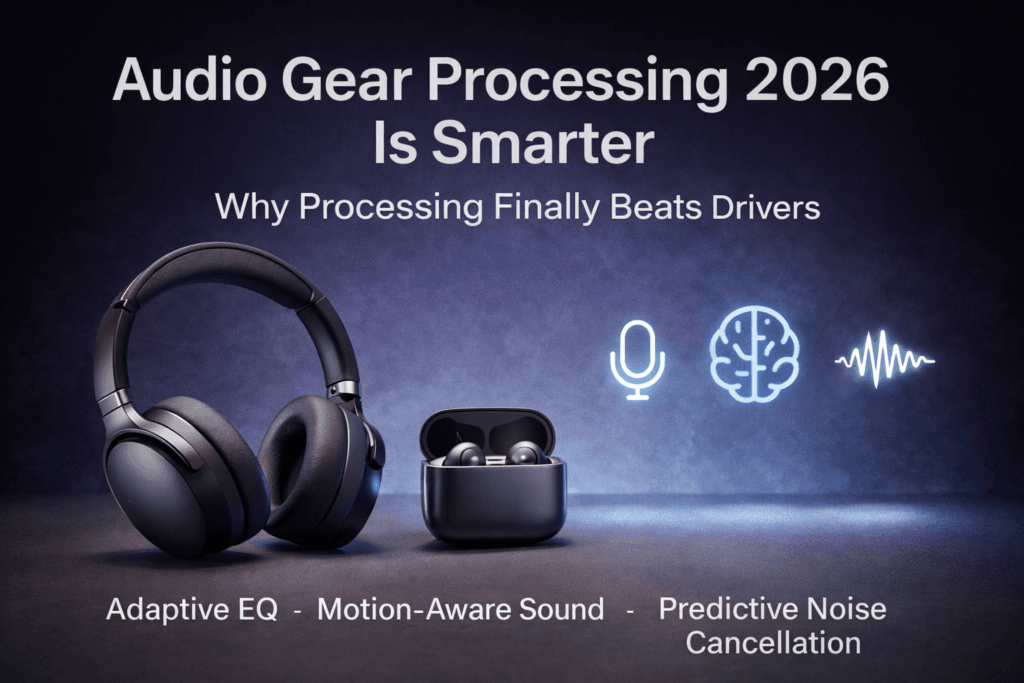
You can buy headphones today with technically excellent drivers—low distortion, wide frequency response, impressive materials—and still feel underwhelmed. The sound isn’t bad, but it doesn’t adapt. It doesn’t understand where you are, what you’re doing, or how your ears actually hear. That disconnect is the quiet reason 2026 audio gear looks different under the hood. The real competition is no longer who builds the cleanest driver—but who controls the smartest signal before it ever reaches your ears.
When a Perfect Driver Still Sounds Wrong
Stand on a noisy street with premium earbuds. Sit in a quiet room and switch them off. Use the same pair on a plane. The driver hasn’t changed, yet your experience shifts dramatically. For years, audio engineering treated that gap as a limitation of environment. In 2026, audio brands treat it as a processing problem.
This is the inflection point behind audio gear processing 2026. The industry has accepted that drivers alone can’t solve perception. Sound quality now depends on interpretation—how audio is shaped, corrected, spatialized, and adapted in real time.
The Hidden Ceiling of Driver Innovation
Driver technology hasn’t stalled—but it has plateaued in perceptual gains.
Modern dynamic, planar, and balanced armature drivers already exceed what most listeners can differentiate in blind tests once tuning is competent. Improvements now yield diminishing returns:
- Lower distortion that’s already below audibility
- Extended frequency response beyond human hearing
- Exotic materials with marginal real-world impact
Meanwhile, user complaints persist:
- “It sounds flat outside.”
- “ANC feels unnatural.”
- “Spatial audio works sometimes.”
- “Great sound… until I move my head.”
Those problems don’t originate at the driver. They originate before it.
Where the Real Sound Is Being Shaped Now
Processing is no longer a post-effect—it’s the core architecture.
In 2026 audio gear, processing pipelines typically include:
- Real-time adaptive EQ reacting to seal, fit, and environment
- Dynamic head-related transfer functions (HRTF) updated by motion data
- Predictive noise modeling instead of static cancellation curves
- Perceptual loudness normalization tuned to human hearing, not SPL meters
The driver has become the output device. The experience lives upstream.
This shift defines audio gear processing 2026 more than any single hardware breakthrough.
Why Processing Finally Caught Up
Processing has always existed—but it was constrained by latency, power draw, and compute efficiency. Those constraints have quietly collapsed.
Three forces converged:
- Dedicated low-power audio NPUs capable of real-time inference
- Sensor fusion (IMUs, mics, pressure sensors) feeding context
- Perceptual audio models trained on how humans actually hear
Instead of tuning for an anechoic chamber, systems now tune for you—moving, turning, walking, talking.
The Misconception: “DSP Ruins Purity”
Audiophile culture long treated processing as contamination. That belief came from an era where DSP was blunt and destructive.
Modern processing behaves differently:
- It operates in micro-adjustments, not global filters
- It adapts continuously instead of applying fixed curves
- It optimizes perception, not measurements
A raw signal isn’t inherently purer if it’s wrong for your ears, your head shape, or your environment. In 2026, the cleanest sound is often the most processed one.
Processing vs Drivers: Where Gains Actually Come From
| Area of Improvement | Driver-Centric Gains | Processing-Centric Gains |
|---|---|---|
| Clarity in noise | Minimal | Significant |
| Spatial realism | Limited | Major |
| Consistency across environments | None | High |
| Personalization | Impossible | Core feature |
| Long-session comfort | Indirect | Direct |
This is why audio gear processing 2026 has become the real battleground. Processing scales; drivers don’t.
Real-World Scenarios Where Processing Wins
Consider three common use cases:
Commuting
Advanced processing predicts low-frequency noise patterns and cancels them before they fully form, avoiding the “pressure” sensation older ANC created.
Gaming or XR
Head tracking feeds spatial audio engines that re-render soundfields in real time. The illusion breaks instantly without processing—even with world-class drivers.
Creative Work
Monitoring headphones now correct for ear fatigue and listening level over time, subtly reshaping response to preserve judgment accuracy.
In each case, the driver is necessary—but insufficient.
Why Personalization Is Now Non-Negotiable
Two people don’t hear the same headphone the same way. Ear canal shape, age-related hearing shifts, and even posture affect perception.
Processing finally makes personalization scalable:
- Ear-mapping during setup
- Continuous micro-corrections during use
- Profile switching for work, play, travel
This is not a gimmick layer. It’s foundational to audio gear processing 2026 as a design philosophy.
The Data That Quietly Changed Product Strategy
Manufacturers track anonymized listening adjustments:
- When users increase dialogue clarity
- When spatial effects get disabled
- When ANC intensity gets reduced
The insight is consistent: people don’t want more sound. They want more appropriate sound.
Processing enables that restraint.
How This Affects Everyday Listeners
For casual users, this shift means:
- Fewer “wow” demos in quiet rooms
- More consistency across daily life
- Less need to tweak EQ manually
The best systems fade into the background. You stop noticing the tech—and that’s intentional.
How Creators and Professionals Feel the Difference
For professionals, audio gear processing 2026 changes trust.
Monitoring tools now:
- Maintain tonal balance across volume changes
- Reduce long-term ear fatigue
- Preserve spatial cues even in imperfect rooms
The gear stops fighting physics—and starts negotiating with it.
A Quiet Industry Truth: Drivers Became a Commodity
There are still great driver engineers. But driver quality is no longer a defensible moat.
Processing stacks are:
- Proprietary
- Continuously updatable
- Differentiated by philosophy, not just parts
This mirrors what happened in smartphone cameras. Sensors plateaued; computation took over.
The language is emotional because the benefit is neurological, not visual.
When Processing Isn’t the Right Answer
There are edge cases:
- Purely analog listening chains
- Studio environments with controlled acoustics
- Listeners who value consistency over adaptation
In these scenarios, heavy processing can feel intrusive. The key distinction in 2026 is optional intelligence, not mandatory intervention.
Reddit Reality Check: What Users Actually Say
| User Observation | Pattern |
|---|---|
| “Sounds better outside than my old pair” | Adaptive EQ |
| “ANC feels lighter” | Predictive cancellation |
| “Spatial finally works” | Head-tracked processing |
| “Battery lasts longer than expected” | Efficient compute |
| “I stopped touching EQ” | Personalization |
| “Updates improved sound” | Software-defined tuning |
| “Drivers feel the same” | They often are |
| “Comfort improved over time” | Adaptive pressure models |
The enthusiasm rarely mentions drivers anymore. That silence is telling.
Where Audio Gear Goes Next
The next phase of audio gear processing 2026 is subtlety, not spectacle:
- Processing that anticipates instead of reacts
- Models that learn when not to intervene
- Cross-device coherence so sound follows you
The driver will remain critical—but increasingly invisible.
Closing the Loop Back to That First Moment
Think back to that underwhelming first listen. The issue wasn’t quality—it was context. In 2026, audio gear finally respects context as a first-class input. Processing is how sound learns to behave like it belongs where you are.
Vibetric Ending
The best audio gear no longer announces itself. It adapts, corrects, and disappears—leaving only the experience behind.
Curious About the Science Behind Audio Processing?
- Follow vibetric_official on Instagram to keep up with the latest trends and insights into audio technology.
- Bookmark Vibetric.com we continuously update our analysis as new developments emerge in audio processing.
Subscribe for updates and receive ongoing, in-depth breakdowns and expert opinions on the future of audio gear.
The Questions Readers Keep Asking About Audio Processing
It refers to the shift toward intelligent, adaptive signal processing as the primary driver of sound quality rather than raw driver improvements alone.
No—but they’re no longer the main differentiator. Processing determines how effectively a driver performs in real conditions.
Only when done well. Modern systems focus on subtle, context-aware adjustments rather than heavy-handed effects.
Not necessarily. Many systems now allow processing to be reduced or disabled for purist listening.
By predicting noise patterns and adjusting cancellation dynamically, reducing pressure and artifacts.
Yes. Processing models can be refined over time, changing tuning without hardware modification.
Efficient audio NPUs have made advanced processing possible with minimal power impact.
Over time, yes. Processing scales more easily than exotic driver materials.
Through ear-mapping, usage data, and continuous micro-adjustments during listening.
Not just driver specs—look for adaptive processing capabilities, update support, and personalization depth.
What’s your take on this?
At Vibetric, the comments go way beyond quick reactions — they’re where creators, innovators, and curious minds spark conversations that push tech’s future forward.