
Subscription Based Technology Services in 2026 — The Problem With Ownership
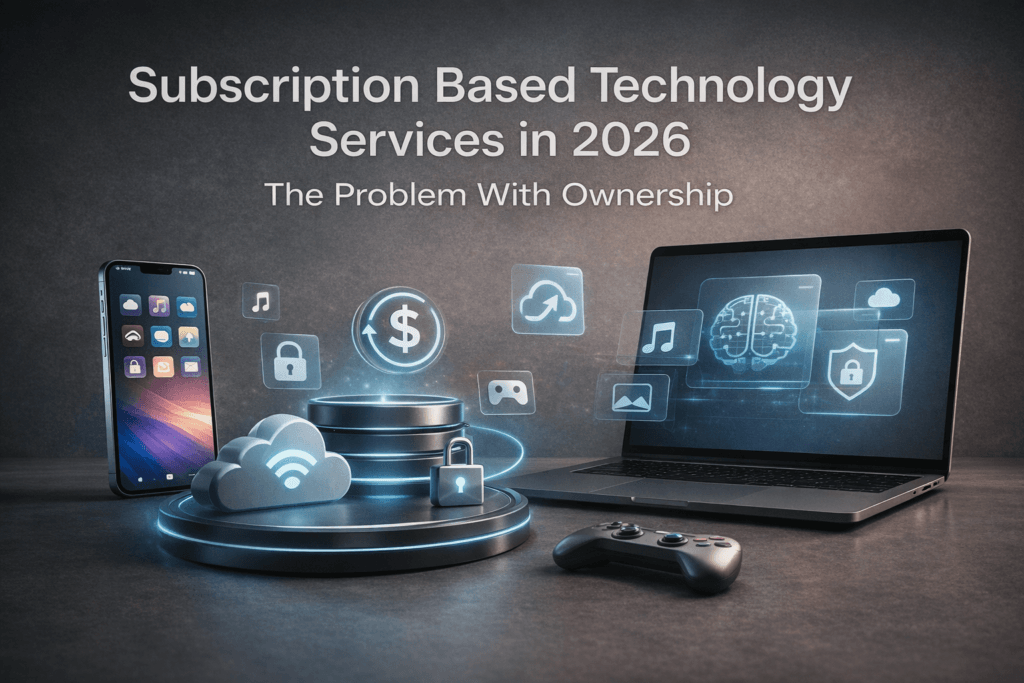
January 2026 didn’t arrive with a single announcement declaring the end of traditional tech ownership. Instead, it revealed something more telling: ownership is no longer the default assumption. Across consumer electronics, software platforms, and even hardware-adjacent services, subscription-first models are no longer experiments—they’re the baseline.
What’s driving this shift isn’t corporate greed alone, nor consumer complacency. It’s a structural realignment between how technology evolves and how value is delivered. Subscription based technology services in 2026 reflect a market that prioritizes continuity, adaptability, and ongoing relevance over one-time transactions.
The Behavioral Shift Brands Are Designing Around
Modern users don’t interact with technology as static products anymore. Devices and platforms are expected to evolve, improve, and respond long after purchase. That expectation fundamentally clashes with ownership models built around fixed capability.
Subscription-first tech resolves this tension by reframing access as a living relationship. Features unlock progressively. Performance tuning improves quietly. Services recalibrate to usage patterns without demanding upgrades. From cloud-linked productivity tools to AI-enhanced consumer devices, companies are designing for habitual engagement rather than episodic buying.
This behavioral reality explains why subscription based technology services in 2026 feel less optional than before. They align with how people already live with technology—continuously, not transactionally.
Hardware Is No Longer the Product—It’s the Gateway
One of the more subtle but profound shifts visible in early 2026 is how hardware has been repositioned. Devices increasingly act as access points to evolving service layers, rather than complete products in themselves.
Whether it’s premium features locked behind ongoing plans, adaptive AI capabilities that improve through subscription access, or ecosystem services that span multiple devices, hardware value now unfolds over time. The initial purchase grants entry; the subscription sustains relevance.
This doesn’t mean hardware quality matters less. It means its role has changed. In subscription based technology services in 2026, hardware stability enables service longevity, not feature completeness at launch.
Why the Industry Is Betting on Predictable Relationships
From an industry perspective, the appeal of subscription-first models is structural. Traditional upgrade cycles are slowing. Differentiation through specs alone has plateaued. Subscriptions introduce predictable revenue and iterative improvement loops, allowing companies to invest in long-term optimization rather than one-off launches.
More importantly, subscriptions provide continuous feedback. Usage data informs feature refinement. Service tiers evolve based on real behavior rather than market assumptions. This creates a feedback-driven innovation cycle that one-time sales simply can’t support at scale.
In this context, subscription based technology services in 2026 aren’t just monetization strategies—they’re development frameworks.
The Consumer Tension No One Fully Resolved Yet
Despite their momentum, subscription-first models introduce a clear tension: perceived value versus cumulative cost. Users increasingly scrutinize whether ongoing fees genuinely enhance experience or merely unlock features that feel artificially restricted.
The companies gaining trust are those that treat subscriptions as capability expansion, not capability withholding. Transparent roadmaps, meaningful updates, and cross-device benefits matter more than ever. Poorly executed subscriptions feel punitive. Well-designed ones feel like maintenance contracts for relevance.
This distinction will define which subscription based technology services in 2026 endure—and which provoke backlash.
A Contrarian View: Subscriptions Aren’t About Control
A common narrative frames subscription tech as a power grab by corporations. The reality is more nuanced. Subscriptions thrive where technology is inherently dynamic—AI systems, cloud-connected services, and adaptive platforms that genuinely change over time.
In these cases, static ownership is inefficient. The contrarian truth is that subscriptions work best when they reduce friction, not increase dependency. When access guarantees consistency, security, and evolution, users accept the trade-off. Resistance emerges only when subscriptions stagnate.
Early 2026 Signals Worth Paying Attention To
| Area | Ownership Model | Subscription Shift |
|---|---|---|
| Consumer software | One-time licenses | Continuous feature layers |
| Smart devices | Fixed capability | Adaptive service unlocks |
| AI platforms | Tool-based access | Ongoing intelligence upgrades |
| Ecosystems | Isolated products | Cross-device service continuity |
This snapshot highlights why the shift feels irreversible. Subscriptions map more cleanly to how modern tech actually functions.
What This Means Going Forward
January 2026 marks a point where opting out of subscription-first tech is increasingly a deliberate choice, not the default. The market is sorting itself: services that justify their presence will thrive, those that don’t will be abandoned quickly.
For users, discernment becomes the new skill—knowing which subscriptions genuinely enhance experience versus those that merely monetize access. For companies, restraint and clarity will matter more than expansion. The era of subscription for subscription’s sake is ending.
Subscription based technology services in 2026 succeed not by locking users in, but by giving them fewer reasons to leave. That’s the quiet contract forming between tech and its audience this year.
Signals to Keep an Eye On
- Follow our Instagram @vibetric_official for clear-eyed analysis of shifting tech business models.
- Bookmark vibetric.com to track which subscription-first platforms earn long-term trust.
- Stay informed as subscription based technology services in 2026 redefine how value is delivered.
What’s your take on this?
At Vibetric, the comments go way beyond quick reactions — they’re where creators, innovators, and curious minds spark conversations that push tech’s future forward.

Powerful Signals AI Scaling Is Redefining Performance in 2026
Powerful Signals AI Scaling Is Redefining Performance in 2026 The hardware race that defined consumer tech for thirty years is decelerating. A
AI Hardware Investment 2027: The Critical Shift Driving the Next Semiconductor Boom
AI Hardware Investment 2027: The Critical Shift Driving the Next Semiconductor Boom In 2023 and 2024, the AI conversation centered on models.