
Apple AirPods Pro 4 Reveal Why Consistent Listening Feels Better Than Raw Specs
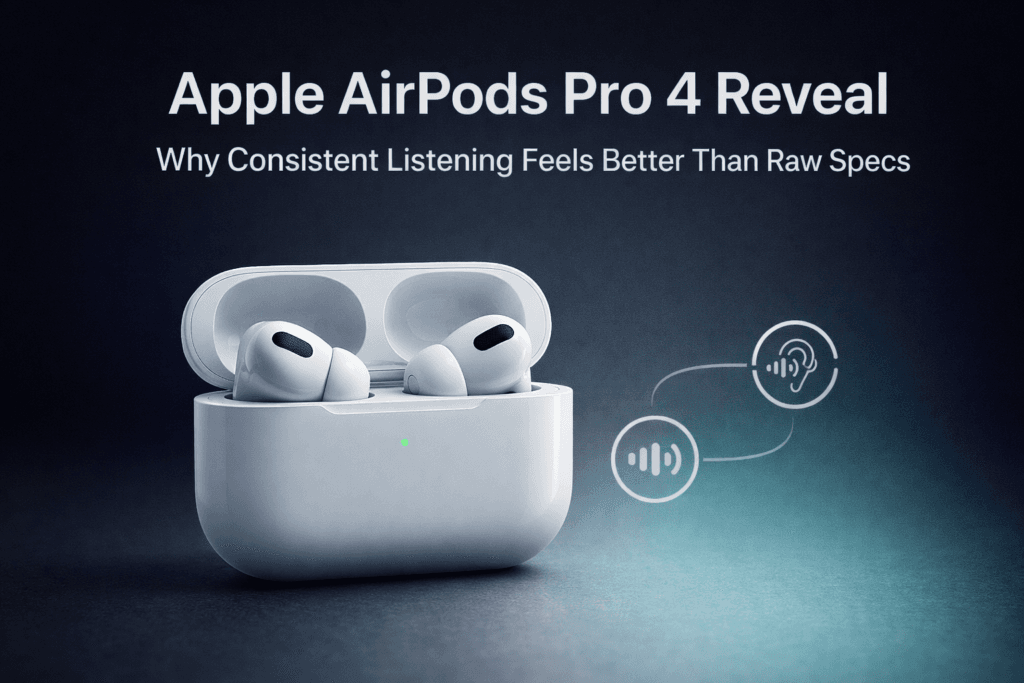
Major audio product launches are often judged within minutes—bass impact, noise cancellation strength, louder claims. But the early story around Apple AirPods Pro 4 feels different. The most meaningful improvements aren’t designed to impress during a quick demo; they reveal themselves through daily use, where consistency, comfort, and behavioral intelligence shape long-term satisfaction.
What makes the fourth-generation model notable is not a single headline feature, but a shift toward experience refinement as the primary upgrade strategy.
Listening Stability Becomes the New Audio Benchmark
A quiet but important change in Apple AirPods Pro 4 is the focus on listening stability—how consistently sound quality holds across different environments and movement patterns. Instead of tuning purely for dramatic low-frequency impact or sharper highs, the new generation emphasizes tonal balance that remains intact whether you’re walking outdoors, commuting, or sitting indoors.
Adaptive processing has matured to the point where adjustments feel less reactive and more predictive. Volume, environmental filtering, and tonal calibration respond more gradually, avoiding the abrupt shifts that earlier adaptive systems sometimes produced. Over time, this creates a listening experience that feels calmer and more natural, particularly during long sessions.
This is a subtle improvement, but it reflects a broader engineering direction: audio that adapts without reminding you it’s adapting.
Comfort Engineering Is Doing More Than the Hardware Suggests
On paper, the design of Apple AirPods Pro 4 may appear evolutionary rather than revolutionary, yet the internal ergonomic tuning tells a deeper story. Weight distribution, venting behavior, and pressure management have been refined to reduce long-session fatigue.
These adjustments don’t necessarily show up in spec comparisons, but they influence how often users actually keep earbuds in their ears throughout the day. Reduced pressure buildup and improved passive stability mean fewer readjustments and less listening interruption—small changes that significantly affect perceived quality over months of use.
In premium audio wearables, comfort has become performance. The better the fit, the more consistent the sound and noise cancellation behave.
Noise Control Evolves from Strength to Judgment
Noise cancellation technology across the industry has already reached impressive levels, making further “strength increases” less meaningful. With Apple AirPods Pro 4, the noticeable shift is toward context-sensitive noise control, where the system balances isolation and awareness more intelligently rather than simply maximizing suppression.
Transitions between full cancellation, adaptive modes, and transparency feel smoother and less intrusive. Environmental awareness sounds more natural, preserving spatial cues instead of flattening surrounding audio. This refinement makes the earbuds more usable in mixed environments—offices, city streets, and travel—without constant manual switching.
The result is noise control that behaves more like an assistant making sensible decisions than a tool requiring frequent adjustment.
The Hidden Performance Layer: Processing Efficiency
Another area where Apple AirPods Pro 4 shows meaningful progress is processing efficiency. Improvements in on-device audio computation reduce latency variability and stabilize performance across battery levels. Instead of delivering peak performance only when fully charged, the system maintains more consistent behavior throughout usage cycles.
This stability matters more than headline latency numbers because it preserves synchronization in real-world scenarios—calls, video playback, and interactive media—where unpredictability is more noticeable than small delays.
Battery efficiency also benefits indirectly. Smarter workload distribution allows features like adaptive audio and advanced noise control to operate without aggressively draining power, extending real-world usability rather than just theoretical endurance.
Use-Case Lens: Who Actually Notices the Difference
The users most likely to appreciate the changes in Apple AirPods Pro 4 are those who wear earbuds for extended daily periods: commuters, remote professionals, and frequent travelers. For them, consistency across environments matters more than peak audio intensity.
Long listening sessions feel less fatiguing. Environmental transitions require fewer manual adjustments. Call clarity remains steady even in shifting acoustic conditions. None of these improvements dominate a quick review demo, yet together they shape the ownership experience far more than incremental driver upgrades alone.
Casual listeners may hear modest improvements; daily heavy users will likely feel them.
The Contrarian Insight: Maturity Over Excitement
A common expectation with each new audio generation is dramatic sonic transformation. The more interesting reality is that premium earbuds are entering a maturity phase, where meaningful upgrades come from calibration, efficiency, and behavioral intelligence rather than dramatic hardware shifts.
Apple AirPods Pro 4 represents this stage clearly. Instead of redefining what wireless earbuds can do, they refine how reliably they do it. The excitement factor may feel quieter, but the day-to-day improvement is more tangible.
In mature categories, trust becomes the differentiator—and consistency builds trust more effectively than spectacle.
Where the Fourth Generation Fits in 2026 Audio Trends
Across the broader premium audio market, the same pattern is emerging: adaptive listening, comfort optimization, and predictive environmental response are becoming central design priorities. Apple AirPods Pro 4 fits squarely within this movement, emphasizing behavioral intelligence over dramatic redesign.
As wireless audio ecosystems continue to evolve, the competitive edge will likely come from how seamlessly devices integrate into everyday routines rather than how aggressively they chase peak performance claims.
The most valuable upgrades are increasingly the ones you notice only after weeks of use—when interruptions are fewer, adjustments are rarer, and listening simply feels easier.
Signals Worth Tracking
- Follow our Instagram @vibetric_official for real-world insights on premium audio releases.
- Bookmark vibetric.com to track long-term performance impressions beyond launch reviews.
- Stay updated as Apple AirPods Pro 4 and next-generation earbuds redefine everyday listening consistency.
What’s your take on this?
At Vibetric, the comments go way beyond quick reactions — they’re where creators, innovators, and curious minds spark conversations that push tech’s future forward.