
Gaming Monitors 2026 Reveal Why Smooth Motion Finally Feels Better Than Size
A few years ago, gaming monitor conversations were dominated by size envy—bigger panels, wider aspect ratios, more desk dominance. In 2026, that instinct feels oddly dated. Players are upgrading again, but not because screens grew. They’re upgrading because something feels different: motion looks calmer, inputs land cleaner, eyes fatigue slower. The shift is subtle enough that spec sheets barely explain it—yet once you notice it, going back feels impossible. The surprise? It has almost nothing to do with size.
When Bigger Screens Stopped Solving the Real Problem
Walk into any gaming setup today and you’ll see restraint where excess used to live. Fewer ultrawide experiments. Fewer desk-spanning panels. What replaced them isn’t minimalism—it’s intentionality.
As panel manufacturing matured, size stopped being the bottleneck. Response time, frame pacing, scanout behavior, and refresh synchronization quietly became the limiting factors. The industry realized something uncomfortable: immersion wasn’t being limited by field of view. It was being limited by instability—micro judder, uneven motion cadence, and visual noise the brain constantly corrected for.
This is the inflection point that defines gaming monitors 2026 refresh rate technology as a category rather than a spec line.
Everyone Notices Resolution—Few Notice the Motion Debt
Resolution upgrades are obvious. Smoothness upgrades are cumulative.
The real issue with earlier high-refresh displays wasn’t peak Hz; it was how inconsistently frames were delivered. Panel response curves didn’t align with GPU output. VRR windows were narrow. Overdrive tuning chased benchmarks instead of perception.
So while numbers climbed, motion coherence lagged. The eye tracked movement; the panel lagged behind it. The brain compensated—and paid the price in fatigue.
The new generation of gaming monitors 2026 refresh rate technology flips the priority stack. Instead of asking “How many pixels?” manufacturers are asking “How predictably do pixels behave over time?”
Smoothness Is a System, Not a Single Spec
Modern displays now treat motion like an ecosystem. Three layers matter, and none work alone.
Panel Behavior Is Finally Predictable
OLED dominance accelerated this shift, but not because of contrast. Self-emissive pixels removed backlight latency, making response curves more linear. Even high-end LCDs followed, tightening gray-to-gray variance instead of advertising unrealistic minimums.
Refresh Rate Is About Stability, Not Extremes
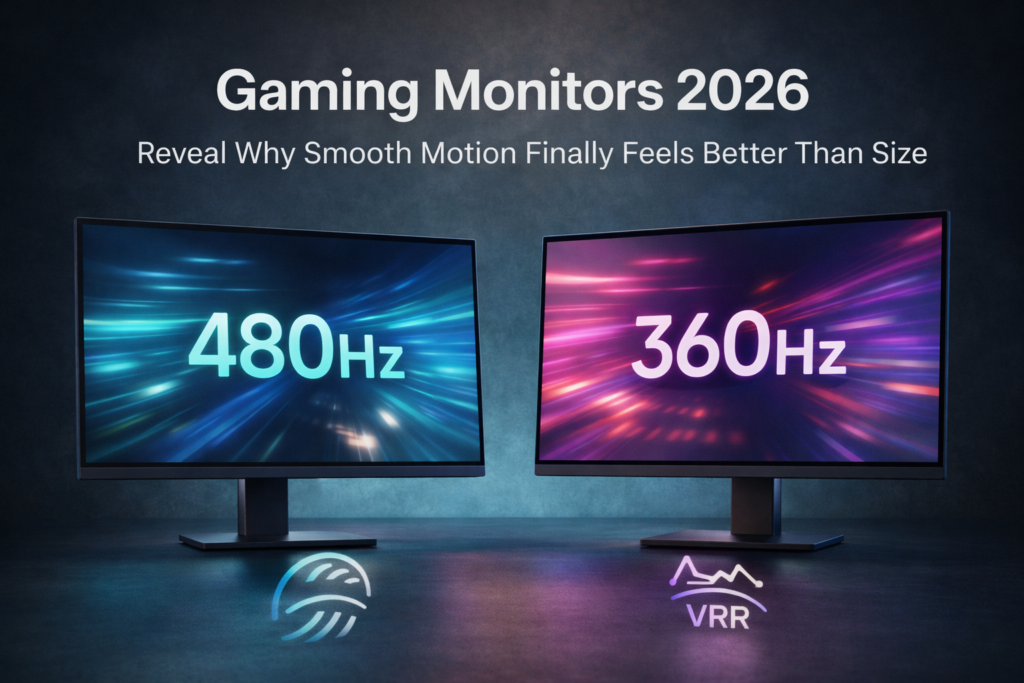
480Hz and beyond exist—but the real breakthrough is consistency across the range. Displays now hold low frame pacing stability at 120Hz just as well as 360Hz. That matters more than peak numbers.
Synchronization Became Intelligent
Modern VRR implementations adapt dynamically to frame delivery instead of rigidly following GPU output. The result is fewer micro-stutters during variable workloads—especially in open-world and simulation-heavy titles.
Together, these layers define why gaming monitors 2026 refresh rate technology feels qualitatively different, not just faster.
Why Motion Feels Calmer Even When FPS Hasn’t Changed
This is where perception diverges from benchmarks. Many players report smoother gameplay without higher average frame rates. That isn’t placebo.
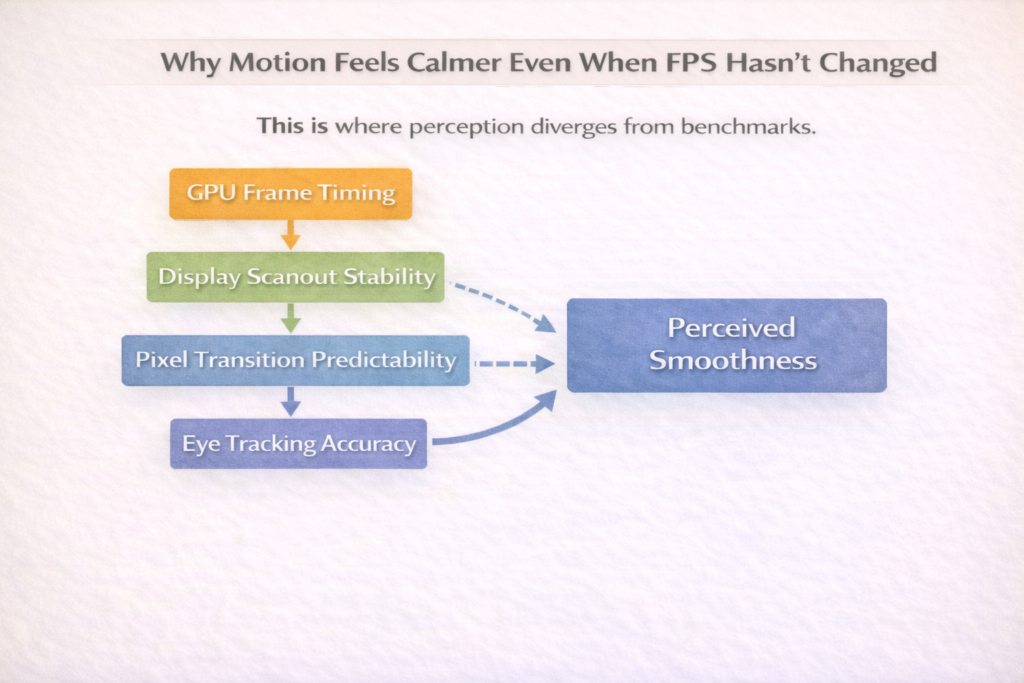
Earlier generations broke this chain in multiple places. The newest displays reinforce it end-to-end. Smoothness emerges not from speed alone, but from reliability.
The Market Quietly Abandoned the “Bigger Is Better” Era
Panel makers didn’t announce this shift loudly—but you can see it in what they stopped pushing.
- Fewer experimental aspect ratios
- Less emphasis on curved extremes
- More focus on uniformity, thermal stability, and long-session comfort
The logic is simple: competitive and hybrid gamers don’t want spectacle anymore. They want control. And control is impossible if motion fidelity collapses under load.
This reorientation is why gaming monitors 2026 refresh rate technology now dominates R&D budgets over raw size scaling.
Real-World Scenarios Where Smoothness Wins
Consider how this plays out outside marketing slides.
Competitive FPS
Players tracking fast targets benefit more from stable frame delivery than higher resolution. Reduced overshoot and cleaner scanout reduce corrective mouse movement.
Open-World RPGs
Frame rate fluctuates constantly. Displays that smooth transitions inside the VRR window feel dramatically calmer during traversal.
Creative + Gaming Hybrids
Editors who game after work notice less eye strain when motion artifacts disappear—even at moderate refresh rates.
Long Sessions
The biggest win isn’t performance—it’s endurance. Smooth displays reduce subconscious tension, letting players stay focused longer.
These scenarios explain why buyers upgrading in 2026 aren’t asking for bigger panels. They’re asking for better behavior.
What the Data Quietly Suggests (Without the Hype)
Manufacturers stopped publishing flashy response-time claims because perception metrics became harder to fake. Instead, internal tuning shifted toward:
- Tighter frame variance tolerance
- Reduced scanline inconsistency
- Smarter overdrive tied to refresh range
No fake numbers. No miracle modes. Just engineering priorities aligned with human vision.
That restraint is the strongest signal yet that gaming monitors 2026 refresh rate technology is entering a maturity phase.
How This Shift Changes the Human Experience
Smoothness alters how games feel, not just how they look.
- Cognitive Load Drops: The brain stops compensating for visual instability.
- Reaction Confidence Improves: Inputs feel more directly connected to outcomes.
- Fatigue Arrives Later: Especially during high-focus sessions.
These effects compound. Players don’t describe them as “better specs.” They describe them as “less friction.”
Choosing the Right Display in the Smoothness Era
Instead of asking what’s biggest, ask who you are.
| User Type | What Actually Matters in 2026 |
|---|---|
| Everyday gamers | Stable VRR range, balanced refresh ceilings |
| Creators / pros | Motion consistency + color stability |
| Competitive players | Low variance, predictable scanout |
| Future-proof buyers | New interface standards, firmware longevity |
Where Smoothness Pays Off—and Where It Doesn’t
| Smoothness-First Displays | Trade-Offs |
|---|---|
| Reduced eye strain | Less spec-sheet drama |
| Better real-world feel | Higher tuning cost |
| Longer session comfort | Fewer “wow” moments in stores |
The smartest gaming monitors 2026 refresh rate technology choices optimize for behavior, not spectacle.
When Smoothness Isn’t the Priority
There are exceptions.
If your setup is primarily cinematic gaming, couch distance, or productivity-first, panel size and resolution still matter more. Smoothness amplifies interaction—but if interaction isn’t central, the gains shrink.
This isn’t a universal upgrade path. It’s a targeted evolution.
What Gamers Are Actually Saying
Spend time in enthusiast communities and a pattern emerges.
| Common Sentiment | Translation |
|---|---|
| “It just feels easier on my eyes” | Motion stability improved |
| “I stopped noticing the monitor” | Reduced visual correction |
| “Specs didn’t impress me—but gameplay did” | Perception > numbers |
| “Hard to explain, harder to give up” | Smoothness lock-in |
The language is emotional because the benefit is neurological, not visual.
Where Display Tech Is Heading Next
Expect the next phase to focus on adaptive intelligence rather than raw capability.
- Refresh logic tied to content type
- Panels that self-optimize over session length
- Reduced latency variance instead of lower latency peaks
The era of brute-force specs is fading. The era of tuned experience has begun.
That trajectory cements gaming monitors 2026 refresh rate technology as a foundational shift, not a passing trend.
The Moment You Stop Thinking About the Screen
The best display technology disappears.
In 2026, the standout gaming monitors aren’t the ones you notice—they’re the ones you forget. Motion flows. Inputs land. Hours pass without fatigue. And suddenly, size feels like a solved problem from another time.
Smoothness didn’t replace immersion. It refined it.
Vibetric Ending
Progress isn’t always louder or larger. Sometimes it’s quieter, steadier, and far harder to unsee once experienced.
What’s Behind the Magic of Modern Gaming Displays?
- Follow vibetric_official on Instagram to keep up with the latest trends and insights into gaming displays and performance tech.
- Bookmark Vibetric.com we continuously update our analysis as new developments emerge in display technology.
Subscribe for ongoing, in-depth breakdowns and expert perspectives on where gaming hardware is heading next.
The Questions That Actually Matter Before You Buy
Because consistency in frame delivery, scanout behavior, and pixel transitions has improved, reducing micro-instability the eye used to correct for subconsciously.
Stability matters more. A display that maintains predictable behavior across its entire refresh range feels smoother than one that only excels at its maximum ceiling.
OLED still holds an advantage in pixel response predictability, but well-tuned LCD panels now deliver comparable motion clarity in real-world gaming scenarios.
It doesn’t lower raw input latency, but it reduces visual noise, making actions feel more immediate and increasing confidence in timing-sensitive gameplay.
These games produce fluctuating frame times, and modern VRR systems smooth transitions that previously caused subtle but constant visual disruption.
Yes. When the brain no longer compensates for inconsistent motion, cognitive and visual fatigue build up more slowly over time.
Not disadvantaged—but their benefits scale less dramatically than motion improvements, especially for competitive or interaction-heavy playstyles.
Increasingly critical. Many motion improvements now come from firmware-level tuning rather than hardware changes alone.
Players who spend long, focused sessions gaming—competitive players, hybrid creators, and enthusiasts—see the most meaningful gains.
Look for stable refresh behavior, wide and well-implemented VRR support, and proven motion tuning rather than headline specs alone.
What’s your take on this?
At Vibetric, the comments go way beyond quick reactions — they’re where creators, innovators, and curious minds spark conversations that push tech’s future forward.