
Global Smartphone Design Trends: The Uncomfortable Truth Behind Predictable Phone Designs
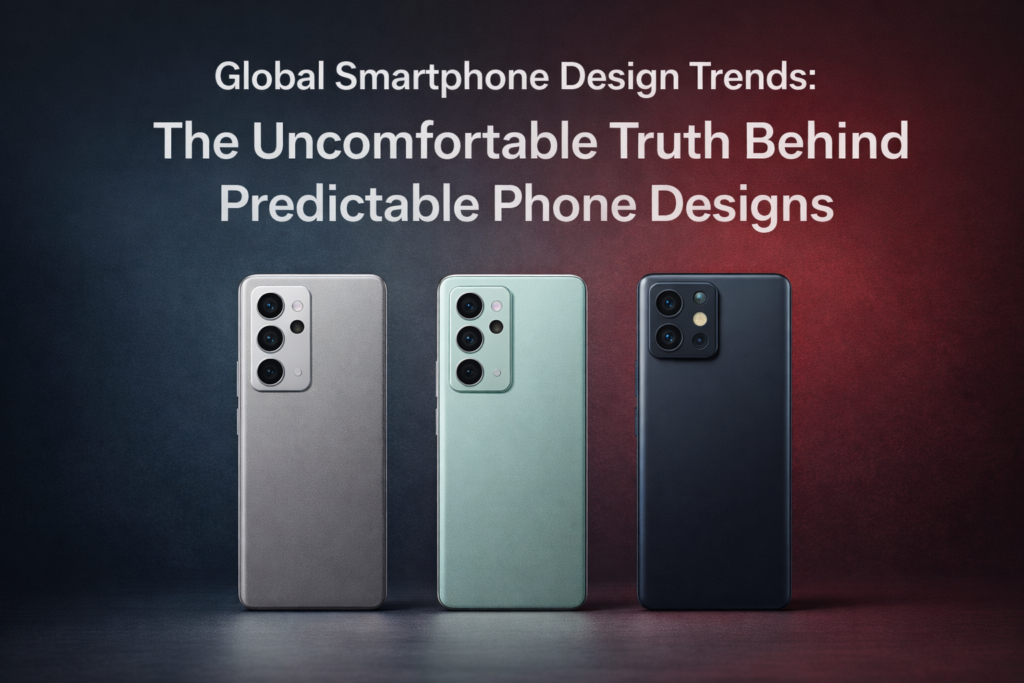
Smartphones once reflected regional taste, cultural preference, and even local priorities. Today, whether you’re browsing devices in Mumbai, Berlin, Seoul, or São Paulo, the similarities are striking. Flat glass slabs, centered camera islands, muted colors, minimal branding. The question isn’t whether global smartphone design trends are converging—it’s why predictability has become the default.
This shift didn’t happen by accident. It’s the result of market pressure, manufacturing reality, and a maturing industry that has quietly standardized what a “modern phone” should look like.
The Era of Regional Identity Is Fading
In the past, design language varied widely. Asian markets embraced bold finishes and experimental form factors. Western markets leaned toward restrained aesthetics and premium materials. Even camera placement and button layouts differed meaningfully.
Now, regional distinction has largely collapsed. A phone designed for one market can be sold almost unchanged worldwide. This isn’t laziness—it’s efficiency. Global smartphone design trends now favor universal acceptability over local character.
When everyone sells everywhere, standing out becomes risky.
Manufacturing Economics Dictate Form
Design freedom shrinks when production scales explode. Global supply chains reward predictability: flat panels are cheaper to source, standardized camera modules reduce costs, and uniform chassis simplify logistics.
Custom shapes, experimental materials, or region-specific models increase complexity without guaranteeing sales. As margins tighten, manufacturers default to what’s proven.
In that environment, design becomes optimized for repeatability, not expression.
Consumer Expectations Have Converged Too
Users around the world now expect the same things from a smartphone: large displays, thin bodies, strong cameras, long battery life. Once those expectations solidified, design variation stopped being a selling point.
Deviation feels risky. A different camera layout or unconventional finish may be noticed—but not always welcomed. Familiarity sells better than novelty.
Global smartphone design trends mirror consumer comfort zones as much as corporate caution.
The Illusion of Choice
Brands still launch dozens of models each year, but many differ only superficially. Colors change. Camera counts shift. Edges become slightly flatter or rounder.
Underneath, the structure remains identical.
This creates the illusion of variety while reinforcing predictability. Design innovation is happening—but it’s incremental, subtle, and carefully controlled.
A Snapshot of Convergence
| Design Element | Global Standard Outcome |
|---|---|
| Display shape | Flat or gently curved slabs |
| Camera layout | Centered or corner modules |
| Materials | Glass + aluminum |
| Colors | Muted neutrals, soft pastels |
this table shows how global smartphone design trends have narrowed visual diversity without reducing technical capability.
Software and Accessories Reinforce Uniformity
Hardware design no longer stands alone. Cases, screen protectors, mounts, and accessories all assume standardized dimensions. Software UI guidelines encourage symmetrical layouts and predictable ergonomics.
Breaking the mold means fighting the entire ecosystem—not just consumer perception. Most brands choose compatibility over experimentation.
Predictability isn’t just safer. It’s easier.
Flagship Influence Trickles Down Everywhere
High-end flagships set the visual tone. Mid-range and budget devices mimic them to appear premium, even when internal components differ drastically.
This top-down effect accelerates convergence. Once a flagship design is validated globally, it becomes the blueprint for everything below it.
Global smartphone design trends aren’t shaped by mass-market users—they’re shaped by flagship validation.
Is Predictability a Problem?
Not necessarily. Predictable design often means refined ergonomics, fewer usability surprises, and broader accessory support. Phones are more comfortable and familiar than ever.
The downside is emotional flatness. Devices feel interchangeable. Brand identity blurs. Design becomes invisible.
Smartphones have become tools first, objects second.
Where Gaming Equipment Is Actually Heading
The future of gaming gear won’t look radically different at a glance. That’s the point. Innovation is moving inward—into tolerances, materials, ergonomics, and long-term usability.
Products will feel better before they look different. And for a market that’s grown up, that’s the right order.
Beyond RGB, industrial design isn’t silent because it’s weak. It’s silent because it doesn’t need to shout anymore.
Where Real Differentiation Is Moving
As external design stabilizes, differentiation shifts inward. Camera processing, battery optimization, AI features, and ecosystem integration matter more than silhouette.
Ironically, this makes design convergence logical. When function defines value, form becomes conservative.
The global smartphone design trends we see today are symptoms of a mature product category—not a lack of creativity.
The Predictable Future
Unless a disruptive form factor gains mass adoption, smartphones will continue to look similar across borders. Radical designs will exist—but as experiments, not defaults.
The slab isn’t exciting anymore, but it works. And in a global market that values reliability over risk, “good enough everywhere” beats “unique somewhere.”
See the Patterns Before They’re Obvious
- Follow our Instagram @vibetric_official for deeper design and tech analysis.
- Bookmark vibetric.com to track how global tech trends quietly standardize.
- Stay ahead of where smartphone design is heading—before it looks inevitable.
What’s your take on this?
At Vibetric, the comments go way beyond quick reactions — they’re where creators, innovators, and curious minds spark conversations that push tech’s future forward.
Community Triage (0)