
Ergonomics in Competitive Gaming: Why Consistency Matters More Than Raw Skill
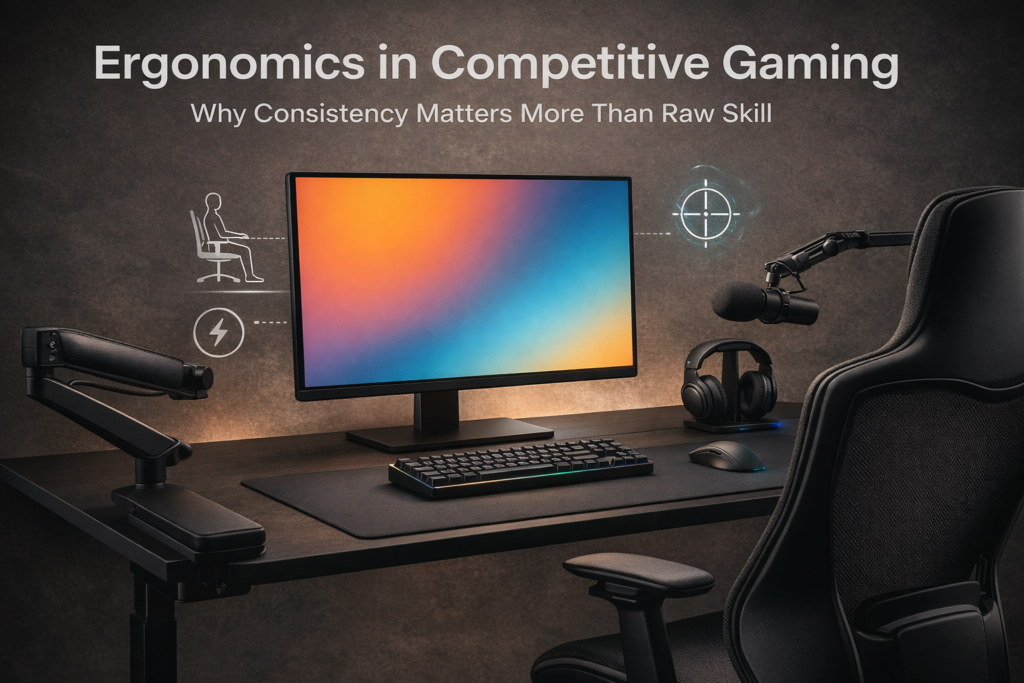
Competitive gaming culture obsesses over improvement loops: aim trainers, VOD reviews, sensitivity tuning, reaction drills. Yet many players plateau despite doing everything “right.” The reason often isn’t mechanical ceiling—it’s systemic leakage. Performance drains through posture, fatigue, and cognitive friction long before skill runs out. Ergonomics in competitive gaming operates in this invisible layer, quietly influencing consistency rather than peak moments. Matches aren’t lost because players can’t perform once. They’re lost because they can’t perform again.
That’s the part nobody scrims for.
What you notice first isn’t the problem — what you ignore is
Most players only think about ergonomics when pain appears. Wrist soreness. Tight shoulders. Lower-back discomfort. But pain is a late signal. The real degradation starts earlier, presenting as subtle inconsistency: missed micro-adjustments, slower corrections, delayed decisions under pressure. By the time pain shows up, performance has already been taxed for hours or weeks.
Ergonomics doesn’t fail loudly. It fails quietly, then compounds.
The hidden cost players describe — without realizing what they’re describing
Spend time in competitive communities and you’ll see the same complaints surface repeatedly:
| Player Language | What’s Actually Happening |
|---|---|
| “My aim feels off after long sessions” | Progressive muscle tension reducing fine motor control |
| “I’m sharp early, sloppy late” | Cognitive fatigue driven by postural compensation |
| “My hands feel heavy” | Poor joint alignment increasing neuromuscular load |
| “I know the play, but I’m slow” | Split attention between discomfort and decision-making |
| “New setup feels worse” | Temporary disruption of motor adaptation |
None of these are framed as ergonomic issues. But every one of them is.
This is why ergonomics in competitive gaming is often misunderstood—it shows up as mental or skill-based failure, even when the root cause is physical alignment.
Why ergonomics is really about cognitive bandwidth, not comfort
The common myth is that ergonomics exists to make gaming more comfortable. Comfort is incidental. The actual goal is cognitive bandwidth preservation.
The human nervous system has finite processing capacity. When posture forces muscles to stabilize inefficiently, the brain allocates resources to maintaining position. That allocation competes directly with the same resources used for situational awareness, prediction, and rapid decision-making.
In high-pressure matches, this tradeoff becomes visible:
- Slower threat recognition
- Increased hesitation
- Reduced confidence in execution
Ergonomics in competitive gaming works by lowering the background “cost” of existing in the setup, freeing attention for the game itself.
The biomechanics that quietly decide input quality
From an engineering standpoint, competitive gaming is a high-frequency, low-margin task. Inputs are small, rapid, and repetitive. That makes joint angles and muscle load disproportionately important.
Key biomechanical truths:
- Extended wrists reduce finger independence and increase error rate
- Elevated shoulders introduce tremor and fatigue into mouse control
- Forward head posture strains visual tracking and reaction loops
- Unsupported forearms force micro-stabilization on every movement
None of these prevent gameplay. They degrade repeatability. And repeatability is the foundation of competitive reliability.
Why short tests lie and long sessions tell the truth
A setup that feels “fine” for twenty minutes proves almost nothing. Ergonomic failure is an endurance phenomenon.
In controlled environments, posture degradation typically follows a pattern:
- Initial neutrality
- Gradual compensation
- Increased muscle activation
- Cognitive fatigue
- Performance inconsistency
By the time players notice step four, step five is already happening.
This is why professional environments optimize for three-to-six-hour stability, not initial comfort. Ergonomics in competitive gaming is validated over time, not first impressions.
The data gap — and why engineering logic fills it
There’s limited public quantitative data tying ergonomic adjustments directly to win rates. That doesn’t weaken the case—it clarifies how to evaluate it.
We already know:
- Increased muscular tension reduces fine motor precision
- Fatigue degrades working memory and attention switching
- Visual strain slows target acquisition
Competitive gaming relies on all three simultaneously. Ergonomic optimization reduces variance in each variable. Less variance equals more consistent outcomes.
This is systems engineering applied to human performance.
A technical snapshot of variables that matter most
| Variable | Performance Effect |
|---|---|
| Seat-to-desk height ratio | Shoulder load, mouse stability |
| Monitor vertical alignment | Neck strain, eye tracking speed |
| Viewing distance | Focus endurance, reaction accuracy |
| Arm support surface | Tremor reduction, micro-correction |
| Foot grounding | Core stability, posture drift |
Optimizing one variable in isolation rarely works. Ergonomics in competitive gaming is an interaction problem, not a checklist.
How genre amplifies ergonomic weaknesses differently
Not all games stress the body the same way.
- Tactical FPS titles magnify wrist angle errors and shoulder tension due to precision flicking.
- MOBAs and RTS expose finger strain and forearm fatigue through sustained APM.
- Fighting games punish asymmetrical posture and grip inconsistency.
- Sim-based esports introduce spinal alignment and pedal geometry as performance factors.
The more specialized the input pattern, the smaller the ergonomic margin for error.
Where most “ergonomic advice” goes wrong
Generic advice—“sit up straight,” “get a better chair,” “use a wrist rest”—fails because it ignores context.
Effective ergonomics is:
- Functional, not aesthetic
- Adaptive, not fixed
- Task-specific, not universal
Some elite players succeed with unconventional setups. But those setups are highly personalized, often refined over years, and paired with deep body awareness. Copying them without that adaptation curve usually backfires.
A performance-first ergonomic framework
Instead of chasing ideal posture, competitive players should aim for stable alignment under load.
Everyday competitive players
Start with monitor height at eye level, elbows near 90 degrees, feet grounded. These changes alone reduce unnecessary tension.
Creators and semi-pros
Optimize for endurance. Adjustable seating, consistent desk geometry, and arm support matter more than premium materials.
High-APM specialists
Minimize wrist extension and maximize forearm contact. Small angle changes here have outsized effects.
Long-term optimizers
Choose systems that adjust as your habits evolve. Static setups age poorly.
When ergonomics isn’t the limiting factor
There are scenarios where ergonomics won’t unlock performance:
- Extremely short sessions
- Low-intensity casual play
- Players still building baseline mechanical skill
Ergonomics doesn’t replace practice. It preserves the returns from it.
Where competitive ergonomics is heading
As esports infrastructure matures, ergonomics is shifting from wellness accessory to performance discipline. Training facilities increasingly treat posture, visual geometry, and session load as tunable variables. Expect more individualized setups, not universal recommendations.
The future of ergonomics in competitive gaming isn’t about chairs—it’s about reducing human-system friction.
The advantage that compounds instead of spikes
Competitive success isn’t decided by your best moments. It’s decided by how rarely you dip below baseline. Ergonomics doesn’t make highlight plays. It prevents quiet mistakes.
And in games where margins are microscopic, preventing loss is often more valuable than chasing gain.
Vibetric Ending
Skill creates potential. Systems determine whether that potential survives contact with reality. Ergonomics in competitive gaming sits at that intersection—rarely visible, constantly influential. The players who understand it aren’t just improving mechanics. They’re protecting consistency.
Curious About the Science Behind Ergonomics in Competitive Gaming?
- Follow vibetric_official on Instagram for ongoing insights into performance optimization, competitive setups, and human-centered technology.
- Bookmark Vibetric.com we continuously refine our analysis as esports environments and training methods evolve.
Subscribe for in-depth breakdowns and expert perspectives on competitive performance systems.
The Questions Competitive Players Actually Ask
They address different layers. Poor ergonomics can undermine the benefits of aim training over time.
Cognitive and fatigue benefits often appear within days; motor adaptation may take one to two weeks.
Yes. Performance degradation often precedes discomfort.
Not inherently. Stability and repeatability matter more than posture style.
No. Good ergonomics removes the need to think about the body at all.
Ideally no. Consistency between environments improves transfer.
Sustained slouching increases fatigue and reduces fine control, even if temporarily comfortable.
Yes. Recovery time shortens and fatigue accumulates faster.
Only partially. They can’t fix joint alignment or posture drift.
Optimizing for comfort instead of long-session stability and repeatability.
What’s your take on this?
At Vibetric, the comments go way beyond quick reactions — they’re where creators, innovators, and curious minds spark conversations that push tech’s future forward.