
MacBook M4 vs Snapdragon X Elite: An ARM Laptop Processor Comparison That Actually Matters
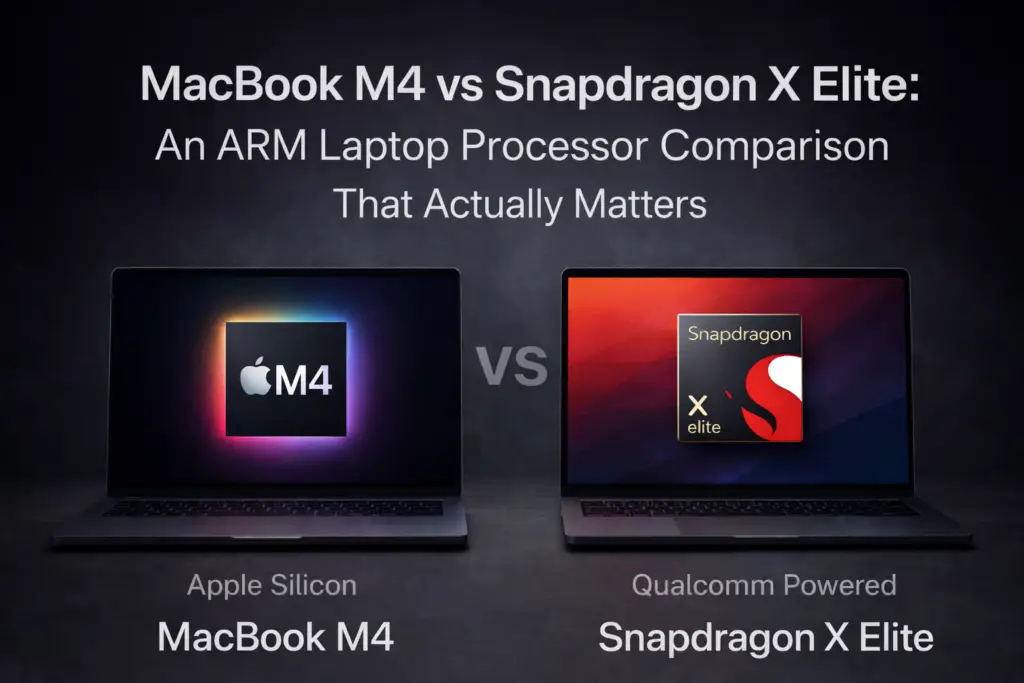
ARM laptops finally crossed the line from curiosity to credibility. Battery life no longer demands compromise. Performance doesn’t collapse when unplugged. Silence is the default. On paper, Apple’s MacBook M4 and Qualcomm-powered Snapdragon X Elite machines seem to promise the same future. Live with both, though, and something subtle shifts. One system earns your trust quickly. The other asks for patience. That emotional delta—not raw speed—is where this ARM laptop processor comparison actually begins.
The day ARM laptops stopped apologizing
There was a time when choosing ARM meant explaining yourself. Explaining compatibility gaps. Explaining missing apps. Explaining why you still carried a charger “just in case.” That era is over.
Apple’s M4 represents a platform that has already survived its growing pains. Snapdragon X Elite represents a platform that just proved it belongs in the conversation. Both mark a turning point—but from opposite ends of maturity.
One arrives calm. The other arrives hungry.
Why people notice your laptop before you do
Watch how laptops behave in shared spaces and you’ll learn more than benchmarks ever reveal.
MacBook M4 users rarely comment on performance. They comment on not thinking about it. Snapdragon X Elite users talk more—sometimes with excitement, sometimes with caveats. That difference isn’t vanity. It’s friction awareness.
This is where ARM laptop processor comparison stops being technical and becomes psychological.
Two ARM philosophies hiding inside similar efficiency numbers
Apple’s M4 strategy: compressing uncertainty
Apple isn’t chasing dramatic gains with M4. It’s narrowing variance.
- macOS schedules workloads knowing exactly how the silicon behaves
- Unified memory removes data-copy penalties before they appear
- Thermal scaling avoids sudden performance cliffs
- Most major applications now assume Apple silicon as baseline
The outcome isn’t peak numbers. It’s predictability.
Snapdragon X Elite’s strategy: forcing expansion
Qualcomm is doing something riskier:
- High-performance Oryon cores finally push Windows ARM into x86 territory
- Multi-core scaling holds under sustained workloads
- OEMs are free to experiment with form factors, thermals, and pricing
That freedom is powerful—but it multiplies outcomes. Two X Elite laptops can feel like entirely different machines.
Comparison table — where divergence shows up over weeks, not minutes
| Dimension | MacBook M4 | Snapdragon X Elite |
|---|---|---|
| Performance feel | Low-latency, fluid | Strong sustained throughput |
| Software confidence | Extremely high | Improving, inconsistent |
| Thermal personality | Controlled, gradual | OEM-dependent |
| Battery behavior | Linear, predictable | Excellent, variable |
| Hardware diversity | Minimal | Broad |
| Risk tolerance required | Low | Moderate |
| Ecosystem control | Vertical | Distributed |
This table doesn’t crown a winner—it reveals trade-offs.
Compatibility isn’t broken—it’s uneven
Most mainstream apps now work on both platforms. That’s not the controversy anymore.
The real issue is what happens when something doesn’t.
On M4, incompatibilities are rare and usually short-lived because Apple silicon is the default target. On Snapdragon X Elite, Windows’ translation layers have improved dramatically—but edge cases remain: older plugins, niche drivers, proprietary enterprise tools.
In a serious ARM laptop processor comparison, compatibility isn’t a checkbox. It’s a probability curve.
What real users keep repeating when hype fades
| Repeated observation | Platform lean |
|---|---|
| “Feels faster than benchmarks imply” | M4 |
| “Battery life surprised me” | Both |
| “One app still won’t run” | X Elite |
| “No fan noise at all” | M4 |
| “Windows ARM finally feels usable” | X Elite |
| “Driver updates matter constantly” | X Elite |
| “I stopped packing the charger” | Both |
Notice the pattern: delight appears on both sides, but reassurance clusters around M4.
Where daily workflows expose the truth
Creative mobility
Photo editing, light video exports, constant previews. M4 fades into the background. Snapdragon X Elite keeps pace—until a non-native plugin interrupts flow.
Corporate multitasking
Multiple displays, video calls, spreadsheets, background sync. X Elite finally handles this class of load convincingly, but enterprise software compatibility still determines success.
Students and travelers
Battery anxiety disappears on both. Predictability favors M4. Flexibility favors X Elite.
The data point that matters most: variance
Peak performance is easy to market. Consistency is harder.
Apple reduces variance through control. Qualcomm accepts variance to scale faster across manufacturers. Neither approach is wrong—but they feel very different under deadline pressure.
This invisible axis anchors every honest ARM laptop processor comparison in 2026.
Choosing without pretending one size fits all
Everyday users
- MacBook M4 if you value reliability and zero configuration
- Snapdragon X Elite if Windows is mandatory and your apps are mainstream
Creators and professionals
- M4 for predictable pipelines
- X Elite only after verifying every tool you rely on
Gamers and enthusiasts
- X Elite offers broader compatibility, but expectations must be realistic
Future-proof buyers
- M4 benefits from Apple’s locked silicon roadmap
- X Elite offers upside if Windows ARM accelerates rapidly
Pros & Cons Snapshot
| Platform | Strengths | Limitations |
|---|---|---|
| MacBook M4 | Stability, efficiency, polish | Limited customization |
| Snapdragon X Elite | Flexibility, scalability | Compatibility risk |
Where the ARM laptop race actually goes next
Apple will continue tightening latency and efficiency. Qualcomm will continue pressuring developers through volume and OEM diversity. The performance gap narrows yearly, but their philosophies won’t converge.
Expect stronger Windows ARM app coverage, better OEM tuning, and Apple doubling down on vertical advantages.
The Long View: Design as Maintenance, Not Monument
The next evolution isn’t AI-designed products—it’s AI-maintained design quality. Products will adapt to aging components, shifting environments, and evolving user behavior. Launch becomes a checkpoint, not a conclusion.
Expect fewer dramatic redesigns and more continuous refinement. Designers move from authorship to stewardship—curating systems that improve quietly over time.
Vibetric Ending
ARM laptops didn’t just improve performance—they changed expectations. Choosing between M4 and Snapdragon X Elite is choosing between certainty and momentum. Both matter. Only one aligns with your tolerance for friction.
Which One Is Right for You: MacBook M4 or Snapdragon X Elite?
- Follow vibetric_official on Instagram for insights into ARM laptops and mobile computing.
- Bookmark Vibetric.com we update as Windows ARM and Apple silicon evolve.
- Subscribe for experience-driven breakdowns of next-generation processors.
The Questions Buyers Ask After the Reviews Stop Helping
1. Is Snapdragon X Elite actually faster than Apple’s M4?
In sustained multi-core workloads, Snapdragon X Elite can match or exceed M4 in well-cooled designs. In everyday use, M4 often feels quicker due to lower latency and tighter OS scheduling.
2. Is Windows on ARM finally safe to buy?
For mainstream productivity, yes. Risk remains for niche software, legacy plugins, and specialized drivers, which still favor macOS reliability.
3. Which platform has more dependable battery life?
Both last all day, but M4 drains more predictably. Snapdragon X Elite results vary more depending on OEM tuning and workload mix.
4. Can either replace an x86 gaming laptop?
No. Casual and cloud gaming work, but driver support and GPU optimization limit serious gaming on both platforms.
5. Which is better for creative professionals?
M4 is safer for consistent exports and plugin stability. Snapdragon X Elite works well only when every tool in the pipeline is ARM-native.
6. Does laptop brand matter more with Snapdragon X Elite?
Yes. Cooling design, firmware, and driver support significantly affect real-world performance, unlike Apple’s tightly controlled M4 ecosystem.
7. Is ARM now the default future for laptops?
ARM has reset expectations for efficiency and battery life. x86 will remain relevant for gaming, legacy, and specialized workloads.
8. Which is the lower-risk long-term buy today?
MacBook M4, due to ecosystem maturity. Snapdragon X Elite offers upside but with more variability.
9. How important is software optimization versus raw hardware?
On ARM laptops, optimization often matters more than peak specs. Well-tuned software can make a slightly slower chip feel faster and more reliable day to day.
10. Will today’s ARM laptops age well over the next few years?
M4 systems are likely to age predictably within Apple’s roadmap. Snapdragon X Elite machines depend more on how quickly Windows ARM software support matures.a
What’s your take on this?
At Vibetric, the comments go way beyond quick reactions — they’re where creators, innovators, and curious minds spark conversations that push tech’s future forward.
Community Triage (0)