
The Quiet, Hidden AI Influence on Product Design Across Industries
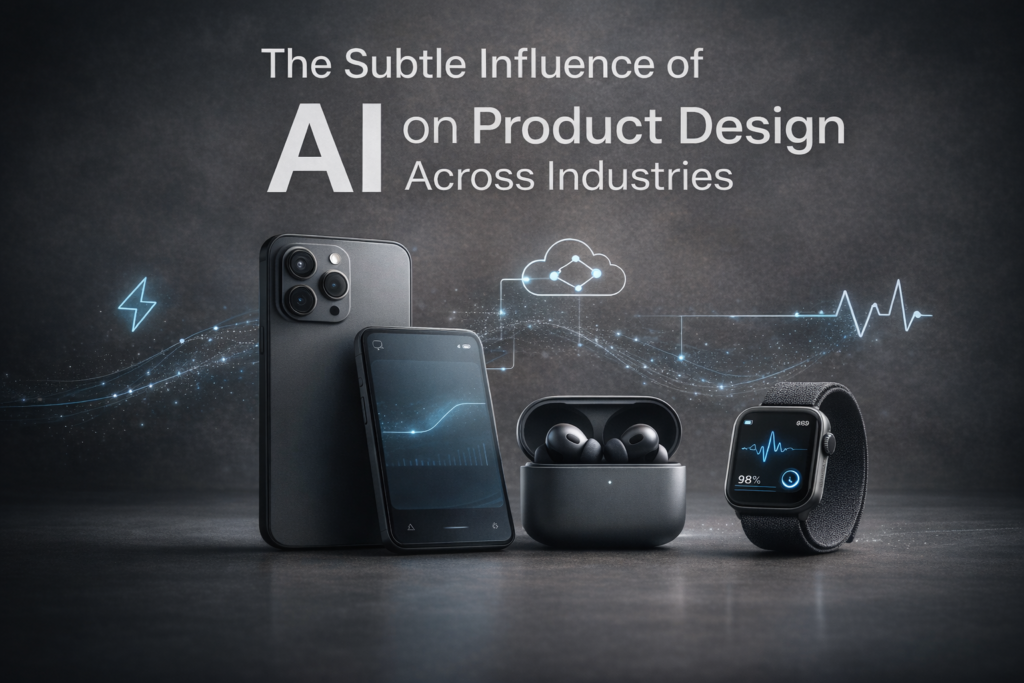
Most people think product design changes when something looks radically different. A folding screen. A new material. A dramatic interface overhaul. But the more consequential shifts rarely announce themselves. They settle in quietly—through smoother curves, fewer buttons, adaptive interfaces, and decisions made before a human designer ever sketches a line. The AI influence on product design isn’t loud or theatrical. It’s subtle, systemic, and already embedded in how products are conceived, optimized, and shipped. The surprise isn’t that AI is involved—it’s how little evidence it leaves behind.
Design Is Already Listening Before You Touch Anything
There was a time when product design began with a blank page and a strong opinion. Today, in many industries, it begins with aggregated behavior. Before form, color, or interaction logic is debated, AI systems analyze usage data, failure reports, environmental stress, and long-term behavioral signals.
This changes the starting point of design entirely. Instead of asking “What should this be?”, teams increasingly ask “What conditions does this need to survive?” The answers shape everything that follows.
The AI influence on product design is not about replacing human judgment. It’s about narrowing uncertainty. Designers still make choices—but those choices are informed by probabilities, not assumptions.
Why Products Feel Calmer Even as They Get Smarter
Many users struggle to articulate why modern products feel easier to live with. They don’t necessarily feel more powerful or more exciting. They feel calmer.
That calmness is engineered. AI-driven analysis identifies friction points that humans normalize or tolerate without questioning—extra taps, ambiguous controls, awkward grip angles, or unnecessary alerts. Once surfaced, these irritations are quietly removed.
The result is not minimalism as an aesthetic trend, but restraint as a design outcome. The AI influence on product design manifests as reduced cognitive load, fewer interruptions, and interfaces that respond instead of instruct.
The Persistent Myth: AI as a Visual Generator
Public discussion often frames AI in design as a visual shortcut—tools that generate mockups, layouts, or concept art. While useful, this is the shallow end of the impact.
The deeper shift is structural:
Design is no longer frozen at launch.
AI enables products to be evaluated continuously after they reach users. Patterns emerge from real-world use—how people actually behave, not how designers predicted they would. Updates, refinements, and adjustments become part of the design itself.
In this model, design maturity replaces design finality.
Where the AI Influence on Product Design Actually Lives
Constraint Discovery Happens First
AI excels at uncovering constraints humans overlook: thermal accumulation over time, repetitive strain patterns, or environmental stress that only appears after months of use. These insights prevent teams from polishing ideas that will fail quietly later.
Simulation Replaces Intuition
Instead of building dozens of physical prototypes, AI-driven simulation tests thousands of virtual variations. Stress, airflow, acoustics, ergonomics, and durability can all be evaluated before production begins. The “best” design is rarely the most daring—it’s the most resilient.
Post-Launch Iteration Becomes Normal
Products now evolve after release. AI monitors usage patterns, detects anomalies, and feeds insight back into design updates. This turns products into adaptive systems rather than static objects.
This layered process defines the modern AI influence on product design: foresight, validation, and evolution.
Why the Feedback Loop Quietly Redefines Design
Why refinement now outpaces reinvention
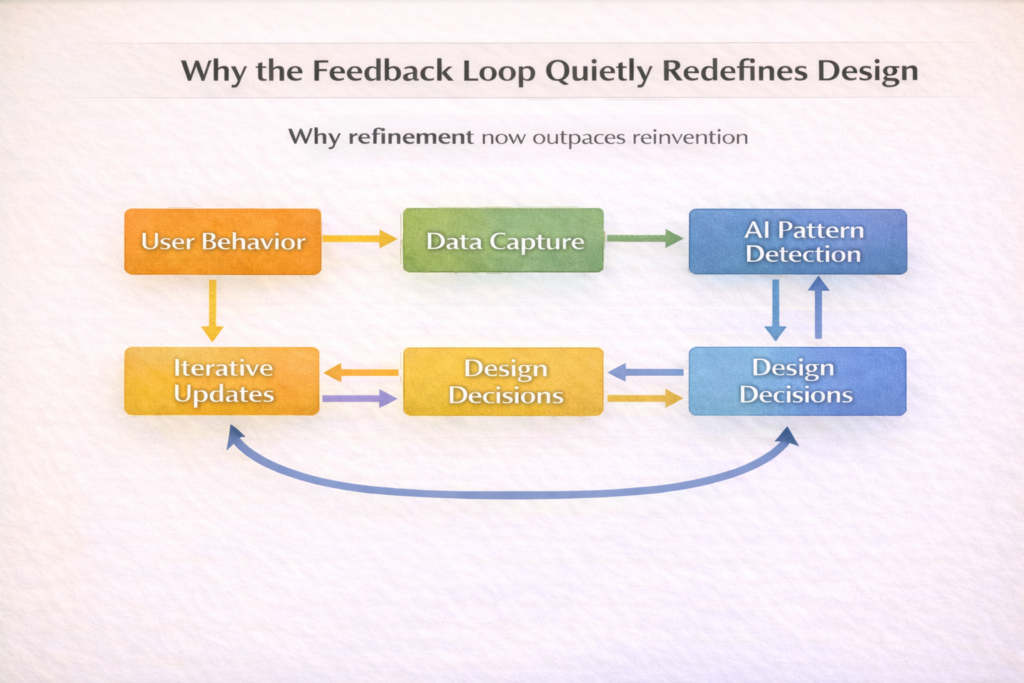
This loop explains why many products feel more “thoughtful” over time without ever being relaunched. The intelligence is not concentrated in one breakthrough—it’s distributed across thousands of adjustments.
One Pattern, Many Industries
Consumer Electronics
AI informs component placement, thermal management, and material tolerance. Users notice fewer quirks, longer lifespan, and consistent performance—not the intelligence behind it.
Automotive
From seat ergonomics to dashboard logic, AI analyzes driving behavior at scale. The result is interiors that feel intuitive without feeling simplified.
Healthcare and Medical Devices
In high-stakes environments, AI helps designers reduce error rates under stress. Design choices are guided by probability, not optimism.
Fashion and Wearables
Here, AI quietly influences sizing accuracy, material durability, and return-rate reduction. The design looks familiar—but performs better over time.
Across sectors, the AI influence on product design favors reliability over spectacle.
Why Designers Trust AI Without Chasing Metrics
Designers don’t always need hard numbers to see value. In many cases, the signal is negative space—the absence of problems. Fewer failures, fewer complaints, fewer revisions after launch.
AI’s role aligns naturally with engineering logic: preventing issues matters as much as enabling features. When something stops going wrong, design has succeeded.
Who Feels the Impact Most
| User Type | What Improves Quietly |
|---|---|
| Everyday users | Easier onboarding, fewer errors |
| Professionals | Tools that adapt to workflows |
| Enthusiasts | Performance under real conditions |
| Long-term owners | Durability and consistency |
This is why the AI influence on product design feels broadly beneficial without feeling revolutionary.
The Limits of Optimization
Optimization has a ceiling. In categories where emotional expression, cultural identity, or artistic distinction matter, AI can unintentionally flatten character. Data favors what works most often, not what resonates most deeply.
AI identifies patterns—but it doesn’t assign meaning. Without strong human direction, products risk becoming efficient yet indistinct.
What Real Users Notice Instead of “AI”
Users rarely credit artificial intelligence directly. Their language reflects outcomes.
| What Users Say | What’s Actually Happening |
|---|---|
| “It just works better” | Edge cases reduced |
| “Feels simpler” | Cognitive load lowered |
| “Updates keep improving it” | Continuous design loop |
| “Nothing changed, but it’s nicer” | Micro-iterations compounding |
| “Hard to explain why I like it” | Data-informed refinement |
This quiet satisfaction is the most honest evidence of the AI influence on product design.
The Long View: Design as Maintenance, Not Monument
The next evolution isn’t AI-designed products—it’s AI-maintained design quality. Products will adapt to aging components, shifting environments, and evolving user behavior. Launch becomes a checkpoint, not a conclusion.
Expect fewer dramatic redesigns and more continuous refinement. Designers move from authorship to stewardship—curating systems that improve quietly over time.
Why You Barely Noticed the Shift
That moment when a product simply feels right—that’s the goal. The most effective AI influence on product design disappears into the experience. It removes friction instead of adding spectacle. It adapts to humans rather than forcing humans to adapt.
Once you recognize this pattern, it becomes impossible to unsee.
Vibetric Ending
AI hasn’t stolen creativity from product design. It has relocated it—away from guesswork and toward intent. The future of design isn’t louder or more complex. It’s calmer, smarter, and increasingly invisible.
What’s Behind the Magic of AI-Driven Design?
- Follow vibetric_official on Instagram to keep up with the latest trends and insights into technology and product innovation.
- Bookmark Vibetric.com we continuously update our analysis as new developments emerge in AI-driven design.
Subscribe for updates and receive ongoing, in-depth breakdowns and expert opinions on how AI is reshaping products across industries.
Questions Designers and Buyers Are Quietly Asking
It means AI informs early constraints, simulations, and iteration cycles. Instead of guessing where problems might appear, teams use data-driven insight to decide what not to design before committing resources.
Bluetooth prioritizes power efficiency and compatibility, not precise timing. That design introduces variability, which is why serious gaming gear relies on proprietary wireless instead.
Because AI optimizes usability, reliability, and longevity—not visual novelty. The goal is fewer problems over time, not immediate visual disruption.
Industries with complexity and scale—consumer electronics, automotive, healthcare devices, and wearables—see the strongest gains due to reduced failure rates and better real-world fit.
Yes, if optimization replaces vision. AI favors statistically successful outcomes, so strong human direction is essential to preserve character and differentiation.
By predicting wear patterns, thermal stress, and long-term usage behavior, AI helps designers address failure points before they emerge in the real world.
Often yes. Fewer physical prototypes, reduced material waste, and lower return rates contribute to more efficient and sustainable design cycles.
Usually without realizing it. Adaptive interfaces, smarter defaults, and context-aware behavior are common touchpoints where AI shapes experience invisibly.
Increasingly so. Cloud-based simulation, analytics, and generative tools have lowered barriers that once limited AI-driven design to large enterprises.
Design stops being a one-time decision. Products become evolving systems that improve through continuous learning rather than periodic reinvention.
What’s your take on this?
At Vibetric, the comments go way beyond quick reactions — they’re where creators, innovators, and curious minds spark conversations that push tech’s future forward.

Powerful Signals AI Scaling Is Redefining Performance in 2026
Powerful Signals AI Scaling Is Redefining Performance in 2026 The hardware race that defined consumer tech for thirty years is decelerating. A
AI Infrastructure in 2026: The Critical Shift Reshaping Modern Technology
AI Infrastructure in 2026: The Critical Shift Reshaping Modern Technology For years, artificial intelligence was presented as decoration. Product launches highlighted AI-enhanced