
Pixel 10 Pro Explained: How Google’s Smarter AI Strategy Is Reshaping Smartphone Design
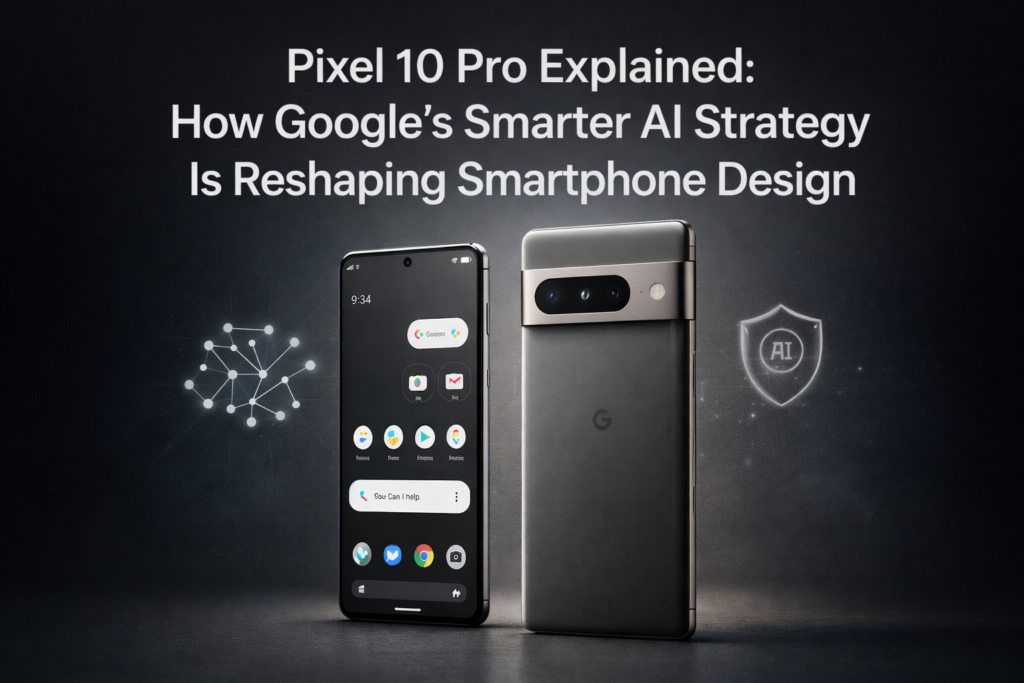
There was a time when smartphones tried to dazzle you every time you picked them up. Animations, features, modes—constant proof that your money bought power. But that logic is eroding. Phones now live in your pocket all day, quietly mediating work, relationships, and attention. The Pixel 10 Pro enters this moment without spectacle. It doesn’t ask to be admired. It asks to be trusted. And that single shift explains almost every design decision Google made.
Why This Phone Feels Less Ambitious—And Why That’s Misleading
The Pixel 10 Pro can seem restrained at first glance. No radical form factor. No benchmark-grabbing bravado. But that surface calm hides a strategic bet: Google believes the next smartphone war will be fought on cognitive load, not specs.
Most competitors still optimize for moments—photos, games, launches. Google optimizes for continuity. The Pixel 10 Pro is designed to think in the background, interpret intent, and quietly reduce friction. That philosophy reshapes priorities long before you reach a feature list.
User Reality Check: What People Actually Notice First
| Early User Reaction | What It Reveals |
|---|---|
| “It feels calmer” | Reduced notification noise |
| “Nothing flashy” | AI impact isn’t visual |
| “Battery feels predictable” | Efficiency over peaks |
| “Camera just works” | Pre-shot intelligence |
| “Not a gamer phone” | Performance is de-prioritized |
| “Gets better with time” | Model-driven evolution |
The Pixel 10 Pro doesn’t win first impressions. It wins second months.
The Hidden Constraint Driving Everything: Always-On Intelligence
AI on smartphones is often misunderstood as a bundle of features. On the Pixel 10 Pro, AI is a constraint. If intelligence is always present—listening, classifying, summarizing—then the device must behave differently under load.
That pressure shapes:
- Thermal envelopes tuned for long sessions, not bursts
- Battery curves optimized for steady draw
- Silicon layouts favoring inference consistency
- OS behavior that avoids surprises
This is why the Pixel 10 Pro avoids aggressive clocks and extreme performance modes. An AI-forward phone must feel reliable more than impressive.
A Subtle Engineering Trade Most Users Never See
High-performance phones chase peaks. AI-first phones chase plateaus. Google’s approach assumes the Pixel 10 Pro will rarely rest. It will continuously parse speech, analyze images, filter calls, and rank relevance.
That changes how success is measured:
- Not “How fast is it once?”
- But “How stable is it all day?”
The Pixel 10 Pro’s internals are designed to stay within comfort zones—thermally, electrically, psychologically.
Where the Camera Strategy Quietly Changed Direction
Pixel cameras were once famous for computational photography after the fact. The Pixel 10 Pro shifts that intelligence before capture.
Instead of reacting, the system predicts:
- What subject matters most
- Which moment you’re trying to preserve
- How you usually frame and edit
The hardware supports this, but doesn’t lead it. On the Pixel 10 Pro, the camera behaves less like a tool and more like a perception layer that never fully turns off.
Quick Snapshot: Two Philosophies, One Form Factor
| Design Question | Traditional Flagship Answer | Pixel 10 Pro Answer |
|---|---|---|
| Where to spend power? | Short bursts | Continuous inference |
| What defines speed? | Benchmarks | Responsiveness |
| Camera priority | Sensors | Context |
| Battery success | Fast charging | Predictability |
| UX goal | Control | Anticipation |
The Psychological Dividend: Fewer Decisions Per Day
The most meaningful change the Pixel 10 Pro delivers isn’t technical—it’s cognitive. The phone intervenes earlier, so you intervene less.
Over time, users report:
- Fewer manual edits
- Less notification triage
- Shorter interaction loops
- Lower background stress
The Pixel 10 Pro reduces “phone fatigue” by design. That’s an outcome no spec sheet can capture.
Industry Reality: Why This Strategy Is Hard to Imitate
An AI-first smartphone isn’t just a hardware problem. It requires:
- Custom silicon tuned for ML workloads
- Deep OS-level integration
- Long-term model deployment discipline
Google controls all three. That vertical alignment allows conservative-looking hardware decisions that age unusually well. The Pixel 10 Pro isn’t built to peak at launch—it’s built to accumulate value as models improve.
A Practical Lens: Who the Pixel 10 Pro Is Really For
Everyday Users
If you want your phone to manage complexity quietly, this is its natural audience.
Creators & Knowledge Workers
Strong for communication, capture, and synthesis—less ideal for heavy rendering or GPU-driven workflows.
Gamers & Performance Chasers
You’ll find the priorities inverted. The Pixel 10 Pro favors stability over spectacle.
Long-Term Buyers
This is where the Pixel 10 Pro excels. Its usefulness compounds over time.
The Counterpoint Google Is Willing to Accept
AI-driven automation isn’t universally welcome. Some users prefer explicit control, visible features, and hardware-forward identity. The Pixel 10 Pro makes assumptions—about relevance, importance, timing. If those assumptions feel intrusive, the experience can feel constrained.
Google accepts this trade-off. The Pixel 10 Pro is opinionated by design.
The Larger Signal: Smartphones as Cognitive Infrastructure
The Pixel 10 Pro hints at a future where phones aren’t interactive objects so much as ambient systems. Devices that:
- Filter information before you see it
- Predict needs without commands
- Learn behavior without training rituals
As more intelligence moves on-device, this design philosophy will spread. The Pixel 10 Pro isn’t radical—it’s directional.
Closing the Loop: Why the Calm Is the Point
When you first use the Pixel 10 Pro, nothing demands your attention. That restraint is intentional. Google’s bet is that the most advanced technology should disappear into routine. If you forget the phone is working, it’s succeeding.
This isn’t a phone that performs for you. It works with you.
Vibetric Ending
True progress in consumer technology doesn’t add noise—it removes friction.
How Will Google’s AI-First Phones Shape the Next Decade?
- Follow vibetric_official on Instagram to keep up with the latest trends and insights into AI-driven smartphone design.
- Bookmark Vibetric.com we continuously update our analysis as Google’s Pixel strategy evolves.
Subscribe for ongoing, in-depth breakdowns and expert perspectives on the future of intelligent devices.
FAQs: Pixel 10 Pro & Google’s AI Strategy
Yes. Its design centers on sustained intelligence rather than peak performance.
Increasingly no—Google prioritizes on-device AI for latency and privacy.
It often feels smoother and more predictable, even if benchmarks don’t spike.
The bigger shift is how intelligence guides capture before you press the shutter.
Users who value reliability, automation, and long-term improvement.
Capable, but not optimized for sustained high-performance gaming.
Yes. Pixel devices typically gain value as models evolve.
When designed well, it improves efficiency by reducing wasted activity.
More than most—its value is tied to Google’s evolving AI stack.
A move from feature-driven smartphones to intent-driven ones.
What’s your take on this?
At Vibetric, the comments go way beyond quick reactions — they’re where creators, innovators, and curious minds spark conversations that push tech’s future forward.

Galaxy S26 Ultra Privacy Display: 5 Brutal Real-World Truths Nobody Tells You
Galaxy S26 Ultra Privacy Display: 5 Brutal Real-World Truths Nobody Tells You There’s a specific anxiety that comes with using a phone