
Laptop Performance Differences Despite Similar Specs: Why Some Feel Better
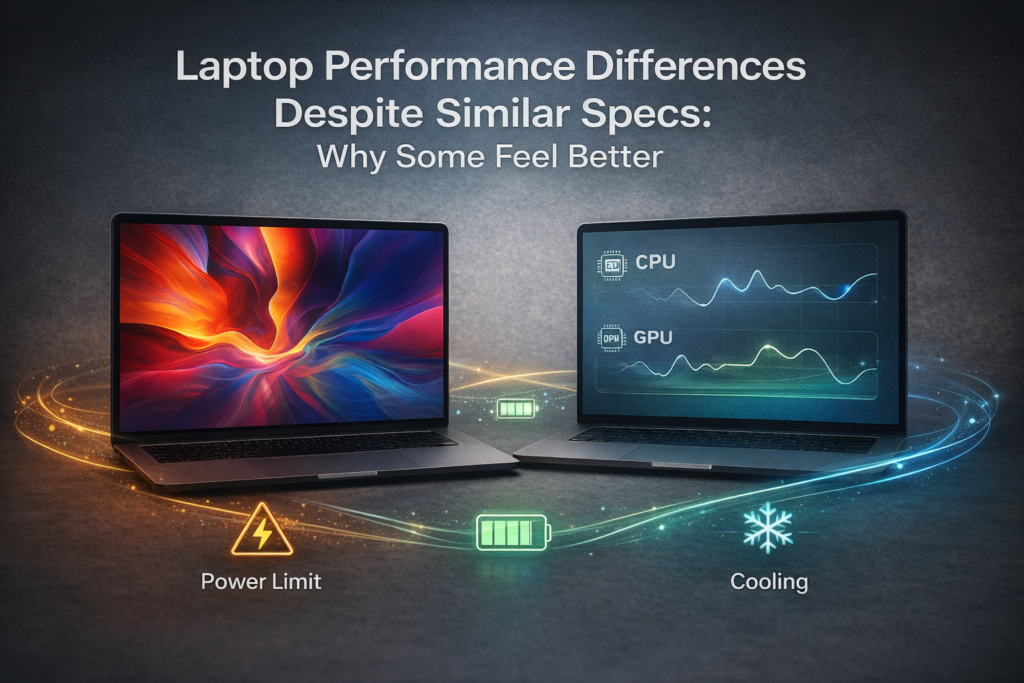
You buy a new laptop with confidence. Same processor class, similar RAM, comparable storage—on paper, it mirrors another machine you’ve used or researched. Yet within days, something feels off. Apps hesitate. Fans spin unexpectedly. Battery drains faster than expected. Nothing is “broken,” but the experience doesn’t match expectations.
That disconnect is where laptop performance differences despite similar specs quietly live. And the reason isn’t marketing deception or placebo—it’s a layered interaction of engineering trade-offs most spec sheets never reveal.
When spec parity masks fundamentally different machines
Two laptops can share the same CPU model, GPU tier, and memory size while behaving like they were built for entirely different users. The real divergence starts long before the device boots up.
Manufacturers don’t design laptops around components; they design them around constraints—thermal envelopes, chassis thickness, battery targets, acoustic limits, and cost ceilings. The components are then tuned to fit those boundaries.
So while consumers see matching specs, engineers see different power budgets, cooling headroom, firmware policies, and sustained performance targets. The specs tell you what’s inside. They don’t tell you how it’s allowed to behave.
Power limits decide more than processor names
Modern CPUs and GPUs are elastic by design. Their performance depends less on their maximum capability and more on how much power they’re permitted to consume—and for how long.
A processor rated for high peak performance may only reach that level for seconds in one laptop and minutes in another. This is governed by firmware-level power limits that are invisible in retail listings.
A quick snapshot of what actually changes
| Hidden Variable | Laptop A | Laptop B |
|---|---|---|
| Sustained power allowance | Higher | Lower |
| Boost duration | Longer | Short bursts |
| Thermal throttling onset | Delayed | Early |
| Fan noise tolerance | Aggressive | Conservative |
| Battery-first tuning | Minimal | Heavy |
These decisions directly create laptop performance differences despite similar specs, especially in sustained workloads like compiling code, exporting video, or multitasking under load.
Cooling systems quietly shape your daily experience
Cooling isn’t just about preventing overheating—it determines whether performance is consistent or erratic.
A thicker laptop with dual fans and larger heat pipes can maintain higher clocks for extended periods. A slimmer machine with similar internals may perform brilliantly for the first minute, then scale back aggressively to protect itself.
What users perceive as “slowness” is often thermal recovery time. The system isn’t weak—it’s waiting.
This explains why some laptops feel fast but unstable, while others feel slower yet dependable. Neither is defective; they’re optimized for different priorities.
Memory and storage: same capacity, different behavior
RAM size and storage type often look identical across competing laptops, but implementation matters more than labels.
- Memory speed and channel configuration affect how efficiently the CPU is fed data.
- Latency tuning influences responsiveness in everyday tasks.
- SSD controllers and thermal management determine whether storage remains fast after sustained use.
Two laptops with “16GB RAM and 1TB SSD” can feel dramatically different under real workloads because their data pathways are not equally optimized.
This is another overlooked contributor to laptop performance differences despite similar specs, especially in creative and productivity workflows.
Software tuning is performance, not an afterthought
Out-of-box software decisions shape performance more than most users realize. Background services, power profiles, thermal policies, and even vendor utilities all influence how aggressively hardware is allowed to perform.
Some laptops prioritize silence and battery longevity. Others default to responsiveness and sustained output. Neither approach is universally better—but they feel very different.
Importantly, these behaviors often persist even after users “debloat” their systems. Core firmware policies remain untouched, silently guiding performance behind the scenes.
Why benchmarks don’t match lived experience
Benchmarks measure potential. Users experience policy.
Synthetic tests usually capture short bursts of peak performance. Real-world usage exposes sustained behavior, thermal cycling, and background contention. That’s why a laptop that scores well in charts may feel inconsistent during daily work.
| Common belief | What actually happens |
|---|---|
| Same CPU = same speed | Power and cooling redefine limits |
| Benchmarks predict experience | They measure controlled bursts |
| Throttling means failure | It’s often intentional design |
| Slimmer is always better | Thinness trades stability for mobility |
Understanding this gap is essential to interpreting laptop performance differences despite similar specs without frustration.
Real-world scenarios where differences surface fast
Consider three common use cases:
The remote professional
Video calls, dozens of browser tabs, background syncing. A laptop tuned for quiet operation may feel sluggish mid-day as thermal limits accumulate.
The creative editor
Rendering and exporting push systems beyond short bursts. Machines with higher sustained power limits finish tasks faster—even with “identical” processors.
The student multitasker
Note-taking, streaming, compiling assignments. Consistency matters more than peaks. A conservative thermal design often feels smoother over long sessions.
In each case, the spec sheet remains constant. The experience does not.
Data without numbers: how engineers think about performance
Engineers don’t ask, “How fast is this chip?”
They ask, “How fast can this chip remain within safe limits?”
Performance is treated as a curve, not a point. Peak capability is just one moment on that curve. Sustained behavior is what defines usability.
This philosophy explains why laptop performance differences despite similar specs are not anomalies—they’re outcomes of deliberate design choices.
The human cost of invisible trade-offs
Performance inconsistency creates cognitive friction. Users blame themselves, software updates, or aging hardware when the root cause is simply mismatched expectations.
This leads to:
- Over-upgrading sooner than necessary
- Distrust in reviews that focus only on specs
- Frustration during tasks that “should be easy”
Understanding these dynamics restores agency. You stop chasing numbers and start evaluating behavior.
Choosing smarter based on how you actually work
Instead of asking “Which laptop has the best specs?” consider these profiles:
Everyday users
Look for balanced thermal designs and conservative tuning. Consistency beats peak speed.
Creators and professionals
Prioritize sustained power delivery, robust cooling, and performance modes that don’t clamp down after minutes.
Gamers and enthusiasts
Thermal headroom and power limits matter more than CPU naming tiers.
Future-proof buyers
Choose platforms with flexible firmware profiles and cooling systems that won’t age prematurely.
| Priority | Optimized designs | Trade-offs |
|---|---|---|
| Thin & light | Portability | Short-lived peaks |
| Performance-first | Sustained output | Weight, noise |
| Battery-focused | Longevity | Reduced headroom |
When spec-based advice still works
There are cases where specs do tell most of the story—entry-level systems, clearly tiered performance classes, or tightly controlled ecosystems.
If your workload is light and bursty, differences may never surface. In those scenarios, chasing deeper details adds unnecessary complexity.
But for anyone pushing their system daily, spec parity is only the starting line.
What real users notice first
Across forums and long-term reviews, patterns repeat—not about raw speed, but how laptops feel over time.
| User observation | Underlying cause |
|---|---|
| “Fast at first, then slow” | Thermal saturation |
| “Quiet but laggy” | Conservative power tuning |
| “Warm but responsive” | Higher sustained limits |
| “Great plugged in, weak on battery” | Aggressive power scaling |
| “Inconsistent performance” | Firmware policy shifts |
These anecdotes align closely with engineering realities, reinforcing why laptop performance differences despite similar specs persist across brands and models.
Where laptop performance is heading next
Future laptops will likely lean further into adaptive behavior—AI-managed power allocation, workload-aware tuning, and user-adjustable performance envelopes.
Specs may matter even less as systems dynamically reshape themselves around usage patterns. Transparency, not raw capability, will become the differentiator.
The challenge for buyers will be understanding intent, not just ingredients.
Returning to the moment of doubt
That uneasy feeling when a “powerful” laptop hesitates isn’t your imagination. It’s the result of dozens of invisible decisions made long before you opened the box.
Once you understand why laptop performance differences despite similar specs exist, the frustration fades. You stop asking why your laptop feels wrong—and start choosing ones that feel right for you.
Vibetric Ending
Performance is not a number.
It’s a contract between hardware, software, and design philosophy.
And contracts are always negotiated behind the scenes.
Wondering What Really Determines Laptop Performance Beyond Specs?
- Follow vibetric_official on Instagram to keep up with the latest trends and insights into laptop technology and performance design.
- Bookmark Vibetric.com we continuously update our analysis as new laptop architectures and tuning strategies emerge.
Subscribe for ongoing, in-depth breakdowns and expert perspectives on how modern laptops actually behave.
FAQ: iPhone 17 Pro Max vs Galaxy S25 Ultra
It depends. iPhone excels in video and consistency; Galaxy excels in zoom and manual control.
It can be, especially if you don’t plan to use its advanced features.
Historically, iPhones maintain software cohesion longer; Galaxy phones evolve faster but change direction more often.
Only in extreme workloads. Everyday tasks feel identical.
Galaxy S25 Ultra offers more tools; iPhone offers more predictability.
Yes. It often matters more than hardware.
Only if your current phone feels limiting—not just old.
Galaxy for multitasking and stylus work; iPhone for focused, distraction-free use.
For some users, yes. For others, it’s essential.
Philosophy: control versus calm.
What’s your take on this?
At Vibetric, the comments go way beyond quick reactions — they’re where creators, innovators, and curious minds spark conversations that push tech’s future forward.
Performance Per Watt in 2026: The Critical Benchmark Redefining Computing
Performance Per Watt in 2026: The Critical Benchmark Redefining Computing For years, performance was measured in absolutes. Faster processors won. Higher benchmark
MacBook Pro M4 (2026): The Smart Efficiency Breakthrough in Modern Laptops
MacBook Pro M4 (2026): The Smart Efficiency Breakthrough in Modern Laptops There’s a moment every serious laptop user recognizes. The export bar